


Asian Allies Less Confident of American Help If China Attacks
By LUKE FUNK
|Kipling’s poem contrasts the Gods of the Market-Place with the Gods of the Copybook Headings — the soft self-congratulatory ideas of the age with the hard enduring truths.
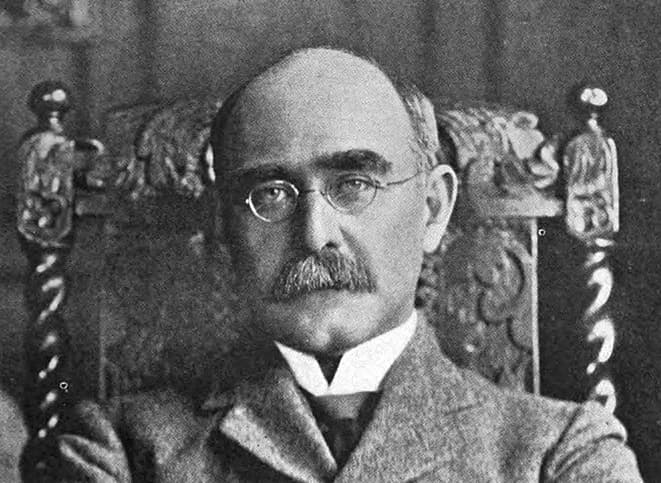
Rudyard Kipling (1865–1936) remains despised by his detractors, dismissed as an irredeemable racist promoter of colonialism. Meanwhile, that dismissal prompts some of his admirers to praise his works for extra-literary reasons, which is just as bad. Almost no one gets Kipling right, so this major and wide-ranging literary talent — the author of memorable poetry, superior fiction, and enduring children’s books — is a blank stone in the garden of English literature.
The Sun has featured three Kipling poems as Poems of the Day: “The Way through the Woods,” “When Earth’s Last Picture Is Painted,” and “Tommy.” For a fourth it’s worth thinking about “The Gods of the Copybook Headings,” a poem that Kipling’s detractors and admirers alike reference more often than they quote. Written in quatrains of rhymed couplets, with six-foot alexandrine lines (mostly, in Kipling’s poem, two three-foot phrases strung together with a strong caesura between), the poem contrasts the Gods of the Market-Place with the Gods of the Copybook Headings — the soft self-congratulatory ideas of the age with the hard enduring truths. The first name he filches from Francis Bacon’s 1620 account of the “Idols of the Market Place,” and the second from the often banal truisms that schoolboys were suppose to inscribe in their copybooks.
The made-up names of geological epochs — Cambrian, Feminian, Carboniferous — are references to movements in Kipling’s time: the Cambridge advocates of universal peace, the women suffragettes, the coal-worker Labor activists. But the claim of the poem is as universal as a parallel passage in Horace: People may convince themselves of claims that have sufficient “Uplift, Vision and Breadth of Mind” to soothe a wishful heart, but the logics of social behavior and physical reality will always return to exact their due.
By LUKE FUNK
|
By MATTHEW RICE
|
By MATTHEW RICE
|
By ALEX ZDAN
|
By MATTHEW RICE
|
By GEORGE WILLIS
|
By DANIEL McCARTHY
|
By A.R. HOFFMAN
|Rudyard Kipling (1865–1936) remains despised by his detractors, dismissed as an irredeemable racist promoter of colonialism. Meanwhile, that dismissal prompts some of his admirers to praise his works for extra-literary reasons, which is just as bad. Almost no one gets Kipling right, so this major and wide-ranging literary talent — the author of memorable poetry, superior fiction, and enduring children’s books — is a blank stone in the garden of English literature.
The Sun has featured three Kipling poems as Poems of the Day: “The Way through the Woods,” “When Earth’s Last Picture Is Painted,” and “Tommy.” For a fourth it’s worth thinking about “The Gods of the Copybook Headings,” a poem that Kipling’s detractors and admirers alike reference more often than they quote. Written in quatrains of rhymed couplets, with six-foot alexandrine lines (mostly, in Kipling’s poem, two three-foot phrases strung together with a strong caesura between), the poem contrasts the Gods of the Market-Place with the Gods of the Copybook Headings — the soft self-congratulatory ideas of the age with the hard enduring truths. The first name he filches from Francis Bacon’s 1620 account of the “Idols of the Market Place,” and the second from the often banal truisms that schoolboys were suppose to inscribe in their copybooks.
The made-up names of geological epochs — Cambrian, Feminian, Carboniferous — are references to movements in Kipling’s time: the Cambridge advocates of universal peace, the women suffragettes, the coal-worker Labor activists. But the claim of the poem is as universal as a parallel passage in Horace: People may convince themselves of claims that have sufficient “Uplift, Vision and Breadth of Mind” to soothe a wishful heart, but the logics of social behavior and physical reality will always return to exact their due.
Cancel anytime
By continuing you agree to our Privacy Policy and Terms of Service.