Pressure by Transgender Activists Forces Washington State University To Suspend Courses Critical of Medical Gender Treatments for Minors
WSU’s med school accredits physician-education courses from a nonprofit that’s skeptical of this field but comes under scrutiny from transgender activist-journalists and a national accreditation body.
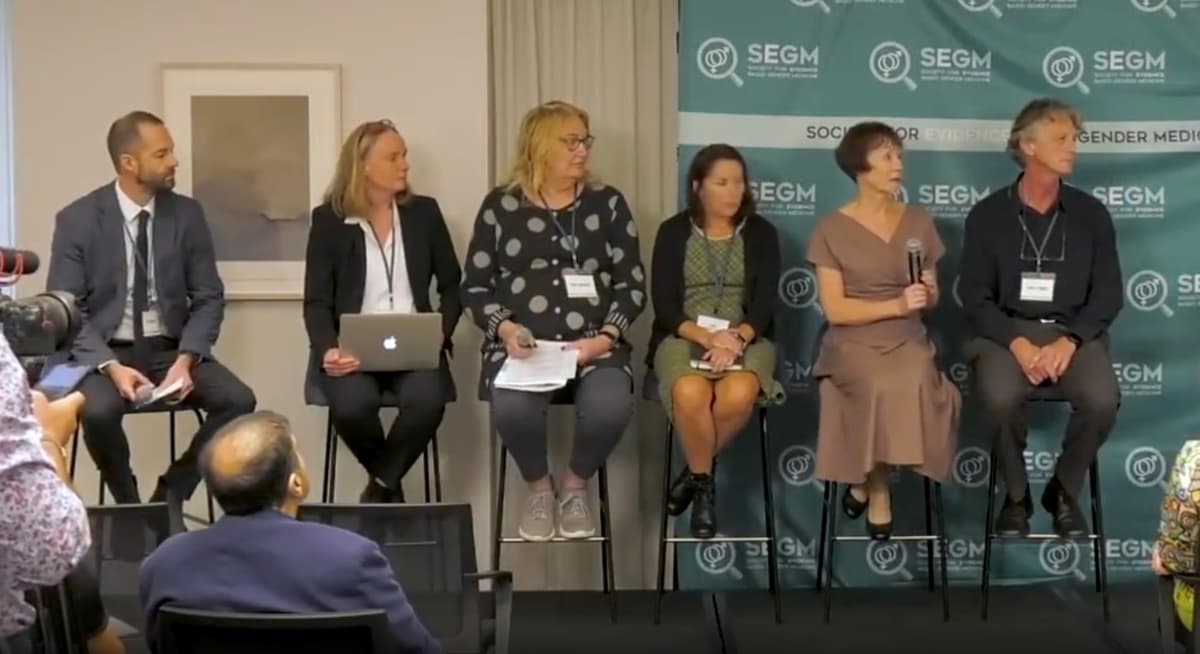

The transgender-activist war against a nonprofit that promotes scientific skepticism of the controversial field of pediatric gender medicine has scored a new, at least temporary win.
Washington State University’s medical school last week was forced to suspend access to a series of accredited continuing medical education courses, or CMEs, that were critical of this field and had been developed by the Society for Evidence Based Gender Medicine, or SEGM.
WSU had come under fire from a pair of activist transgender journalists for lending credibility to SEGM. Trans activists typically regard the nonprofit with hostility, considering it a threat to minors’ access to medical treatments that can alter the young patients’ sex characteristics. Efforts to discredit and professionally isolate SEGM have been aided in particular by its recent branding as a hate group by the increasingly controversial left-wing advocacy nonprofit the Southern Poverty Law Center.
The trouble started for WSU after inquiries by the trans journalists apparently drew the attention of the national body that oversees accreditation for continuing medical education courses – the Accreditation Council for Continuing Medical Education – whose seal of approval is required for the courses to count towards a health care provider maintaining their licensure. The ACCME, last week launched an investigation of WSU’s vetting of the courses in question and, in an extraordinary move, ordered the university to suspend the full SEGM suite of courses even before the investigation’s conclusion.

WSU spokesperson Pam Scott confirmed in a statement that SEGM’s “course materials are suspended” during the investigation. “We are working with the ACCME to confirm that all accredited materials comply with ACCME standards,” Scott said. “We remain committed to providing high-quality, evidence-based continuing medical education courses.”
This development in the international imbroglio over how best to care for the burgeoning population of youth who experience gender-related distress (defined as youth reporting severe conflict between their sex and gender identity) comes as U.S. higher education stands at a turning point in its reconciliation of academic freedom with what’s known as institutional neutrality – in which universities avoid taking positions on controversial issues.
American universities are grappling, in part, with the contentious fallout from having taken stands on the massacres on October 7 and the war in Gaza, as well as on the murder of George Floyd and federal immigration policies. Many of these institutions are now facing broadsides from the Trump administration, most centrally for, in White House’s view, allowing antisemitism to fester and, more broadly, remaining inhospitable to conservative views. On the matter of gender identity, the Trump Administration has wielded the threat of pulling federal funding to force some elite schools to bar transgender women from women’s sports and forbid cross-sex entry into locker rooms and bathrooms.
WSU, known locally as “Wazzu,” is a public land-grant university based in eastern Washington, an area that leans conservative. The university adopted its own institutional neutrality policy in September 2024.
The policy states WSU is “committed to fostering an environment where diverse ideas and perspectives can flourish.”

WSU’s recent capitulation over the medical-education courses, while apparently involuntary and potentially temporary, directly follows the acquiescence to trans-activist pressure by a star academic at McMaster University in Hamilton, Ontario. SEGM had commissioned the lab of McMaster professor Dr. Gordon Guyatt, considered one of the “godfathers” of evidence-based medicine, to conduct a series of systematic reviews of the evidence behind pediatric gender medicine.
Following the publication of three of the five SEGM-commissioned reviews earlier this year, Guyatt’s team was subjected to a mounting activist campaign to disavow SEGM. He and several of his colleagues ultimately complied in a public statement in August. Dr. Guyatt has since characterized SEGM as anti-transgender and devoted to promoting bans of gender-transition treatment for minors.
SEGM’s leadership has denied these claims and defended its reputation as a scientific collective devoted to free academic inquiry.
The nonprofit’s cofounder, health researcher Zhenya Abbruzzese, told the Sun that Guyatt recently told her that he disapproved of the SPLC designation, saying, “I agree that the hate group reference was unfortunate.” The Sun was able to confirm this.

Guyatt did not respond to a request for comment.
Dr. Julia Mason, an Oregon pediatrician and founding SEGM board member, said in a statement to the Sun that the organization is “dedicated to advancing the quality of research and clinical understanding in gender medicine, focusing on youth. SEGM is not a political or ideological organization; its mission is to strengthen the scientific foundations of clinical care.”
Accusations of ‘Pseudoscience’ and ‘Medical Lysenkoism’
Founded in 2019, the U.S.-based SEGM has a small staff and is otherwise a loose collective of physicians and researchers who share concerns about the relative weakness of the evidence base supporting treating gender-related distress among youths with puberty blockers, cross-sex hormones and gender-transition surgeries. Those in SEGM’s orbit tend to believe that current evidence fails to persuasively argue that the reported positive mental health outcomes associated with these interventions outweigh the potential risks for minors. These potential harms include the loss of fertility and sexual function and permanent physical changes, such as, among biological females, a deepened voice or the inability to breastfeed among those who undergo mastectomies.
SEGM has become increasingly influential in stirring up skepticism about pediatric gender medicine among figures across Western nations in medicine, academia and the media. Consequently, the organization has been subjected to a campaign from trans activists and the left more broadly to discredit the nonprofit and render it too toxic for other professionals to associate with.
This campaign has been aided, in particular, by the addition by the Southern Poverty Law Center of SEGM to its roster of hate groups.
The Alabama-based SPLC made its name in the 1970s suing the Ku Klux Klan, neo-Nazis and other avowed, racist hate groups. But over the past decade, the group has come under increasing fire from conservatives as it has infused its advocacy with left-wing politics and put multiple conservative groups – including the late Charlie Kirk’s Turning Point USA – on its famous “hate map.”

The SPLC hate group designation of SEGM, made in 2024, was based on a sprawling SPLC-commissioned report that claimed SEGM was “the hub” of a shadowy network of anti-trans organizations promoting “pseudoscience” and opposing gender-transition treatment for youths. (SEGM has strongly refuted these assertions.) This included SEGM’s intellectual support for the theoretical and highly contested phenomenon of “rapid-onset gender dysphoria” among minors and the organization’s prioritization of psychotherapy as a treatment of gender-related distress among youths – rather than potentially irreversible medical treatments – which many in the trans movement believe is tantamount to a support of harmful so-called conversion therapy.
The SPLC report zeroed in on the fact that SEGM and various conservative anti-LGBTQ organizations all received funding through certain so-called donor advised funds. And yet SPLC also receives funding—millions of dollars annually—through those very funds.
Jesse Singal, the most prominent journalist producing critical coverage of pediatric gender medicine, in August wrote on his Substack, “The idea that SEGM is a hate group does not track with anything I have seen.”
“SPLC itself is an activist organization and their legitimacy as fair arbitrator of what a hate group is has significantly eroded in the recent decade,” said Dr. Erica Li, an assistant professor of pediatrics at WSU who served as SEGM’s liaison to the CME accreditation team at the university.
The SPLC and the authors of its report on SEGM did not return a request for comment.
Dr. Li said that her own skepticism of pediatric gender medicine has been influenced in part by her family’s painful history in Maoist China. Her grandfather was a Christian martyr who was imprisoned for his faith and died while incarcerated. Dr. Li said she saw parallels between the Communist suppression of free speech during that era and the shunning to which skeptics of pediatric gender medicine are routinely subjected in present-day America. She characterized this field as guided by “medical Lysenkoism”—a reference to agricultural practices that, while demonstrably based on shoddy science, Communist powers persistently imposed on Chinese farmers even as the methods failed and contributed to catastrophic famine under Chairman Mao.
Following SEGM’s inaugural conference in New York in Oct. 2023, which Mr. Singal and this reporter each attended, the organization sought to obtain CME accreditation for a series of videos that featured presentations and panel discussions from that event by various medical, scientific and mental health experts.

In the transcript of an interview Mr. Singal recently conducted with Gordon Guyatt regarding the academic’s break from SEGM, Singal referenced the organization’s conference, where Dr. Guyatt had presented about evidence-based medicine. Mr. Singal argued that “it was a science conference like any other.”
SEGM’s CME videos from that conference cover an array of topics, observing a critical approach to pediatric gender medicine. The videos, which focus on international perspectives, include technical discussions of evidence-based medicine principles and medical guideline development; the scientific foundations of gender-transition treatment for minors; findings about such treatment in Nordic countries; questions about whether such treatment actually reduces suicidality and suicide death in youth as supporters claim; and what is known—and what remains a matter of concern—about puberty blockers’ impacts on the brain.
Central to the videos’ discourse is the fact that a slew of systematic reviews by international researchers have in recent years found that the evidence backing gender-transition treatments for minors is weak and uncertain. Since the conference, Guyatt’s reviews reached the same conclusion.
Officials at WSU’s Elson S. Floyd College of Medicine, which is headquartered in Spokane and was founded only a decade ago, vetted SEGM’s course materials during a nine-month process that Dr. Li characterized as extraordinarily thorough. Four of the courses went online on the WSU web site in January, followed by three more in June.
For the first few months, the videos drew little attention.
Then, on Oct. 22, SEGM posted about them on X.
‘I’ve Never Seen Anything Like This’
On Wednesday evening, the reporter and trans activist Erin Reed, who has a long history of disparaging SEGM, published a scathing article on her popular and influential Substack lambasting the university for lending credibility to a nonprofit that the SPLC has deemed a hate group. The article was written by Reed’s staff reporter, a fellow trans activist.
Within an hour of the article’s publication WSU suspended SEGM’s CME videos, according to emails from a member of the university’s accreditation team, Andrea Keesey, that were obtained by the Sun. These emails indicated that the ACCME had that evening alerted WSU that it was under investigation due to a complaint about the validity of their content under the ACCME’s standards. Extraordinarily, the governing body compelled WSU to remove the videos in question immediately, pending the investigation’s outcome.

Ms. Keesey, who is the associate director of continuing education at WSU’s medical school, said in the email of ACCME’s demands: “We need to provide a written response by Nov 16 detailing our process for accrediting the 7 modules, how we ensured the evidence is fair and balanced etc.” She expressed concern that if an investigation came down against the medical school, WSU could be put on probation by the ACCME or even lose its authority to accredit CMEs outright.
“I am very sorry about this situation—I’ve never seen anything like this from a national accrediting body,” Ms. Keesey wrote.
Dr. William Malone, an Idaho endocrinologist and SEGM’s cofounder, said in an email to the Sun regarding the ACCME’s recent demands: “We cannot find anything that indicates that the agency can demand that the provider suspend a course before the investigation has taken place.”
The ACCME did not respond to the Sun’s questions about whether such a specific official policy exists. The organization does have a policy allowing it to “immediately suspend such Provider’s accreditation status” in the event of a “credible allegation” of a factor that “poses an immediate danger to patients or earners.” But the ACCME has not apparently suspended WSU’s entire accrediting capacity, given that other CME courses remain live on its web site.
Dr. Graham McMahon, president and CEO of the ACCME, told the Sun in an email that the organization “does not comment publicly on specific providers or activities that may be under review.” He added: “As a general matter, all accredited continuing education must comply with ACCME Standard 1, which requires that content be accurate, evidence-based, and based on current science and best available evidence.”
Jessie Appleby, an attorney with the Foundation for Individual Rights and Expression, a nonprofit that advocates for academic freedom, said in reference to Ms. Reed’s publication, “It seems odd that the accrediting body would require the videos to be pulled down based on this Substack article that has nothing in it that I can see that would make you think that the videos necessarily did violate” the criteria to which McMahon referred.
In an emailed statement, a representative for Ms. Reed noted that the article links to the SPLC report, “which documents SEGM’s pseudoscientific positions in detail” and which “appear throughout the CME videos in question.” Asked for specifics about this alleged pseudoscience, Ms. Reed’s team did not reply.
While the WSU spokesperson Pam Scott would not confirm whether she was specifically distinguishing the university’s vetting from the SPLC’s designation of SEGM as a hate group, she said that the medical school “cannot choose, when acting in its accreditation capacity, to use other standards to accredit or not accredit.”
Scott added: “Accreditation indicates that the courses met ACCME’s requirements for scientific balance and educational integrity. This designation does not represent the university’s endorsement or co-sponsorship of the group providing the course.”

In SEGM’s written application for the CME accreditation, which the Sun obtained, the organization informed WSU about the considerable politicization of pediatric gender medicine and about the fact that many clinicians who harbor concerns about the field “feel they cannot speak out” for fear those concerns will be “misunderstood as animus toward transgender people.” The application argued that the course might actually help clinicians overcome such barriers.
SEGM’s Julia Mason said in her statement to the Sun that the courses “underwent multiple independent reviews through Washington State University’s CME office,” which were “approved at every stage for both scientific accuracy and balance.” She added: “If this level of rigor were now to be deemed unacceptable, it would raise serious concerns about the validity of numerous other CME programs addressing complex or evolving areas of medicine—underscoring that SEGM’s CME course is being scrutinized not for its quality, but for the questions it seeks to explore.”
In an emailed statement, Dr. Alison Clayton, an Australian psychiatrist who is featured in SEGM’s CME videos and has published skeptical scholarship about pediatric gender medicine, pointed to several other CMEs produced by LGBTQ organizations about gender-transition treatment that she said contained notable errors or concerning framing.
“This includes,” Clayton wrote, “misleadingly suggesting that the research demonstrates that youth gender-transition treatment substantially improves mental health outcomes (not according to recent high-quality systematic reviews); positioning the child as the prime decision maker without addressing the youth’s potential lack of competency; and recommending hormonal treatments that even the World Professional Association for Transgender Heath’s (WPATH) guidelines caution against because of the lack of evidence and an unfavorable risk-benefit profile.”
Prior to the publication of Ms. Reed’s article, the head of WSU’s CME accreditation office, Dr. Radha Nandagopal, stood firm in the face of pushback from at least one person who expressed concern about the university having vetted courses for SEGM. According to emails obtained by the Sun, an eastern Washington psychologist emailed the university in March, asserting there was “inaccurate information portrayed and statements and recommendations that are not in alignment with” the American Academy of Pediatrics’ policy statement on the gender-affirming care method and the WPATH treatment guidelines. (The psychologist did not reply to a request for comment.)

In reply, Dr. Nandagopal acknowledged that SEGM’s courses “may challenge aspects” of major U.S. medical societies’ guidance on these medical practices. But, she said, “WPATH is aligned in its acknowledgment of the need for evidence-based healthcare for transgender children and adults.”
Citing her own experience as a pediatric endocrinologist, Dr. Nandagopal continued: “I can say that there is a growing voice for the concern of patients, psychiatrists, endocrinologists, and pediatricians about a tendency broadly to conflate immediate pubertal suppression with what is considered appropriate gender-affirming care; i.e. we can care for and hold high ethical standards for the treatment of children with gender dysphoria and simultaneously question whether immediate pubertal suppression is appropriate.”
Dr. Nandagopal added that “this was something I processed more deeply myself as I went through this and other continuing education for my own learning.”
Activist Blowback
Ms. Reed’s Substack publication prompted many people to express outrage about WSU’s accreditation of SEGM’s courses in the article’s comment section and in response to Ms. Reed’s post about the article on the left-wing social-media platform Bluesky. Among these responses, there were numerous calls, including from people who reported being WSU alumni, for collective action against the university. Many noted that Ms. Reed’s article included a link for filing complaints with the ACCME, which she also shared on Bluesky with an invitation to her 261,700 followers to pursue.
Subsequently, the Spectrum Center, a Spokane-based LGBTQ advocacy group, launched a sign-on letter that referenced Ms. Reed’s article in which it said the university’s validation of the SEGM course “violates WSU’s own non-discrimination policies” and demanded the school revoke the accreditation.

On Friday, Ms. Reed posted on social media that she was “pleased to announce that following our reporting,” the ACCME had launched its investigation and the SEGM courses “are at least temporarily pulled down.”
WSU recently altered its main web page for CMEs, removing the names, photos, emails and phone numbers for the officers overseeing accreditation, according to an archive of the page. In their place is now a generic email address for the CME team. The site also newly stated that applicants must first be interviewed before applying for accreditation.
Kassandra Forsman, 48, a Spokane resident and retired marine told the Sun she was “pretty upset” when she learned from Reed’s article about WSU’s accreditation of SEGM’s courses. While she said she had not seen the videos, she was debriefed on their contents by a local doctor with expertise in this subject. Accordingly, Forsman said she was preparing to file complaints with the university and the ACCME.
Born a boy, Forsman said she had known she was transgender when she was four years old, but that anti-trans stigma, “spread by people with the same ideology and beliefs as SEGM,” prevented her from coming out as a woman until she was 44.
“WSU approving SEGM perpetuates harm by promoting unsafe or unproven treatment modalities that are proven to dramatically increase the risk of harm and suicide by transgender people, especially trans youth,” she said.
The only study to directly assess whether cross-sex hormone treatment among youths attending gender clinics was associated with a difference in the suicide death rate, conducted in Finland and previewed at the 2023 SEGM conference, found no such association.
Some research has found that providing such treatment is associated with reduced depression, anxiety and suicidality among youths. But the systematic reviews that SEGM holds up as the best available scientific authority on this field, including those by Gordon Guyatt’s team, have found that such studies are unreliable.
Dr. Kristopher Kaliebe, a psychiatry professor at the University of South Florida who is featured in the SEGM videos, criticized Reed’s article for relying on “inflammatory language and hostile rhetoric” that he said “is without substance.” The article “provides no specifics regarding the CMEs,” he said.
“Capitulation to activist pressure is part of why there is a broken chain of trust,” Dr. Kaliebe said of the ACCME forcing the pre-emptive suspension of SEGM’s course series. “There is only one way to restore trust: through rigorous standards of open expression and constructive disagreement on these important topics. I see SEGM upholding these standards, but I am not seeing this from SEGM’s critics.”