Will the Supreme Court End the Tumult Over Confirming Federal Prosecutors?

A unanimous bipartisan panel of the Third Circuit concludes that Alina Habba is not lawfully in office.
Andrew Harnik/Getty Images
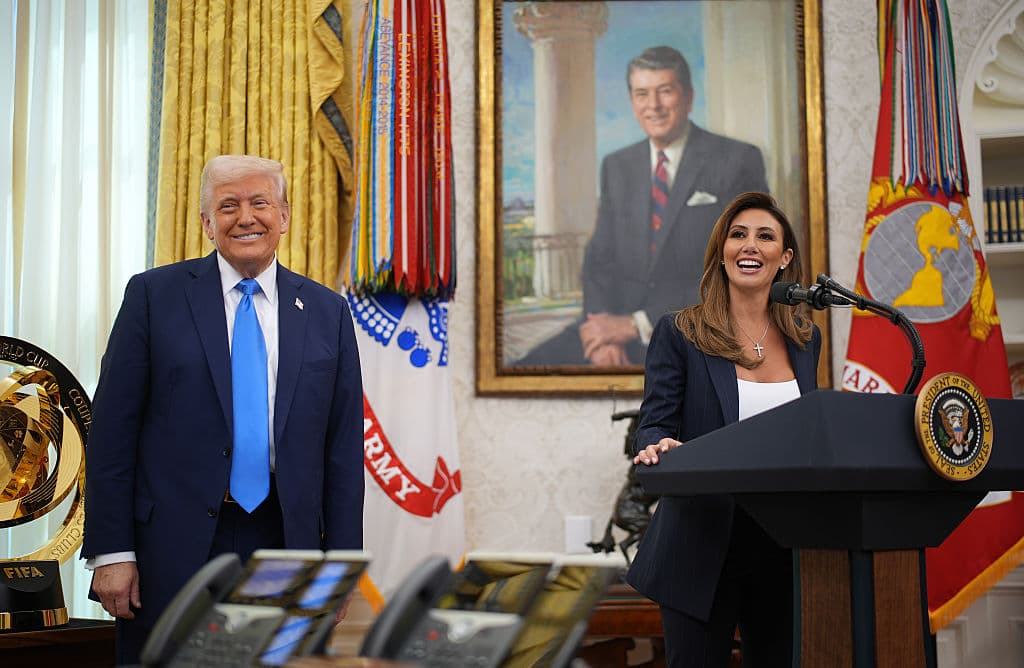
President Trump and Alina Habba before she was sworn in as the interim United States Attorney for New Jersey, March 28, 2025. Andrew Harnik/Getty Images

Monday’s ruling by the riders of the Third Circuit against President Trump’s choice for federal prosecutor in the Garden State suggests, at least to us, that the Supreme Court will need to weigh in on an escalating appointments crisis. A panel of three judges on the appeals court — two nominated to the bench by a Republican, and one by a Democrat — holds unanimously that Alina Habba, the United States Attorney at Newark, does not lawfully hold the post.

This issue first emerged in lights in the case that Special Counsel Jack Smith launched against President Trump for keeping documents at Mar-a-Lago. Mr. Trump’s legal team challenged the qualifications of Mr. Smith himself, who had — and has — not been confirmed by the Senate. The argument was ridiculed by Attorney General Merrick Garland, who asked “Do I look like somebody who would make that basic mistake about the law?”

Hmmmm. Mr. Garland said that “until now, every single court, including the Supreme Court, that has considered the legality of a special counsel appointment, has upheld it.” Yet Judge Aileen Cannon was skeptical. “The Appointments Clause,” she caviled, “is a critical constitutional restriction stemming from the separation of powers,” giving Congress “a considered role” in weighing “the propriety of vesting appointment power for inferior officers.” 

Judge Cannon’s finding was never weighed in higher courts because the Mar-a-Lago case against Mr. Trump was dropped — by the Biden administration. Yet the Appointments Clause is back in the spotlight in Mr. Trump’s second term. This time President Trump is at the other end of the telescope. Now the legal scrutiny is arising over Mr. Trump’s appointments, particularly the United States Attorneys in New Jersey, Virginia, and other jurisdictions. 

These prosecutors are serving in an interim or “acting” capacity due to Senate delays in confirming nominees. The legal doubts over Ms. Habba’s appointment were echoed by a federal district judge in Virginia, Cameron Currie, who found that Mr. Trump’s choice of Lindsey Halligan as U.S. Attorney for the Commonwealth’s Eastern District lacked for legality, too. That has upended Mr. Trump’s effort to prosecute James Comey and Letitia James.

The president’s prosecutorial picks at Albany, John Sarcone, as well as at Las Vegas and in California’s Central District are being challenged in the courts, too. Monday’s decision by the riders at Philadelphia marks the first time this issue has reached the appellate bench. This could prove to be a way station en route to Supreme Court consideration of Mr. Trump’s ability to make interim appointments absent Senate confirmation. The sooner the better. 

The unanimity of the ruling by the Third Circuit panel, though, could well give Mr. Trump pause. The riders stress that United States Attorneys, who lead “some of the most critical agencies in the Federal Government,” are, by statute, subject to the “presidential appointment and Senate confirmation process” ordained in the Constitution. The riders contend that interim appointments are for a “limited time, and under special and temporary conditions.” 

These columns have lamented how Senate traditions like the blue slip, as well as limits on recess appointments, crimp the president’s prerogatives. This is not to overlook the constitutional importance, well marked by The Great Scalia* in NLRB v. Canning, of the Senate’s role in confirmation. All the more reason for the Supreme Court to promptly take up the question of whether Mr. Trump’s choices for key prosecutorial roles hold their posts legally. 

___________

* The “founding generation regarded” Senate approval of presidential nominees, Justice Antonin Scalia argued in that case, “as a critical protection against” what historian Gordon Wood called “despotism.”


The New York Sun

© 2025 The New York Sun Company, LLC. All rights reserved.

Use of this site constitutes acceptance of our Terms of Use and Privacy Policy. The material on this site is protected by copyright law and may not be reproduced, distributed, transmitted, cached or otherwise used.

The New York Sun

Sign in or  create a free account

or
By continuing you agree to our Privacy Policy and Terms of Use