
‘Endgame’ at the Irish Arts Center Cements Samuel Beckett as the Playwright of the Hour

The otherworldly and indelible play the Nobel-winner considered his best premieres at Hell’s Kitchen, courtesy of a Galway troupe.

HanJie Chow via Irish Arts Center
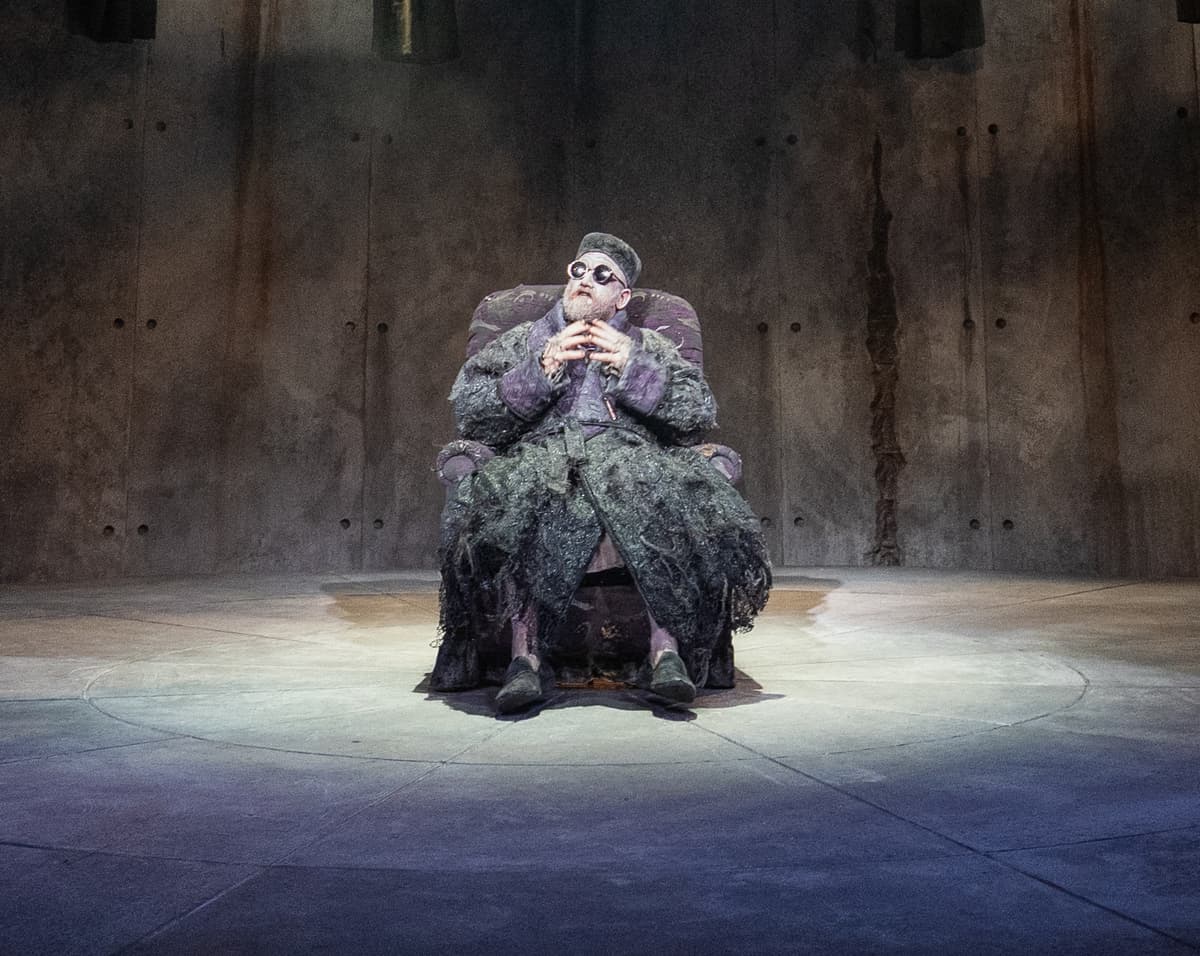
Rory Nolan as Hamm in 'Endgame,' by Samuel Beckett. October 2025. HanJie Chow via Irish Arts Center

The Nobel Laureate and Irish playwright Samuel Beckett reckoned that “Endgame” was his masterpiece, and a new staging at the Irish Arts Center confirms the play’s eminence as a landmark of 20th century absurdity in its bleakest edition. The literary sage Harold Bloom reckoned that “to find a drama of its reverberatory power, you have to return to Ibsen” — another practitioner of drama unafraid of the dark.

This has been an autumn of Beckett at New York City. Broadway has seen a staging of “Waiting for Godot” with Keanu Reeves and Alex Winter. NYU put on “Krapp’s Last Tape” with the noted Irish actor Stephen Rea. Now comes “Endgame,” originally written in French — “Fin de partie — and translated into English by Beckett himself. It was first performed in 1957, in French, at the Royal Court Theater at London.

“Endgame” runs a bracing hour and a half with no intermission. The central character is an aged blind man, Hamm, who sits in his chair and issues commands to a servant, Clov. They are both damaged — Hamm cannot stand and Clov cannot sit. Hamm’s parents, Nagg and Nell, live in dustbins. Nell dies during the course of the play after recalling an afternoon on Lake Como. That wisp of a memory is the only lovely thing Beckett deigns to invoke.

The play’s title refers to the final stages of a chess match. Beckett was an avid player. At one point Hamm declares “My kingdom for a knight-man!,” but there are no winners here, hardly any strategy, and murky stakes. Hamm and Clov, imprisoned together in a gray concrete chamber, are locked in a danse macabre. Clov begins the play by announcing that “It’s nearly finished,” and Hamm proclaims “It’s time it ended.” There is still the whole play to go.

Bosco Hogan and Marie Mullen as Nagg and Nell in ‘Endgame,’ by Samuel Beckett. October 2025. HanJie Chow via Irish Arts Center

“Endgame” comes to the west of Manhattan by way of the west of Ireland, courtesy of the Druid theater company.  The group traces its origins to Galway, the same significant soil tilled by the poet William Butler Yeats. The Druid can claim to be Ireland’s first professional theater company outside of Dublin. Two of its founders, Garry Hynes and Marie Mullen, have hands in this production. It is an excellent staging of a difficult play.

“Nothing is funnier than unhappiness … it’s the most comical thing in the world” could be the key to Beckett’s entire sensibility, though the laughs he elicits are by rule more rueful than hearty. There is a touch of Shakespeare’s uncanny late play “The Tempest” here, a master coming close to the limits of language. Clov tells Hamm “I use the words you taught me. If they don’t mean anything any more, teach me others. Or let me be silent.”

In “The Tempest” Caliban tells his master Prospero that “You taught me language, and my profit on ’t/ Is I know how to curse. The red plague rid you / For learning me your language!” Both Beckett and the Bard explore the relationship between servitude and studies. Clov reaches beyond his imprisonment to dream of a world where all would be silent and still, and each thing in its last place, under the last dust.”

Clov tells Hamm that “There’s one thing I’ll never understand. Why I always obey you. Can you explain that to me?” Hamm, played by Rory Nolan, is a fantastic wreck, blind, festooned in a threadbare robe, and immovable from a decaying recliner. His orders to Clov are all make-work, in the manner of Sisyphus’s job to roll a boulder up a hill. They are also ways to pass the time in the brutalist dungeon to which both have been confined.

One imagines that Vladimir and Estragon from “Waiting for Godot” would recognize Clov and Hamm as fellow travelers of the byways of the abyss. “Godot,” though, takes place entirely outside, on a corner, one imagines, of the heath on which King Lear unravels. “Endgame” transpires entirely indoors. The play ends with Clov on the threshold, between staying and leaving. It’s checkmate — and Beckett’s gambit pays off in spades. 


The New York Sun

© 2025 The New York Sun Company, LLC. All rights reserved.

Use of this site constitutes acceptance of our Terms of Use and Privacy Policy. The material on this site is protected by copyright law and may not be reproduced, distributed, transmitted, cached or otherwise used.

The New York Sun

Sign in or  create a free account

or
By continuing you agree to our Privacy Policy and Terms of Use