Supreme Court Agrees To Hear Trump’s Birthright Citizenship Case
The justices could upend a legal precedent that has largely affirmed birthright citizenship as a constitutional right for more than 125 years.
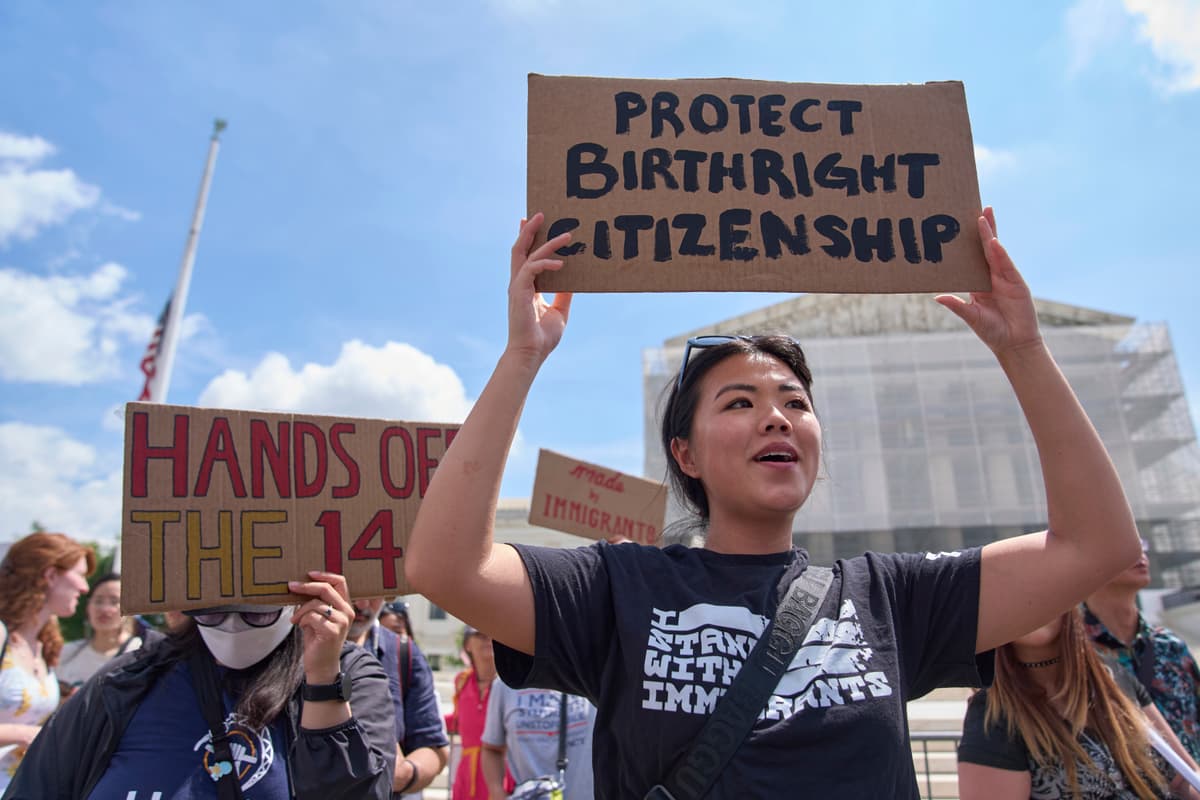

The Supreme Court agreed on Friday to take up the constitutionality of President Trump’s executive order that limits birthright citizenship.
Mr. Trump signed the “Protecting the Meaning and Value of American Citizenship” executive order on his first day back in the White House as part of his sweeping agenda to crack down on illegal immigration. The order seeks to deny American citizenship to children born in America if the parents are in the country illegally or are visitors on short-term visas.
Multiple lower courts have blocked the policy from being implemented but the Trump administration argues the lower courts are misrepresenting the Citizenship Clause of the 14th Amendment.
The administration petitioned the high court in September to take up the case. The Nine will hear arguments in the spring and a decision could come by July.
Solicitor General D. John Sauer states that the clause was adopted only to confer citizenship on newly freed slaves and their young children after the Civil War. Mr. Sauer claims the executive order restores the original meaning of the clause.
The government’s case claims, “The plain text of the Clause, its original understanding and history, and this Court’s cases confirm that the Clause extends to children who are “completely subject” to the “political jurisdiction” of the United States, meaning that they owe “direct and immediate allegiance” to the Nation and may claim its protection.”
A group of 18 Republican members on the House Judiciary Committee filed a brief in support of the administration’s case, claiming “The historical record confirms that the Fourteenth Amendment does not confer citizenship on the children of aliens unlawfully present in the United States.”
A group of Democrat-run states that sued the administration over the policy claim the Citizenship Clause is broad by design in a filing with the Supreme Court.
Their blunt response to the administration’s case states, “No defensible theory of constitutional or statutory interpretation supports Petitioners in this case.”
Legal precedent has largely affirmed birthright citizenship as a constitutional right since the 1898 Supreme Court case United States v. Wong Kim Ark, which granted citizenship to the American-born son of Chinese immigrants. A 6-to-2 court held that because the child’s parents were not “employed in any diplomatic or official capacity under the Emperor of China,” they were subject to America’s “jurisdiction” — and that their child was a citizen.
Federal judges who have recently considered the issue have largely rejected the administration’s argument, citing the long-held broad legal consensus.