
‘A Temporary Solution to a Permanent Problem’: New Orleans Faces Security Reckoning a Year After Terror Attack

One year after a deadly truck attack, The Big Easy tightens its security plan with National Guard presence while facing renewed scrutiny over safety lapses.
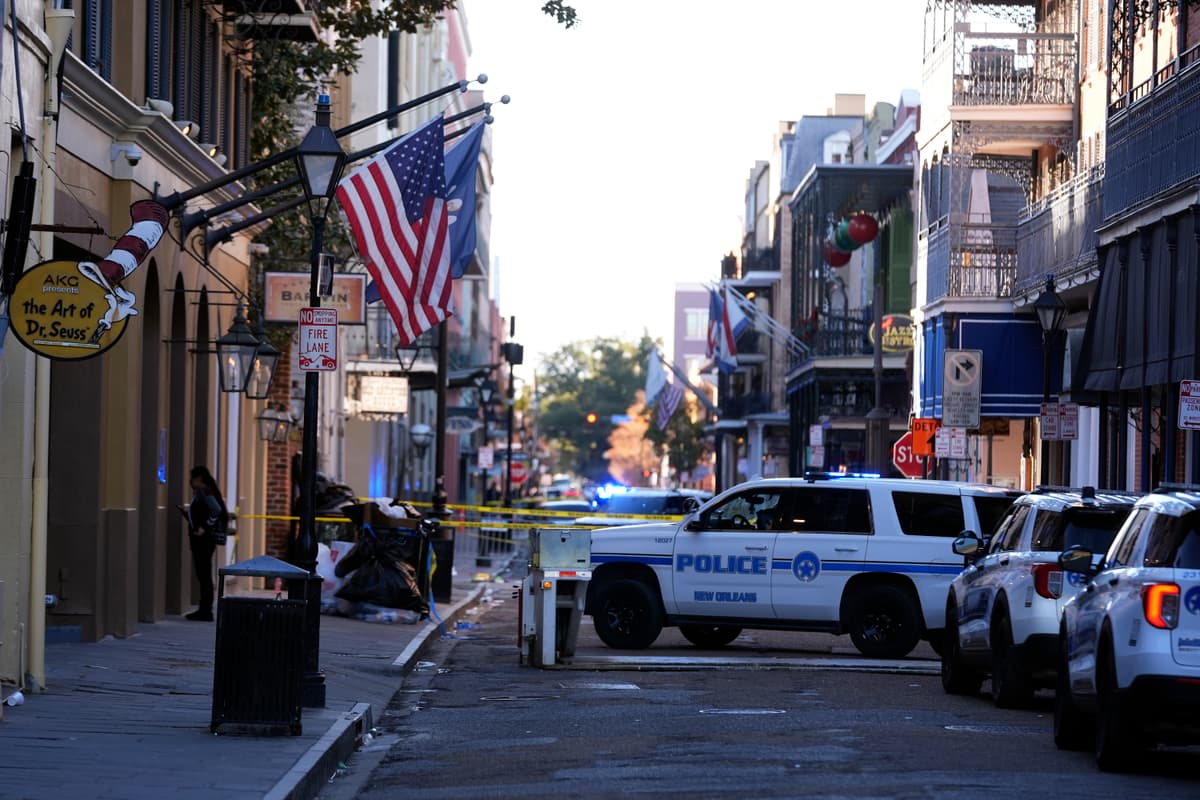
AP/Gerald Herbert
The aftermath of a vehicle driving into a crowd on New Orleans' Canal and Bourbon Street, January 1, 2025. AP/Gerald Herbert

As the city of New Orleans prepares to ring in the new year, National Guard troops have boots on the ground across the Crescent City one year after a fatal truck attack on Bourbon Street that killed 14 people.

The city’s security plan for celebrations includes a high-visibility deployment of 350 National Guard troops. Dozens of soldiers patrolled the Bourbon Street area on Tuesday, providing a stark military presence against the backdrop of the French Quarter. While armed, the troops maintained a casual posture, chatting with pedestrians and monitoring the newly established security zones as the city prepared for round-the-clock celebrations.

Officials in Louisiana maintain that the city is safe for holiday revelers in the Big Easy as they’ve implemented addition measures to crack down on potential threats, but the families of those who were killed during the violent rampage in the early morning hours of January 1 say that not enough has been done to prevent similar incidents.

“We need to learn from what happened,” attorney Morris Bart, who is representing victims and their families, told reporters on Tuesday as National Guard troops arrived in the city. 

“It’s kind of ridiculous … that a year after this tragedy nothing has been done to resolve this situation.”

The violent attack was carried out by Shamsud-Din Jabbar, a U.S. Army veteran who had pledged support for the Islamic State on social media. Jabbar drove a pickup truck into the New Year’s Day crowds before he was shot and killed by police. The attack left 14 dead and dozens more injured.

In the past 12 months since, a flurry of investigations by city officials, state agencies, and victims’ attorneys have questioned whether the massacre was preventable. Inquiries have focused specifically on the street’s bollard system—the steel columns designed to stop vehicles from entering pedestrian zones. At the time of the attack, the barriers were non-functional because they were in the process of being replaced.

The victims included 18-year-old Nikyra Dedeaux, who was celebrating with friends just before she was scheduled to begin college. Her mother, Melissa Dedeaux, told The Associated Press that while the city prepares to ring in 2026, her focus remains on the trauma of the past year. She said she continues to be haunted by graphic social media footage of her daughter’s final moments.

“I’m a parent that had to wake up, log on my Facebook account and see my daughter’s last days — my daughter’s last time. I didn’t get to see her on Bourbon the night it happened. I saw her on a video.” She said. “I saw no safety. I saw that my daughter could still be here.”

The city’s current defense against vehicle attacks consists of a nightly manual operation. To create pedestrian zones, officers must position 32 large steel barriers and a fleet of police vehicles to fill gaps in the permanent bollard system.

“They are not meant to be utilized in the fashion they are,” 8th District New Orleans Police Department Captain Samuel Palumbo, said to the AP, adding that the barriers that can withstand only low-speed collisions. While speaking before the New Orleans Governmental Affairs Committee earlier this month, he noted that the system is a “temporary solution to a permanent problem.”

Mr. Palumbo’s suggestion to the committee was for the city to install permanent security gates that can withstand crashes up to 50 miles per hour. A vote on the matter was postponed until incoming mayor Helena Moreno assumes office next month.


The New York Sun

© 2025 The New York Sun Company, LLC. All rights reserved.

Use of this site constitutes acceptance of our Terms of Use and Privacy Policy. The material on this site is protected by copyright law and may not be reproduced, distributed, transmitted, cached or otherwise used.

The New York Sun

Sign in or  create a free account

or
By continuing you agree to our Privacy Policy and Terms of Use