
Alvin Bragg Scrambles To Prevent Trump From Whisking Stormy Daniels Hush Money Case to Less Hostile Federal Court
The district attorney is on the clock to submit his arguments to Judge Alvin Hellerstein, who is also presiding over the prosecution of President Nicolás Maduro.
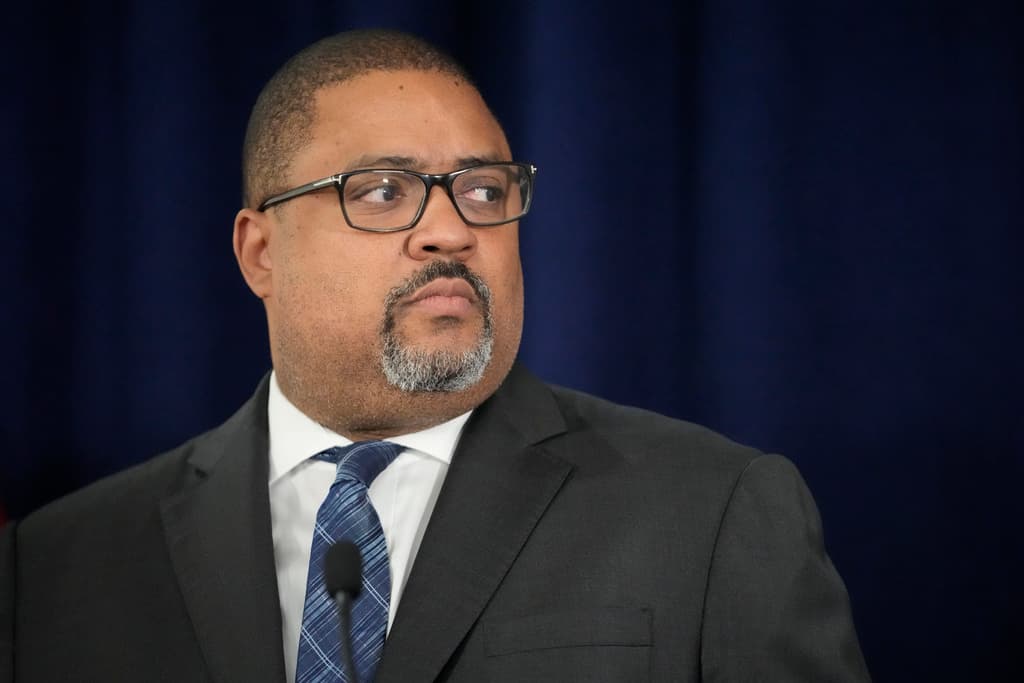
Manhattan’s district attorney, Alvin Bragg, has until Wednesday to gather his arguments for why his hush money prosecution of President Trump belongs in New York state court — and not in a federal forum that could be friendlier to the 47th president.
Mr. Bragg’s brief outlining those arguments will be docketed to none other than Judge Alvin Hellerstein, the 92 year old jurist appointed to the bench by President Clinton who is also presiding over the criminal trial of President Nicolás Maduro of Venezuela, who was captured at Caracas over the weekend. Judge Hellerstein had previously ruled that the hush money case was not a federal matter because it did not touch on federal duties.
A former federal prosecutor tells Politico that Judge Hellerstein is “just old and old-school.” In November, though, a panel of the Second United States Appeals Circuit ordered him to reconsider the question of whether Mr. Bragg’s case belongs in a federal rather than a state forum.
The Second Circuit panel — composed of three judges appointed by Presidents Obama and Biden — reckoned that Judge Hellerstein “did not consider whether certain evidence admitted during the state court trial relates to immunized official acts or, if so, whether evidentiary immunity transformed the state’s case into one that relates to acts under color of the presidency.” Mr. Trump in his appeal of his 34 convictions calls the case the “most politically charged prosecution in our nation’s history.”

The panel wrote that “We leave it to the able and experienced District Judge to decide whether to solicit further briefing from the parties or hold a hearing to help resolve these issues. We express no view and ‘neither rule nor imply’ that the District Court should resolve Trump’s motion … in any particular way.” Still, the order for reconsideration amounted to a win for Mr. Trump because it reopened a path to federal court, where a jury would be drawn from a more heterogeneously political pool than ultramarine Manhattan.
The Congressional Research Service explains that the mechanism of removal to federal courts “seeks to provide a neutral federal forum to preserve the supremacy of federal law and prevent federal officers and their agents from being improperly sued or punished when they attempt to perform their duties.” To access federal court, though, a defendant must show that they were “acting within the scope of their official duties or with actual or apparent legal authority related to their office.”
Judge Hellerstein ruled that the bones of the case — Mr. Trump paid the adult film performer Stormy Daniels, whose real name is Stephanie Clifford, some $130,000, which she alleges was meant to keep her quiet regarding an alleged sexual encounter between the two — did not rise to this standard. The judge wrote that “Reimbursing Cohen” — Mr. Trump’s erstwhile attorney, Michael Cohen — for advancing hush money to Stephanie Clifford cannot be considered the performance of a constitutional duty.”
The convictions were brought in by a Manhattan jury presided over by Judge Juan Merchan, with whom Mr. Trump repeatedly locked horns and who eventually issued a gag order against him. Mr. Trump called Judge Juan Merchan “psychotic” and “corrupt” and highlighted that the judge had made small financial contributions to President Biden and Democrats during the 2020 election. Judge Merchan’s adult daughter Loren worked at a marketing firm that advised Vice President Harris’s campaign.
Judge Merchan turned away Mr. Trump’s repeated requests that he recuse himself, and also refused to lift a gag order he placed on Mr. Trump that barred him from complaining about various players in the case and their families. He fined Mr. Trump $10,000 for violating the gag orders and threatened to imprison him.
In the end, Judge Merchan instructed the jury that the once and future president could be convicted of a felony if the jurors agreed that he falsified business records — a misdemeanor — in the service of a second crime. The jury, though, was not required to agree on the nature of that second crime, only that one existed.
Judge Merchan likewise rejected Mr. Trump’s argument that the hush money case touched on his presidential duties — and testimony and evidence that ought to have been immune from prosecution under the Supreme Court’s ruling in Trump v. United States that official presidential actions are presumptively immune from prosecution. Judge Merchan disagreed, finding that the case turned exclusively on “private acts.”
Mr. Trump on appeal argues that Judge Merchan erred in that determination and also that his jury instructions were unconstitutional because they violate the Supreme Court’s ruling in Ramos v. United States that all serious criminal convictions, both state and federal, require unanimity from the jury room. One legal scholar,Seth Barrett Tillman, who writes in an amicus brief along with the Landmark Legal Foundation that the instructions violated “the most basic conceptions of traditional American jury rights and due process.”