


Ken Burns, Ignoring Founders’ Reliance on Rome, Insists Iroquois ‘Crucially Influenced’ America’s Revolution

America’s debts — Revolutionary and Republican — to Rome resonate 250 years after Washington’s crossing of the Delaware.
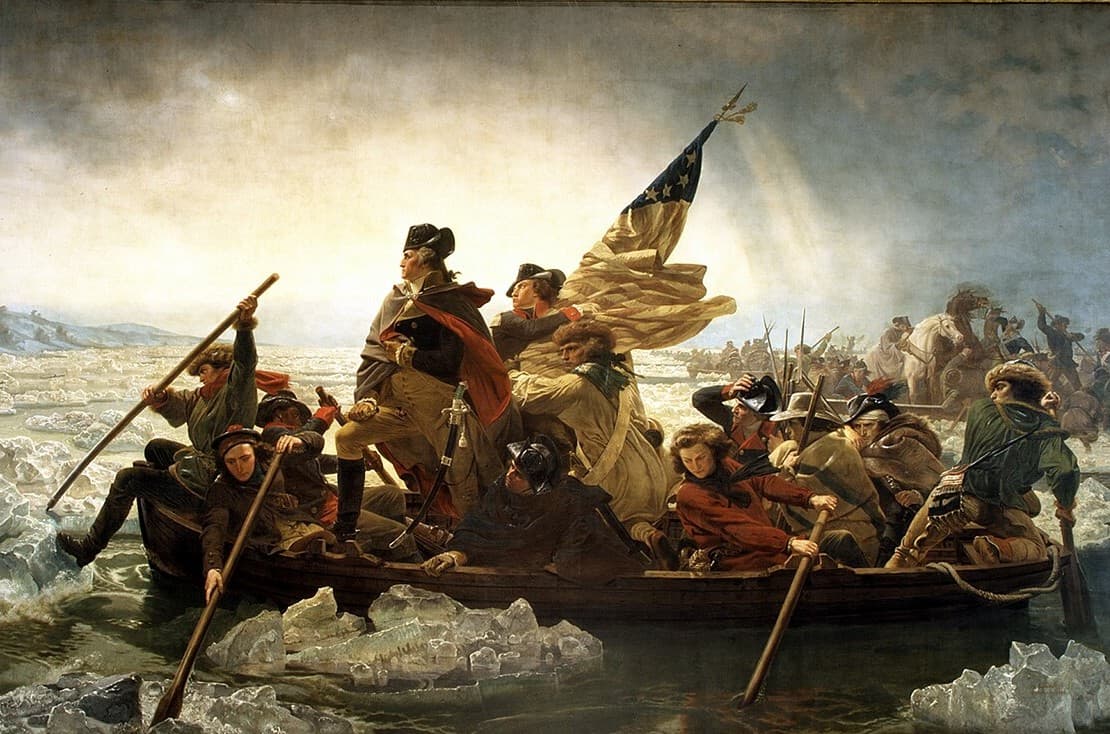
Via Wikimedia Commons
Emanuel Leutze: 'Washington Crossing the Delaware,' 1851, detail. Via Wikimedia Commons

To paraphrase Monty Python, “What have the Romans ever done for the American Revolution?”

On the night of December 25, 1776, in the midst of a fierce winter storm, General George Washington and his troops crossed the icy Delaware River, landing on the opposite bank in New Jersey. From there, Washington’s army marched to Trenton and launched a surprise attack that overwhelmed and defeated the Hessian garrison.

In delivering this much needed Christmas victory, Washington had adopted the Fabian Strategy employed by Quintus Fabius Maximus Verrucosus, the Roman general whose skirmishing tactics paved the way for Rome’s eventual defeat of Carthage in the Second Punic War.

That’s just the tip of the Delaware River iceberg, though.

In claiming that the Iroquois “crucially influenced the founding of the United States,” Ken Burns’s recent documentary ignores the Founders’ seminal inspiration: the Roman Republic. 

That res publica, which arose centuries before the birth of Jesus Christ, was the model the Founding Fathers chose at the Constitutional Convention of 1787.

The Founders looked to this ancient Italian polity in creating America’s tripartite system of government. As historian J. Rufus Fears noted: “They crafted our Constitution to reflect the balanced Constitution of the Roman Republic, with the sovereignty of the people guided by the wisdom of the Senate, with a powerful executive in the form of the commander in chief, the consul.””

Indeed, John Adams wrote that “the Roman Constitution formed the noblest people and the greatest power that has ever existed.”

And like Rome’s Lucius Quinctius Cincinnatus, Washington resigned his commission at the height of his power. Having defeated the British Crown, he returned to his Mount Vernon “villa” for a life of rustic simplicity following the Revolutionary war. 

Thus was born the American Cincinnatus, the man who became our Pater Patriae (“Father of his Country”) by emulating the Roman ideals and civic virtues embodied in the motto of the Society of the Cincinnati: “He gave up everything to serve the Republic.”

What’s more, Thomas Jefferson derived our national credo from Filippo Mazzei’s essay in the 1774 Virginia Gazette. The future president, who was fluent in Italian, translated Tutti gli uomini sono per natura egualmente liberi e indipendenti to read: All men are created equal.”

Stanley Elkins and Eric McKitrick, in “The Age of Federalism: The Early American Republic, 1788-1800,” mark how “the very nomenclature of government — ‘president,’ ‘senate,’ ‘congress’ — as well as the official iconography, the mottoes of state, even the architecture, would be heavily Roman.”

Both substantively and symbolically, the Founding Fathers embraced the laws, virtues and ideals of republican Rome. Sic floret respublica — “Thus shall flourish the republic” — was the Latin motto inscribed on our first federal paper money, the so-called Continental Currency, which, alas, fell prey to the same inflation that would eviscerate the value of Roman coinage under the emperors.  

The latin phrase E pluribus unum (“Out of many, one”), though, still adorns the Great Seal of the United States of America on the dollar.

And when the president delivers the State of the Union address in the House of Representatives, he is flanked by two bronze fasces — symbols of Roman magistratical authority.

Our legal system, which has its origins in a jurisprudential continuum spanning the Twelve Tables of Rome and Justinian’s Corpus Iuris Civilis, would be impoverished without legal phraseology like stare decisis, habeas corpus, certiorari, posse comitatus, culpa in contrahendo, and paca sunt servanda

What’s more, our entire governmental structure is predicated on Roman principles — the separation of powers, a bicameral legislature, checks and balances, the power of the purse, filibusters, vetoes, term limits, impeachment, and the Electoral College — even if, in Rome, these republican institutions drifted into the autocracy of emperors.

Nor should we forget that the most hallowed of American tenets — citizenship — has an ancient provenance. The apostle Paul asserted his universal rights as a Roman citizen and secured a trial by declaring: Civis Romanus sum.

Roman jurists had pragmatically translated the ideals of the ius naturale (natural law) into the ius gentium (the law of mankind) and the ius civile (the individual law of the Roman Empire).

In the “Emancipation of Women in Ancient Rome,” historians Roger Vigneron and Jean-François Gerkens assert that the Romans believed men and women to be inherently equal. That is, “inside the Roman people itself, the role of juridical equality was the duty to be pursued.” 

As Alfred North Whitehead declared: “I know of only two occasions when the people in power did what needed to be done about as well as you can imagine its being possible.” The first period was Rome under Caesar Augustus; the other, the American Revolutionary era.


The New York Sun

© 2025 The New York Sun Company, LLC. All rights reserved.

Use of this site constitutes acceptance of our Terms of Use and Privacy Policy. The material on this site is protected by copyright law and may not be reproduced, distributed, transmitted, cached or otherwise used.

The New York Sun

Sign in or  create a free account

or
By continuing you agree to our Privacy Policy and Terms of Use