
Anti-Israeli Countries’ Attempt To Ban Israel From Eurovision Song Contest Falls Flat — With Help From Germany, Austria

Outcome infuriates bloc of four European Broadcasting Union states — Spain, Ireland, the Netherlands, and Slovenia — that condemn Israel over Gaza war.
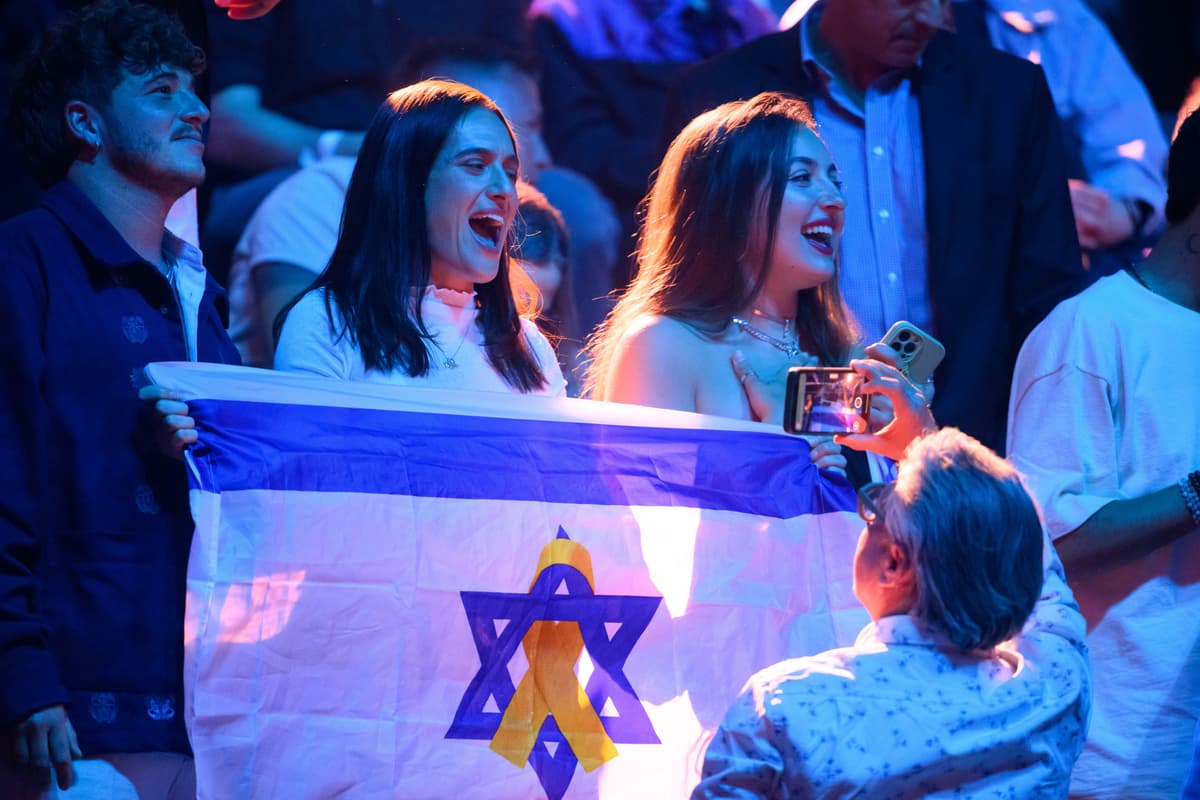
Harold Cunningham/Getty Images
Fans wave the Israeli flag as Yuval Raphael representing Israel performs during the 69th Eurovision Song Contest at Basel, May 2025. Harold Cunningham/Getty Images
DAVID MAY
DAVID MAY

The campaign to banish the Jewish state from the worlds of sport and culture is playing out on its latest stage: the Eurovision song contest. Organizers of the wildly popular musical competition rejected a call to banish Israel last Thursday. That outcome marked a rare moment of frustration for advocates of excluding Israel, suggesting that the much-needed pushback against them may have arrived, thanks to the stances of key European states.

Eurovision organizers decided to change the contest’s regulations after Israel dominated last year’s general public vote. Consequently, the European Broadcasting Union Assembly, which brings together representatives from member states and organizations, held a vote to determine if those changes were sufficient, or if further action — possibly including kicking Israel out of the competition — was necessary. Yet fewer than a quarter of voting members supported even holding a vote to exclude Israel.

This outcome infuriated the bloc of four European Broadcasting Union states — Spain, Ireland, the Netherlands, and Slovenia — that have harshly condemned Israel during the war in Gaza triggered by the Hamas massacre in southern Israel on October 7, 2023. Following the vote, the bloc declared that they would not participate in the 2026 Eurovision song contest due to Israel’s inclusion.

This bloc has also adopted its own punitive measures against Israel at the governmental level, such as canceling military contracts with Israel, unilaterally recognizing a Palestinian state, and supporting spurious war crimes cases targeting Israel at both the International Court of Justice and the International Criminal Court. These moves have been stoked by public opinion in these countries, where the most extreme anti-Zionist and antisemitic tropes have been mainstreamed and normalized.

Had Israel been banished from Eurovision, however, other states stated that they would have withdrawn in solidarity. Both Germany and Austria declared that they would pull out of the contest were Israel to be barred. Those countries in favor of barring Israel cited as a precedent the expulsion of Russia from the contest due to its illegal aggression against Ukraine. As the Ukrainian representative to the EBU emphasized, though, “it is not right to compare Russia’s expulsion to Israel.”

In part, the difference is procedural: Russia’s exclusion is the result of one EBU member waging war against another. Palestinian institutions, by contrast, are not part of the EBU. Far more important is the substantive difference: Russia launched a war of aggression against Ukraine without provocation. Hamas, not Israel, launched the war in Gaza with atrocities that amounted to the deadliest day for Jews since the Holocaust. The Palestinian terrorist group seeks the elimination of the Jewish state, just like Russian leader Vladimir Putin’s goal of destroying Ukraine’s sovereign independence and national identity.

Equally weighty considerations informed both Germany’s and Austria’s backing of Israel within the EBU. Given their complicity in the Holocaust, boycotting the Jewish state conjures disturbing memories for both countries of the Nazi campaign during the 1930s to boycott Jewish stores and businesses. Committed to defending Israel’s right to a secure existence as a democratic, Jewish state as a core national interest, Germany, out of all the states in the European Union, takes the dimmest view of the anti-Zionist ideology that seeks to cast Israel as an imitator of South Africa’s apartheid regime.

Eurovision is decidedly a cultural event and not a political one. Its official slogan is “United By Music.” Yet politics are never far away. In 2009, Georgia pulled out after its song, “We Don’t Wanna Put In,” was deemed too critical of Mr. Putin. In 2022 — as Russia was barred in perhaps the most political move the EBU has yet undertaken — Ukraine unsurprisingly won the competition amid a global surge in sympathy.

And in the first contest that followed Hamas’s atrocities, Israel was required to change its song from “October Rain” to “Hurricane” because the original title was considered too political. Performer Eden Golan finished fifth despite death threats and constant harassment from pro-Hamas protesters.

International cultural and sporting events should be opportunities for inclusion and fraternity. Attempts to use them as bludgeons against Israel risk undermining the fair play and collegiality that these affairs should be promoting. The failed attempt to oust Israel from Eurovision will certainly mar next year’s contest. It should serve as a warning to other bodies of the dangers of getting swept up by anti-Israel fervor.


The New York Sun

© 2025 The New York Sun Company, LLC. All rights reserved.

Use of this site constitutes acceptance of our Terms of Use and Privacy Policy. The material on this site is protected by copyright law and may not be reproduced, distributed, transmitted, cached or otherwise used.

The New York Sun

Sign in or  create a free account

or
By continuing you agree to our Privacy Policy and Terms of Use