Appeals Court Revives Detention of Anti-Israel Activist Mahmoud Khalil

A three-judge appeals panel hands the Trump administration a victory in its efforts to deport the embattled Columbia University graduate.

AP/Yuki Iwamura
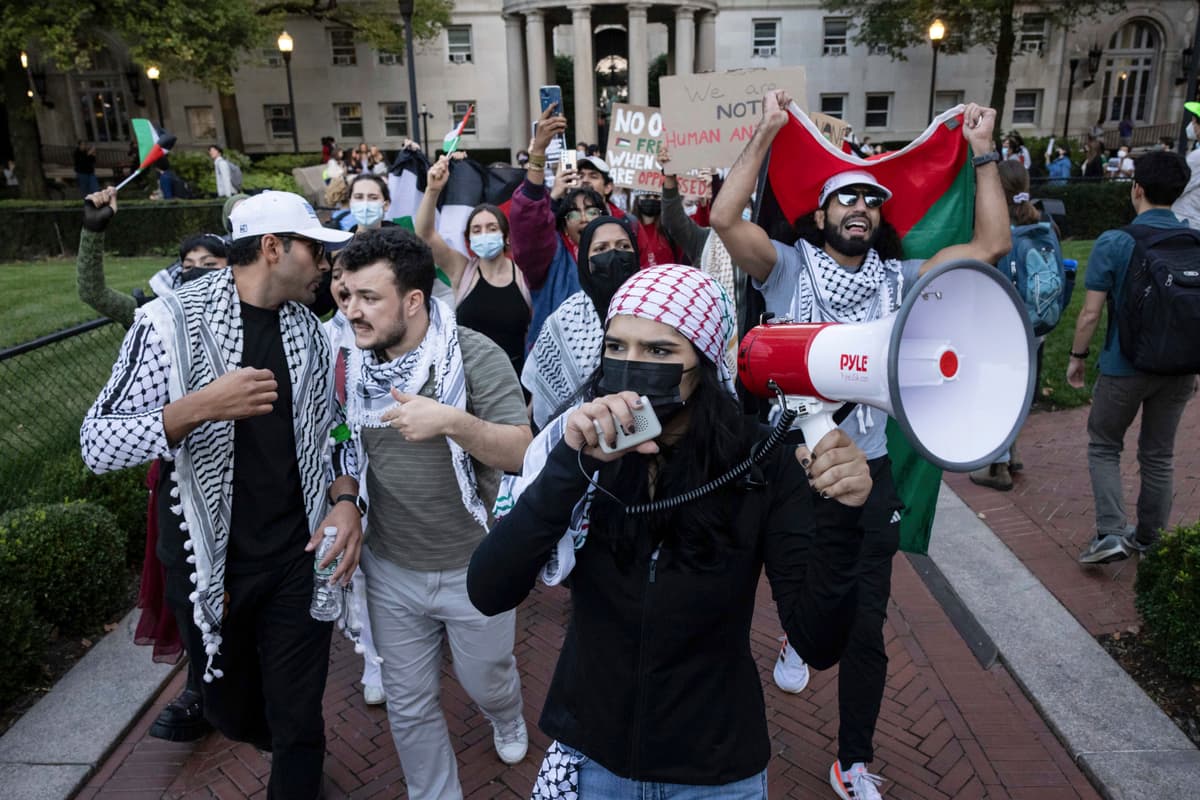
Mahmoud Khalil, second from left, demonstrates during a protest at Columbia University in 2023. AP/Yuki Iwamura

The Trump administration on Thursday scored a victory in its effort to deport an embattled anti-Israel activist, Mahmoud Khalil, after a federal appeals panel reversed a lower court ruling that had released the former Columbia University student from immigration detention. 

A three-judge panel on the U.S. Court of Appeals for the Third Circuit ruled 2-1 that the federal district court in New Jersey “lacked jurisdiction over Khalil’s removal proceedings.” The judges ordered the lower court to dismiss Mr. Khalil’s habeas corpus petition, opening the possibility that the anti-Israel activist could be returned to detention while his case proceeds.

Mr. Khalil was quick to return to his anti-Israel activism following his release, conducting a press tour, appearing at various pro-Palestinian protests, and meeting with politicians supportive to his cause such Senator Bernie Sanders.

A few weeks after leaving federal detention, Mr. Khalil sat down for an interview with the New York Times’ Ezra Klein, during which he justified Hamas’s October 7 massacre and dismissed allegations of antisemitism at Columbia as “manufactured hysteria.” A month later, during an appearance on CNN, he refused to say “yes” when asked to “specifically condemn Hamas.”

Mr. Khalil, who was born in Syria but holds Algerian citizenship, was arrested by immigration officers in March after the State Department revoked his visa and green card. The 31-year-old graduated in December with a master’s degree from Columbia’s School of International and Public Affairs and served as one of the ringleaders of the anti-Israel, pro-Hamas student encampment movement that roiled Columbia after October 7, 2023.

The state department initially justified the administration’s deportation of Mr. Khalil by calling up a provision in the Immigration and Nationality Act that allows the government to deport non-citizens who pose “potentially serious adverse foreign policy consequences for the United States.” 

The government also argued that Mr. Khalil committed immigration fraud by lying on his green card application about his employment history, namely his involvement in the United Nations Relief and Works Agency, a UN group accused of aiding Hamas and employing people who participated in the October 7 massacre. 

The administration further accused Mr. Khalil of withholding his previous employment at the Syria office of the British Embassy at Beirut, as well as his work with an anti-Israel student group at Columbia, Columbia University Apartheid Divest.

While proceedings continue in New Jersey, an appeals board in the immigration court system is considering a ruling from an immigration judge in Louisiana that gave the government the green light to proceed with its deportation efforts against Mr. Khalil on the basis of the foreign policy law. 

Mr. Khalil has sought to convince that judge to grant him asylum on the basis that deporting him back to the Middle East would place him in reach of the Israeli government. That claim has been greeted with doubt by legal scholars and foreign policy experts.


The New York Sun

Š 2026 The New York Sun Company, LLC. All rights reserved.

Use of this site constitutes acceptance of our Terms of Use and Privacy Policy. The material on this site is protected by copyright law and may not be reproduced, distributed, transmitted, cached or otherwise used.

The New York Sun

Sign in or  create a free account

or
By continuing you agree to our Privacy Policy and Terms of Use