

Are Trump’s New Battleships the Future of Naval Warfare — Or Already Obsolete?

Military strategists are divided on the wisdom of investing billions on large surface vessels in an age of hypersonic missiles, drone warfare and improved submarines.
Tasos Katopodis/Getty Images
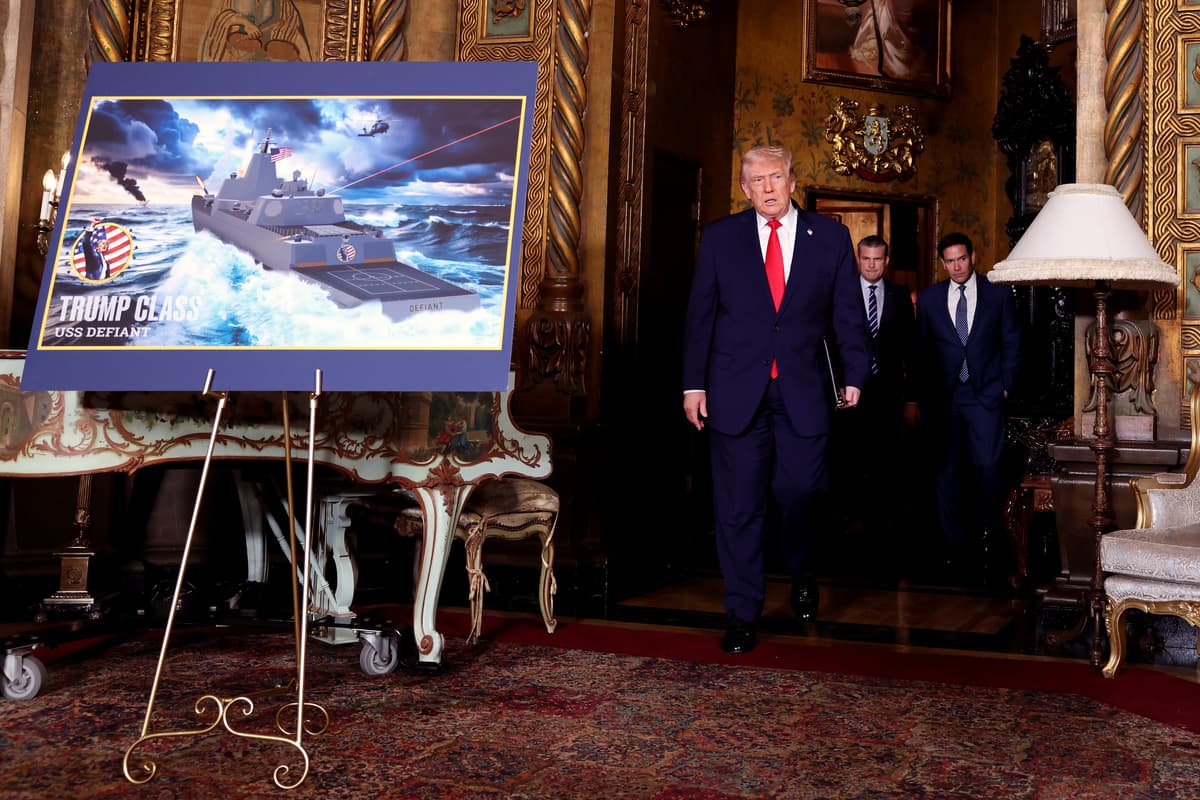
President Trump, joined by the secretaries of state and defense and the secretary of the Navy, arrives to announce plans for a fleet of “Trump-class” battleships at Palm Beach, Florida, on December 22, 2025. Tasos Katopodis/Getty Images

The announcement by President Trump of a new class of battleships bearing his name grabbed headlines for its audacity. It also called attention to a profound question that military strategists have been grappling with for some time.

In an era when Ukrainian naval drones costing just $50,000 have devastated the Russian Black Sea Fleet, and China possesses more than 1,000 medium-range missiles capable of striking United States aircraft carriers 1,000 miles offshore, are massive surface warships still viable?

The Trump-class vessels, which the president claims will be 30,000 to 40,000 tons and longer than World War II-era Iowa-class battleships, represent a dramatic gamble. According to Navy specifications, the ships will feature hypersonic missiles, nuclear-capable cruise missiles, electromagnetic railguns, and directed energy lasers. 

Mr. Trump declared them “the fastest, the biggest, and by far 100 times more powerful than any battleship ever built.”

The announcement, however, comes at a moment when the fundamental assumptions underlying naval power are under siege. The question is not simply whether these ships will be built, but whether they represent the future of naval warfare — or an expensive bet on yesterday’s strategy.

“This new class of ship is exactly the opposite of what the Navy needs,” a senior fellow and director of military analysis at Defense Priorities, Jennifer Kavanagh, tells The New York Sun. “At worst, it will be irrelevant and useless in a future war. At best, it will be an attractive and easy target for adversary missiles in a future war.”

The Drone Revolution and the Death of Big Ships

The war in Ukraine has provided a real-world laboratory for testing the vulnerability of large naval vessels in the drone age. Ukraine has sunk multiple Russian warships using Magura V5 unmanned vessels laden with explosives, including the $65 million patrol ship Sergey Kotov. 

Most dramatically, Ukrainian forces claimed in December to have used underwater “Sub Sea Baby” drones to strike a Russian submarine at Novorossiysk naval base in what they described as a historic first.

The implications are stark. The Russian Navy has moved almost all its significant assets to the port of Novorossiysk on the eastern coast of the Black Sea and generally minimized patrolling due to the drone threat. 

Military analysts note that anti-ship missiles and drones can attack carriers from beyond the range of their air defenses, fundamentally challenging the survivability of large surface combatants.

Some analysts go further, suggesting Washington should focus on large numbers of small naval vessels capable of carrying a few missiles or drones each, dispersing them across vast waterways to negate adversaries’ missile advantages by presenting too many targets. In this view, putting enormous firepower on a single platform creates precisely the kind of high-value target that modern weapons are designed to destroy.

“As described, it is too big, too slow, too expensive, and relies on unproven technologies,” Ms. Kavanagh said. “If the Navy wants to spend this kind of money on exquisite capabilities, it should focus on nuclear submarines, which are more versatile and survivable.”

The Case for the Battleship

Yet the Trump administration’s vision is not without strategic logic. The ships are designed to operate in multiple configurations — independently; as part of carrier strike groups; or commanding their own surface action groups. With 128 vertical launch cells for Tomahawk cruise missiles, anti-ship missiles, or missile defense interceptors, they would pack formidable firepower.

These weapons aim to address the same threats critics contend make surface ships vulnerable. The Navy is fielding Coyote and Roadrunner counter-drone systems designed to defeat drone swarms at a lower cost, reducing reliance on expensive standard missiles against inexpensive targets.

Advocates also cite aircraft carriers as evidence that large ships continue to play a central role. Unmanned systems, such as drones and autonomous aircraft, are increasingly being launched and coordinated from carriers. This model could allow Trump-class ships to support unmanned forces across large operational areas by acting as command-and-control nodes.

The Railgun Question

Among the most intriguing aspects of the Trump battleship proposal is the inclusion of electromagnetic railguns — weapons that the Navy officially abandoned in 2021. As railguns use electromagnetic force instead of gunpowder to launch projectiles at hypersonic speeds, they can theoretically reach targets 220 miles away, approximately 10 times the range of a ship-mounted gun.

The Navy did not cancel its railgun program casually. Despite more than 15 years in development and $500 million in spending, technical challenges proved insurmountable. Chief among these was barrel durability. The massive forces involved in firing wore out the barrel after only one or two dozen shots, and the rate of fire was too low to be useful for missile defense.

“This is just one of the unproven technologies that the new class of ship will rely on,” Ms. Kavanagh said. “Many won’t reach maturity, and integrating those that do will be another challenge. It’s likely the Navy will have to abandon the railgun a second time after wasting more money on it.”

The Industrial Reality

Even accepting the strategic argument for battleships, daunting obstacles loom, beginning with the cost.

Based on Congressional Budget Office estimates for building a future class of 14,500-ton destroyers — which are now to be replaced by the Trump-class battleships —  it has been calculated that the president’s new vessels will cost about $9.1 billion each, compared to roughly $2 billion for the Arleigh Burke-class destroyers now in service. Because of one-time development costs, the first ship completed could cost as much as $15 billion.

Meanwhile, America’s shipbuilding industrial base faces severe challenges. Construction of the Navy’s newest aircraft carrier, the USS John F. Kennedy, has slipped about two years behind schedule. The Navy secretary, John Phelan, canceled the Constellation-class frigate program last month after it fell about three years behind schedule.

“It will take years simply to deal with the design and technological challenges of this ship,” Ms. Kavanagh said. “Frankly, it will be a miracle if any are ever built.”

Construction timelines present another hurdle. At 30,000 to 40,000 tons, the ship is much larger than anything the United States has built in the last 80 years, aside from aircraft carriers, and its design will take many years. Mr. Trump said he wants the first ships completed within about two and a half years, but experts point out that the Navy has a poor track record and integrating multiple experimental weapons systems has been extremely complicated.

A Broader Shift in Naval Thinking

The debate over Mr. Trump’s battleships reflects a larger transformation in how military planners think about sea power. China’s introduction of the carrier-based J-35 stealth fighter and the KJ-600 aircraft, which serves as an airborne surveillance and command center, strengthens China’s ability to compete at sea and in the air, fundamentally altering the calculus for United States naval operations in the Pacific.

Some analysts warn that the whole concept of massive surface combatants may be reaching its historical endpoint. With no reliable defense against hypersonic missiles, the future of supercarriers in high-intensity conflicts, particularly in the Indo-Pacific, is under scrutiny. 

A Swedish diesel submarine nearly sank the USS Ronald Reagan without being detected during an exercise in 2005, demonstrating the threat to carriers posed by improving submarine and missile technology.

Others argue that as long as carriers are adapted for modern warfare, there is no reason they cannot help America to maintain naval dominance for decades to come.

The same logic could apply to battleships designed from the ground up to address 21st-century threats. But Ms. Kavanagh is not buying it.

Efforts to design and build the Trump-class battleships “will suck up valuable time and shipbuilding capacity and divert resources from other priorities,” she said. “The Navy will be less ready and less effective in future crises and contingencies as a result of this program.” 


The New York Sun

© 2026 The New York Sun Company, LLC. All rights reserved.

Use of this site constitutes acceptance of our Terms of Use and Privacy Policy. The material on this site is protected by copyright law and may not be reproduced, distributed, transmitted, cached or otherwise used.

The New York Sun

Sign in or  create a free account

or
By continuing you agree to our Privacy Policy and Terms of Use