


Beijing Introduces Condom Tax in Effort to Boost Birth Rate

The communist government hopes to reverse four years of declining population.
Getty Images
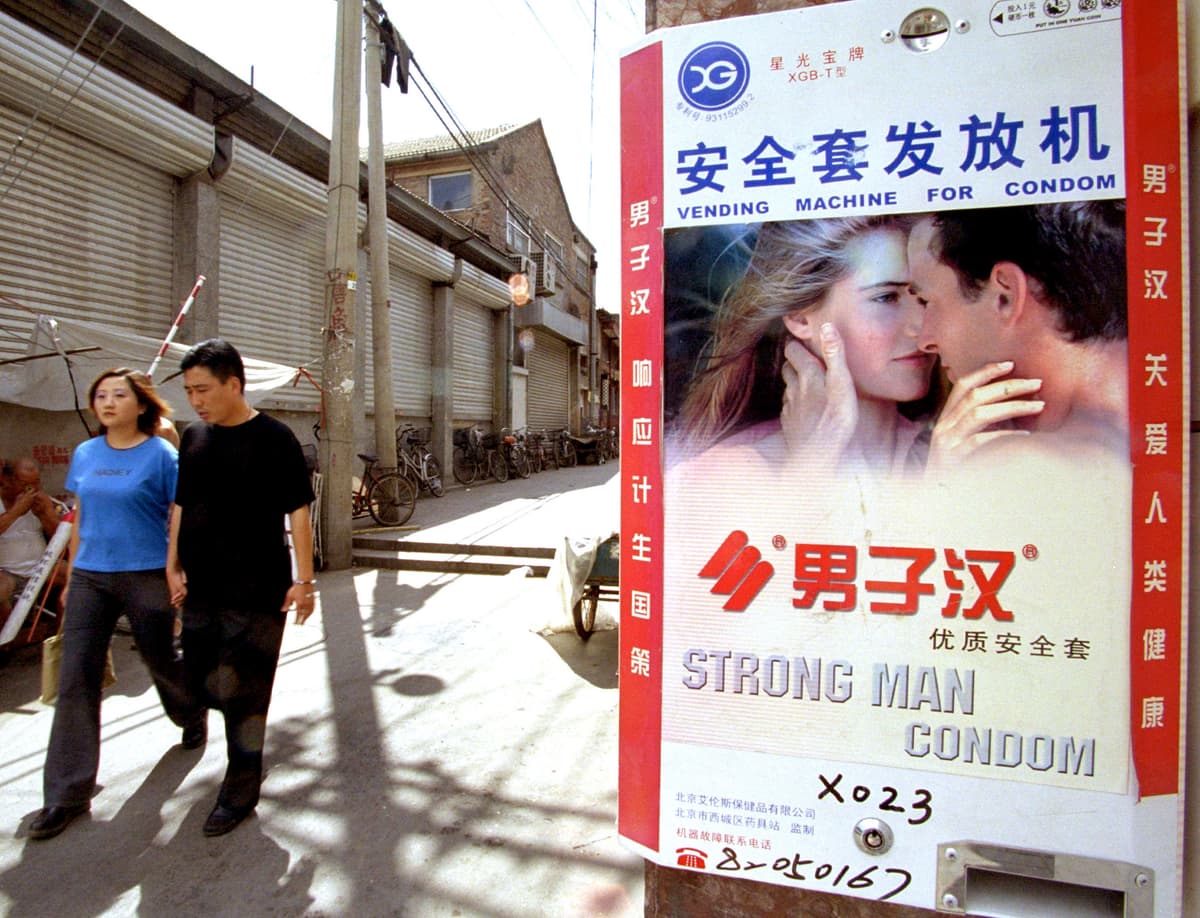
A couple walk pass a condom vending machine at Beijing on July 16, 2002. Getty Images
LUKE FUNK
LUKE FUNK

Communist China is slapping a 13 percent value-added tax on condoms and birth control pills at the start of 2026 in a desperate attempt to boost the nation’s declining birth rate.

China’s population — while still over 1.4 billion — has declined for four years in a row with no sign of a turnaround.

China enacted a one-child policy in 1980 over fears of overpopulation. The central government even handed out free condoms as part of the effort.

That policy resulted in an aging population and shrinking workforce. The median age in China had risen to 40.1 last year from 35.7 in 2015.

The government ended the program in 2016 when it allowed couples to have two children, but the new policy has not led to increased birth rates. China’s fertility rate sat at 1.02 last year, far below the 2.1 births per woman needed to maintain a stable population. It has not been that high in China since 1990.

A major disincentive is the high cost of raising a child. China ranks as the second-most expensive place in the world to have children, according to the YuWa Population Research Institute.

An economic slowdown has also left young families feeling uncertain about their future, according to the BBC. “I have one child, and I don’t want any more,” the network was told by 36-year-old Daniel Luo, who lives in the eastern province of Henan.

Critics on Chinese social media have joked that even with the tax, condoms will be cheaper than raising a child.

The central government has increased other incentives to encourage couples to start having children including extended maternity leave and cash handouts.

While some observers say the condom tax is largely symbolic and unlikely to have much impact on the population, there are concerns about unintended consequences. These include the risk of more sexually transmitted diseases.


The New York Sun

© 2026 The New York Sun Company, LLC. All rights reserved.

Use of this site constitutes acceptance of our Terms of Use and Privacy Policy. The material on this site is protected by copyright law and may not be reproduced, distributed, transmitted, cached or otherwise used.

The New York Sun

Sign in or  create a free account

or
By continuing you agree to our Privacy Policy and Terms of Use