Caravaggio, Sorcerer of Shadows, Brings His Dark Charisma to the Morgan Library With an Early Masterpiece
‘Boy With a Basket of Fruit,’ on loan from Rome’s Galleria Borghese, is an early scoop of an electric new style.
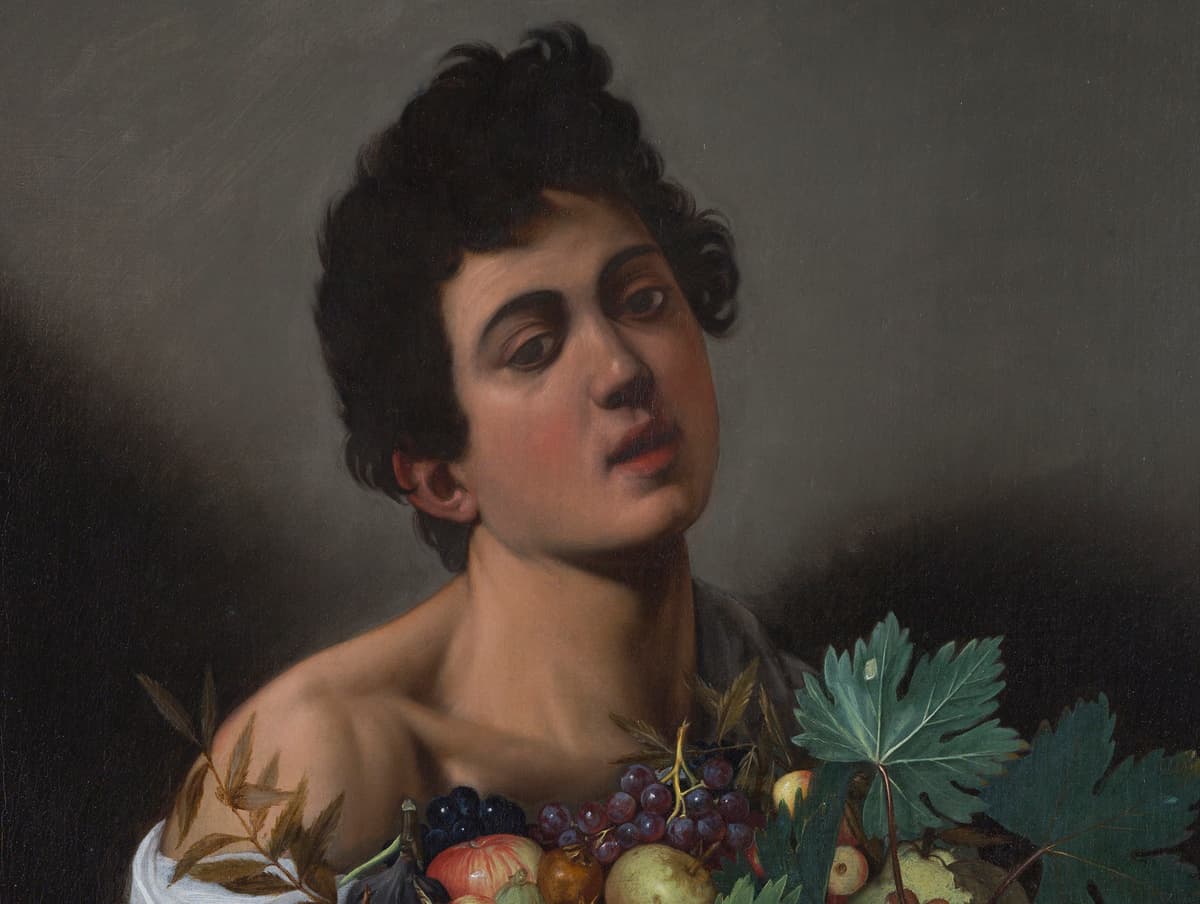

The appearance of Caravaggio’s “Boy With a Basket of Fruit” at the Morgan Library & Museum is an occasion to be seduced anew by the dark master of the Baroque. “Boy” was not Caravaggio’s first work, but it was the first to convey the charismatic chiaroscuro that would become his calling card. The Morgan touts it as his “first masterpiece,” a scoop of his new style that would yield paintings of such electric intensity that they appear to anticipate cinema.
“Boy” dates from 1595, the same year that a 24 year-old Michelangelo Merisi de Caravaggio moved to Rome from his native Lombardy. Like Leonardo da Vinci, he has come to be known by his hometown. Da Vinci lived for two decades at Lombardy’s largest city — Milan — and his ingenious influence would serve for Caravaggio as both touchstone and point of departure. Like da Vinci, his singular genius gave rise to legions of followers.
“Boy” was painted on speculation in more ways than one. Caravaggio was poor, a desperado and a desperate man who painted to survive. He killed a man in a brawl, which forced him to flee to Naples. His work only grew in depth and beauty, even as he wandered through Sicily and Malta in search of a papal pardon. One 20th century art historian reckons that “What begins in the work of Caravaggio is, quite simply, modern painting.”
This painting comes to the Morgan from Rome’s Galleria Borghese. The sitter is the Neopolitan painter, Mario Minniti, then 16 years old. Caravaggio was working as an apprentice at the studio of a macher of Mannerism, Cavaliere d’Arpino. Caravaggio’s remit was flowers and fruits, and “Boy”shows a painter finding his form in both still-life and portraiture. The peaches and pears are all the more beautiful for their bruises.
Caravaggio’s style would come to be known as tenebrism, after the Italian tenebroso, whose meaning conveys the “dark, gloomy, and mysterious.” It is chiaroscuro brought to the most extreme pitch, with deep darks, violent contrasts, and spotlighting shafts of light. While “Boy” is a far ways away from “The Taking of Christ,” which hangs at Dublin, and the “Crucifixion of St. Peter,” at Rome, there are already suggestions in its shadows of the paintings to come.

“Boy” is compelling because it straddles an ambiguous line between artifice and honesty. The boy is obviously posing — this is a painting about how a studio works, like a candid shot taken at a Hollywood backlot. It fronts the contrivance of painting at a time when the old Renaissance model of apprenticeship was breaking down and an open market was developing. At the same time, what the Morgan calls the boy’s “remarkable frankness” is on full display.
Caravaggio paints his subject with tousled hair, and parted lips, a flush flowing through his cheeks and ears. His shirt is slipping off, as if he has been made to sit for one a few brushstrokes too long. Caravaggio painted quickly directly on canvas and almost always from live models — no drawings of his have survived. The painting’s subject is every bit the artist’s model, just as much as the basket of fruit he holds, spilling out overripe figs and pomegranates.
The painting’s background — blurs of blacks and greys, the darkness carved into something like angel’s wings against the boy’s back — shows Caravaggio already growing into the sorcerer of shadows that he would become. That skill surfaces in the hollows of the boy’s collarbone and the curve of his shoulder, which demonstrates how Caravaggio had downloaded the mastery of muscle and tendon from an earlier Michelangelo.
While “Boy” is the jewel of this show, curated by John Marciari, which runs through April 19, the Morgan has surrounded that painting with others that help the viewer better understand Caravaggio’s context. “The Girl With Cherries,” from Marco d’Oggiono, dates from 1491-95. It is so informed by da Vinci that the girl at its center could be a cousin to the “Mona Lisa.” No pale imitation, this work is deft in its attention to flesh, fabric, and fruits.
If “Boy” runs hot, though — all slouch and pulse and flex — “Girl” is cool, comfortable in the liminal space between portrait and allegory. A stranger vision is presented in Giuseppe Arcimboldo’s “Four Seasons in One Head,” merges flora and fauna into an uncanny hybrid, with hair replaced by branches and bark taking the place of skin. It could be a creature out of J.R.R. Tolkien’s imagination, and scholars still debate Arcimboldo’s sanity.
A more conventional but still compelling vision is Bartolomeo Cavarozzi’s “Basket of Fruit,” from 1620. Caravaggio was dead a decade when this was painted, but it bears his imprint — these are his grapes and figs and pomegranates, with the same split sides, insect wounds, and spilled seeds. A pure still life with no human figure was still a rarity at the beginning of the 17th century — Cézanne’s revolution in still life geometry lies far in the future.
The French classicist Nicolas Poussin said that Caravaggio “came into the world to destroy painting,” but the lineage of the “Caravaggisti” comprises Bernini, Gentileschi, Rubens, Velázquez and Rembrandt. One of his biographers reports that “’after a fortnight’s work he will swagger about for a month or two with his sword at his side … ever ready to engage in a fight.” Of his greatness, though, there can be no dispute.