Defiant Jack Smith Insists Trump Committed ‘Fraud’ When He Said the Election Was Stolen, But What About Freedom of Speech? 

The special counsel tells lawmakers that he ‘makes no apologies’ for how he prosecuted the 47th president.
Composite from AP/Alex Brandon and Anna Moneymaker/Getty Images
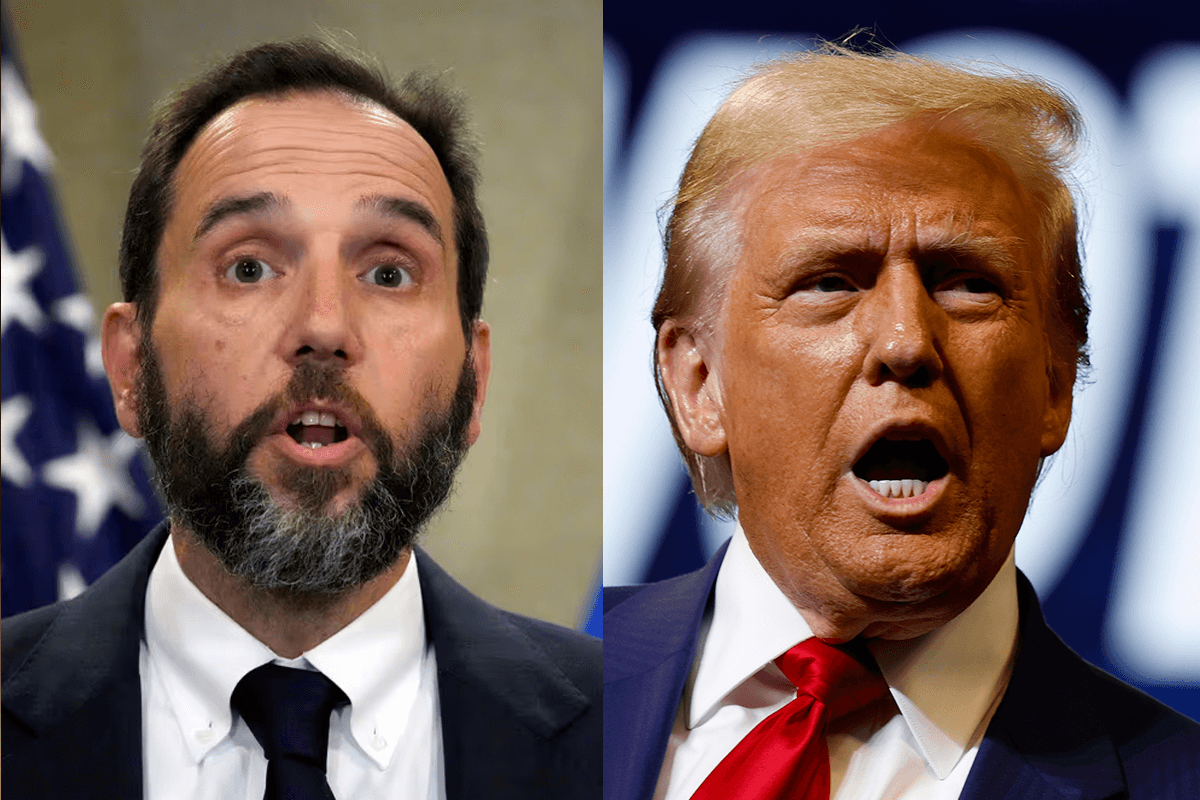
Special Counsel Jack Smith on June 9, 2023, at Washington and President Trump on October 26, 2024, at State College. Composite from AP/Alex Brandon and Anna Moneymaker/Getty Images

Special Counsel Jack Smith’s explanation of his theory of his election interference case against President Trump is raising questions about whether the hard-charging prosecutor was set to trample on the hallowed terrain of the First Amendment.

The chairman of the House Judiciary Committee,  Congressman Jim Jordan, asked Mr. Smith during the special counsel’s closed door testimony to Congress last month whether Mr. Trump’s claims about the 2020 election — the core of Mr. Smith’s case — were constitutionally protected. The special counsel charged Mr. Trump, who pleaded “not guilty,” with four counts of seeking to reverse the results of the 2020 vote. 

The prosecutor replied to Mr. Jordan regarding those statements of Mr. Trump: “Absolutely not. If they are made to target a lawful government function and they are made with knowing falsity, no, they are not. That was my point about fraud not being protected by the First Amendment.” Mr. Smith also shared that he makes “no apologies” about seeking to gag Mr. Trump regarding the prosecution, a request that an appellate court reckoned was broad enough to violate Mr. Trump’s free speech rights.

To this day, when Mr. Trump inveighs against the administration of the 2020 election, he cites specific examples of fraud in battleground states he lost. His camarilla of aides and advisors also cited what they claimed to be evidence of fraud. Had Mr. Smith’s case gone to trial, Mr. Trump’s defense team would likely point to dozens of detailed — if unproven  — allegations of fraud in Georgia and Nevada as evidence that Mr. Trump was not making knowingly false statements. 

Many of these allegations —  such as those concerning the Dominion voting machines and the Georgia mother-daughter vote counters — have been addressed in civil litigation and found to be false. But without the benefit of hindsight, when applying the fog of post-campaign war, an argument could be made that Mr. Trump truly believed the election was stolen. The issue was likely to be hotly contested at trial.

The Washington Post writes in an editorial that “Of course fraud is a crime. But that almost always involves dissembling for money, not political advantage.” The Post speculates that Mr. Smith’s years spent prosecuting war crimes at the Hague impressed upon him the narrower view of free speech rights that pervades the Continent. The paper —  which recently purged its left-leaning opinions team in favor of more conservative writers – speculates that Mr. Smith “maybe went native in the Netherlands.”

Mr. Smith was asked if his boss, Attorney General Merrick Garland, was concerned that the indictment of Mr. Trump “may have relied too heavily on statements that the President had made and infringed on his free speech if you were going to prosecute him for it.” To that Mr. Smith acknowledged that “we knew that a sort of First Amendment defense would be part  of the case … we wanted to make clear that this was not about trying to interfere with anyone’s First Amendment rights, that this was a fraud.”

The special counsel was then asked “But the President’s statements that he believed the election was rife with fraud, those certainly are statements that are protected by the First Amendment, correct?” The response was “Absolutely not … There is no historical analog for what President Trump did in this case. As we said in the indictment, he was free to say that he thought he won the election. He was even free to say falsely that he won the election. But what he was not free to do was violate Federal law.”

Mr. Smith declared under oath that “I think all of us want to make sure people’s First Amendment rights are not abridged in a way that they shouldn’t be. I think I certainly feel that way. I’m sure everybody in this room feels that way.” He insisted, though, that there is a “carve out” for “when you’re committing a fraud, meaning you’re not just saying something that’s untrue, you’re saying it knowing it’s untrue or with reckless disregard for the truth, that’s not protected by the First Amendment.”

The Supreme Court held in a landmark case from 1966, Mills v. Alabama, that  “Whatever differences may exist about interpretations of the First Amendment, there is practically universal agreement that a major purpose of that Amendment was to protect the free discussion of governmental affairs.” Courts have long held that political speech is owed the highest level of legal protection, far surpassing the prerogatives afforded to, say, commercial or sexual speech.

Immediately after the unveiling of Mr. Smith’s indictment of Mr. Trump in 2023 an attorney, John Lauro, for the once and future president denounced the case as “an attack on free speech, and political advocacy. And there’s nothing that’s more protected, under the First Amendment, than political speech.”

There is plenty of case law, though, to suggest that if Mr. Smith managed to prove that Mr. Trump engaged in fraud — via so-called “alternate electors” or any other means — the First Amendment would not have been a viable defense. In a case from 2023, United States v. Hansen, Justice Amy Coney Barrett — named to the high bench by Mr. Trump —  writes that “fraudulent representations through speech for personal gain” are “not protected by the First Amendment.”

Mr. Trump could have argued that Mr. Smith’s accusation that his speech lost legitimacy when it targeted  “a lawful government function” was too vague to serve as a pretext for setting aside the First Amendment. To convict Mr. Trump, though, Mr. Smith would have had to contend not only with the constitutional rights owed to every American, but also to those owed to just one — presidential immunity. 

The Supreme Court held in Trump v. United States, from 2024, that official presidential actions — including speech — are presumptively immune from prosecution. Mr. Smith insisted, in a second indictment, that his case could have survived that ruling. The question of whether Mr. Trump’s speech at the Ellipse on January 6, 2021, was legally protected has been fiercely contested as part of the effort to hold him civilly liable for January 6. 


The New York Sun

© 2026 The New York Sun Company, LLC. All rights reserved.

Use of this site constitutes acceptance of our Terms of Use and Privacy Policy. The material on this site is protected by copyright law and may not be reproduced, distributed, transmitted, cached or otherwise used.

The New York Sun

Sign in or  create a free account

or
By continuing you agree to our Privacy Policy and Terms of Use