
Erdogan’s Courtship of Pakistan Stirs Fears of a Nuclear-Armed Turkey

Given the two nations’ uniquely poor records on counterterrorism and regional aggression, the Ankara-Islamabad ties warrant concern.
AP/Burhan Ozbilici, file
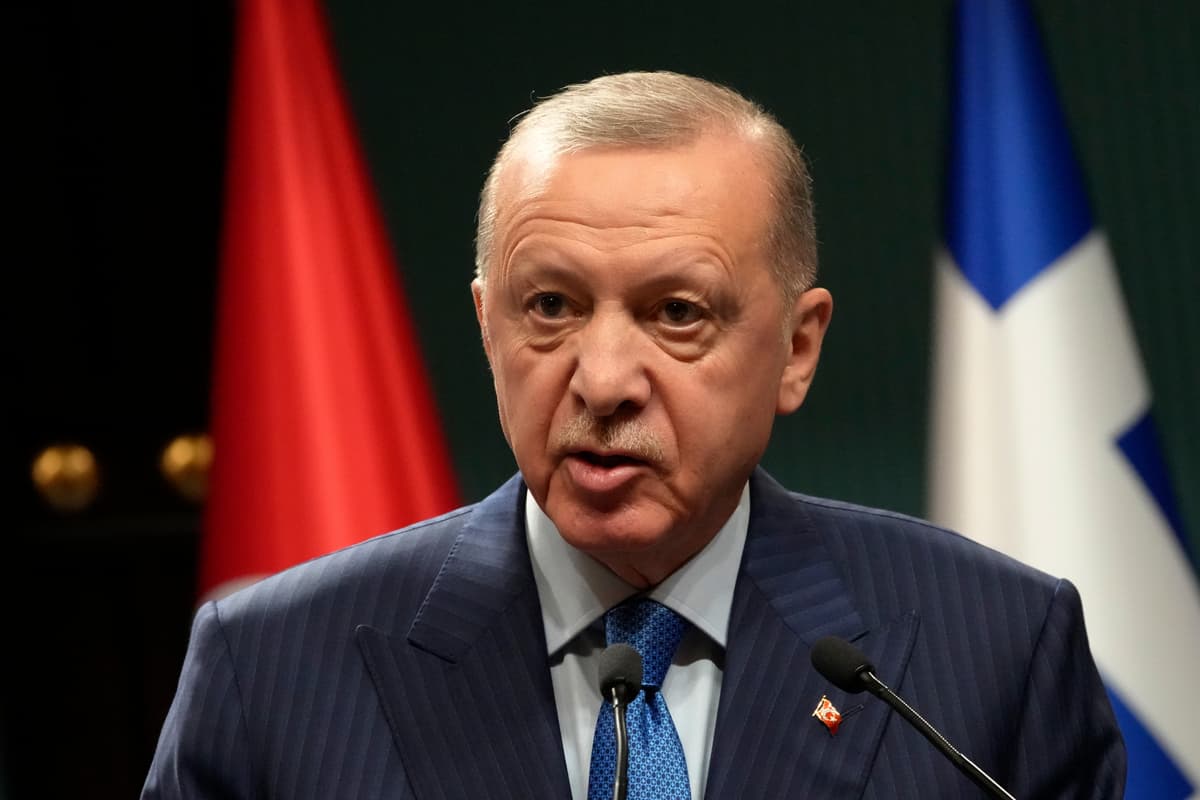
President Recep Tayyip Erdogan at Ankara, May 13, 2024. AP/Burhan Ozbilici, file

One bull in the china shop of South Asian security — a nuclear-armed Pakistan — is bad enough, but Ankara’s recent steps toward an economic and military foothold at Islamabad suggests the region could soon need to deal with two. Since November, President Recep Tayyip Erdogan of Turkey has sought out various means to infiltrate Pakistan’s economy and security environment. 

Developments like a $300 million offshore oil and gas contract are but the tip of the iceberg. The pro-Erdogan Turkish press are gleefully depicting doorway deals like this as the start of a “strategic commitment” between two ambitious middle powers. Onlookers should not be fooled by Turkey’s NATO membership or Pakistan’s “major non-NATO ally” status. Given their uniquely poor records on counterterrorism and regional aggression, America and its allies ought to watch the Ankara-Islamabad courtship with worry.

Mr. Erdogan’s understanding of how to use Pakistan for Turkish power extends well beyond resource markets and trade — although it’s a good start for Ankara’s strongman. On December 2, Turkey’s Energy Ministry signed a series of agreements with Pakistan granting Ankara operating rights over one of Pakistan’s offshore oil and gas fields and a dominant stake in hydrocarbon prospecting. 

If Mr. Erdogan were to conclude that his strategic assets are at risk, he might seek basing or port-access arrangements along Pakistan’s coastline. Such an arrangement would give Turkey the ability to project military power astride the maritime routes entering and exiting the Persian Gulf — among the world’s busiest and most strategically vital shipping lanes.

Of immediate concern is the positionality that Ankara is gaining from access to the Indian ocean. The signing of the oil exploration deal between the Turkish Petroleum Corporation and the Pakistani government is framed as an economic deal between the two countries. 

However, as one analyst, Amine Ayoub, points out, the deal also affords Ankara the opportunity to operate inside Pakistan’s maritime economic zone — an opportunity that is likely to give the Turkish navy a forward operating base that will threaten Israel’s trade routes. 

In a reality where 90 per cent of Israel’s trade is obtained from the sea, Ankara’s maritime agreement with Islamabad can place a “chokehold on the eastern approaches to Eilat,” Mr. Ayoub argues. Turkey would then “control the entrance to Israel’s trade routes in the Mediterranean” and “stand ready to interdict them in the Indian Ocean.”

Just as Pakistan’s energy market gives Mr. Erdogan a strategic position in the Arabian Sea, so too does the arms market. Bloomberg reported on December 5 that the Turkish Defense Ministry entered talks with Islamabad to open a combat drone factory in Pakistan. The planned facility would produce some of Turkey’s most advanced aerial weapons, including Baykar Technology’s newest Kizilelma unmanned fighter jets and Bayraktar TB3 long-range UAVs.

Such a deal is well within Mr. Erdogan’s reach. Turkey already produces Pakistani warships, upgrades Islamabad’s F-16s, and is attempting to bring Pakistan into the KAAN fighter jet program. Yet Turkey’s aspirations with its Muslim partner are not limited to conventional weapons. It is no secret that Mr. Erdogan covets equipping Turkey with nuclear weapons. 

He is a sharp critic of previous Turkish governments for attaching Ankara’s name to the Treaty on the Non-Proliferation of Nuclear Weapons. Believing that this is a mistake, Mr. Erdogan could be eyeing a new-found opportunity to deepen collaborative ties with Pakistan on nuclear weapons capability sharing — the only Muslim power known to have perfected and deployed nuclear weapons. 

Concrete details of collaboration between the two capitals are not publicly available. Yet Pakistan’s dire need for capital and economic assistance, given the weak state of its economy, is common knowledge. Turkey’s desire to invest in Islamabad’s oil and defense industry could provide the incentive necessary for Pakistan’s leadership to reciprocate in kind by allowing Turkey to purchase nuclear weapons and or come under its nuclear umbrella.

Ankara is not wasting time in expanding the scope and potential of its horizons.

Washington, on the other hand, missed another opportunity to hold Ankara to account. On December 29, President Trump hosted Prime Minister Benjamin Netanyahu in Florida, where in a joint press conference he told reporters that America was “seriously” considering selling F-35 stealth fighters to Turkey. This is music to Erdogan’s ears, furthering several of his goals — and none in our favor: undermining the rules-based order, jeopardizing the security and stability of our allies and, ultimately, our own national security. 

___________

The Turkey Program Research Intern at Foundation for Defense of Democracies, William Doran, contributed to the authorship of this article.


The New York Sun

© 2025 The New York Sun Company, LLC. All rights reserved.

Use of this site constitutes acceptance of our Terms of Use and Privacy Policy. The material on this site is protected by copyright law and may not be reproduced, distributed, transmitted, cached or otherwise used.

The New York Sun

Sign in or  create a free account

or
By continuing you agree to our Privacy Policy and Terms of Use