Europe Rearms To Face Russia
‘If “little green men” ever cross our border, we will open fire,’ says the foreign minister of Estonia.

While President Trump downplays traditional Republican worries about a military menace from Moscow, Russia’s neighbors are taking a radically different tack. Last week, Estonia, Latvia, and Lithuania quietly left the Ottawa Convention banning anti-personnel mines. By February, Finland and Poland are to follow. In the new year, Finland, Lithuania, and Poland plan to start making the mines, which are designed to maim or kill invading foot soldiers.
“If ‘little green men’ ever cross our border, we will open fire,” Foreign Minister Margus Tsahkna of Estonia told Polish journalists last week. He alluded to soldiers who seized Ukraine’s Crimea in 2010 without insignia identifying them as Russians. “If we see that Russian fighter jets pose a threat to our security, we’ll be shooting them down. This is a red line — and Putin must remember it.”
Long gone are the low tension, post-Cold War days of an enmity that dared not speak its name. At that era, instead of training to fight Russian invaders, NATO war games pitted “Blue” armies against “White” armies. With that fiction in the past, Lithuania plans to retrofit all its road bridges with Belarus and Russia with explosives for easy demolition.

“Russia is the threat today, tomorrow and long into the future,” Prime Minister Petteri Orpo of Finland told broadcaster YLE in advance of an “Eastern Flank” summit in Helsinki this month. “The biggest pressure is on the eastern edges of Europe.”
Yesterday, Latvia announced that it has completed construction of a barbed wire topped fence along its entire 174-mile border with Russia. In the coming year, surveillance cameras are to be added.
Starting in 2026, Poland requires that all new buildings have bomb shelters, part of a $4.5 billion a year program to protect civilians from the kind of attacks endured by Ukrainians in nearly four years of full scale assault by Russia. In a throwback to 1950s-era America, construction companies are marketing to suburbanites tubelike shelters that can be buried in gardens. Over the last 250 years, Poland has endured three major invasions and occupations by Russia.
Europe’s alarm about Russia is accompanied by politicians using straight talk that clashes with Europe’s traditional silky diplomatic language.
“If you don’t do it, get your Russian language courses — or go to New Zealand,” Secretary General Mark Rutte of the North Atlantic Treaty Organization warned European leaders about the consequences of not investing in defense. He predicts that by 2030, Russia will have recovered from the Ukraine debacle and have the military strength to attack the Baltics or Poland.

“We have a simple choice: either money today – or blood tomorrow,” Poland’s prime minister, Donald Tusk, said in a debate over European funding for Ukraine. “And I’m not just talking about Ukraine. I’m talking about Europe.”
The European Commission president, Ursula von der Leyen, chimed in, saying: “Ukraine security is our security.” The arguments carried the day. On Dec. 19, the European Union approved extending $105 billion in aid to Ukraine over the next two years.
This is more than 100 times more than the $800 million aid to Ukraine that President Trump approved on the same day. The Kremlin has noted the change. Russia’s foreign minister, Sergei Lavrov, complained Sunday to newswire TASS: “After the change of administration in the US, Europe and the European Union have become the main obstacle to peace.”
On talk shows on Russian state-controlled television, guests routinely call for assassinating European leaders or dropping nuclear bombs on European capitals. Last week on Rossiya-1’s “Evening with Vladimir Solovyov,” a guest argued: “The Tower of Babel that is the EU has to be destroyed.”

By contrast, the Kremlin approves of America’s new National Security Strategy. For the first time in decades, this once-a-year document makes no mention of Russia as an enemy. It merely calls for “strategic stability.” Kremlin spokesman Dmitry Peskov told state television: “The adjustments that we see correspond in many ways to our vision.”
On December 19, Mr. Putin, at his marathon annual press conference, berated the NATO secretary general: “Rutte, do you even know how to read? What are you talking about — war with Russia? Read the new U.S. National Security Strategy!”
After reading the Strategy, many Europeans see the Trump Administration as soft on Russia. Confirming their fears, Reuters reported from Washington that American intelligence reports continue to warn that Mr. Putin has not abandoned his dreams of capturing all of Ukraine and reclaiming parts of Europe. A Democratic member of the House Intelligence Committee, Congressman Mike Quigley, told Reuters: “The Europeans are convinced of it. The Poles are absolutely convinced of it. The Baltics think they’re first.”
At London, Air Chief Marshal Richard Knighton told the RUSI think tank two weeks ago: “The Russian leadership has made clear that it wishes to challenge, limit, divide, and ultimately destroy NATO.”
Similarly, the European Council on Foreign Relations warns: “In Europe, this anxiety sits atop a deeper fear: that the American government, distracted by domestic politics and tempted by retrenchment, might soon reduce its presence or attach conditions to its role in Europe’s defense.”
In this new environment, Europe is fast rearming.
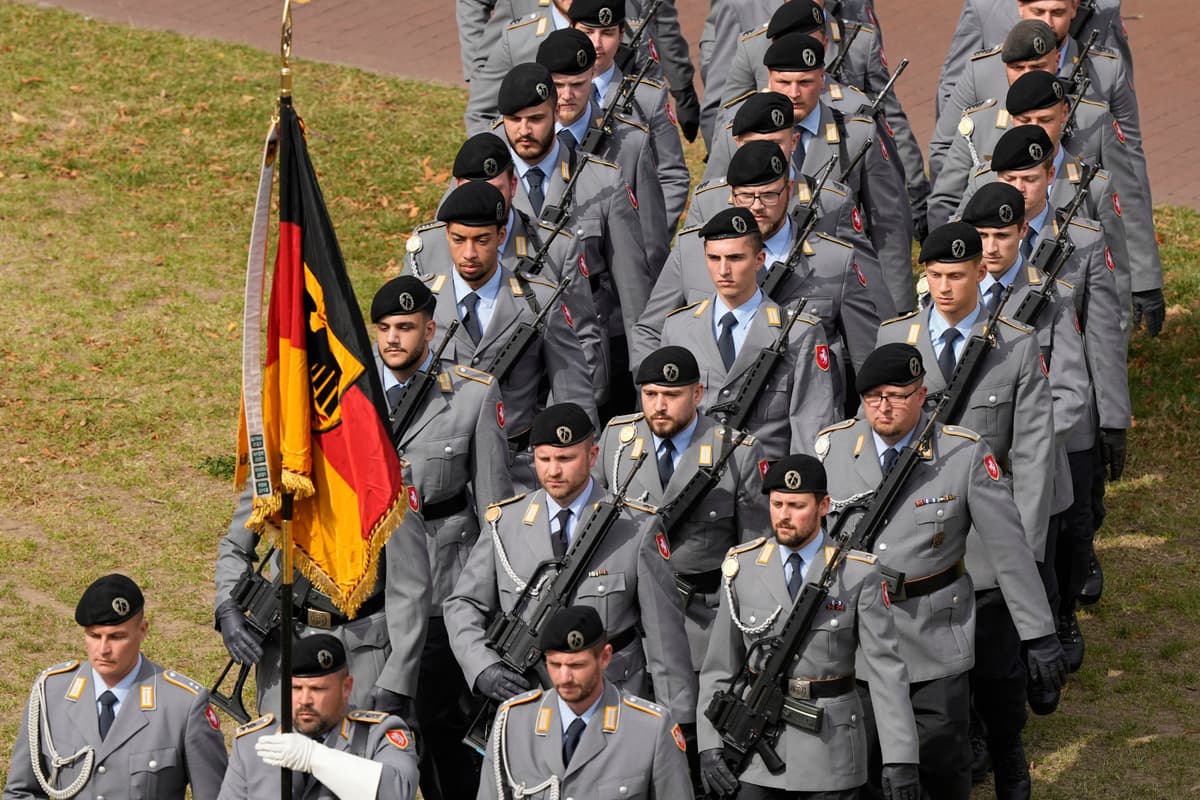
Germany is tripling its annual military spending to around $180 billion in 2029. On December 5, Germany’s parliament approved a new military service law that aims to boost Bundeswehr soldiers by nearly 50 percent, to 260,000, and to double reservists to 200,000. Starting next month, young men will have to register and undergo medical checks for a draft.
Next door, France plans to start in the next year a voluntary, paid military service for 18 and 19-year-olds. The goal is also to double reservists to 100,000 by 2030. Britain at present has 76,000 full-time soldiers, the smallest peacetime army since the Napoleonic wars of two centuries ago. Now Britain plans to invest in drones and other modern equipment to make its armed forces more lethal, if not larger.

Across the Channel, the Netherlands plans to increase its army personnel to 200,000, from 74,000 today. Closer to Russia, Poland launches a military training program this year. The goal is to train 400,000 civilians a year.
In Finland, a country which fought two major wars against Russia in the 20th century, a law goes into effect on Thursday raising the top age for reservists to 65 years, from 60. This is part of a plan to increase reservists by 15 percent, to 1 million within five years. With a population of only 5.6 million, Finland hopes to keep Russia at bay with mandatory male conscription and an active duty military of 280,000 soldiers.
Chancellor Friedrich Merz of Germany has emerged as the outspoken major leader in Europe on the Russian threat. At a recent Christian Social Union party conference, he compared Mr. Putin’s expansionism to that of Hitler: “Just as the Sudetenland was not enough in 1938, Putin will not stop.”