
Exclusive: Alvin Bragg Fires Back at Trump’s Move To Get Stormy Daniels Hush Money Appeal Moved to Less Hostile Federal Court
The Manhattan district attorney makes his case for keeping the prosecution of the 47th president in the Empire State.
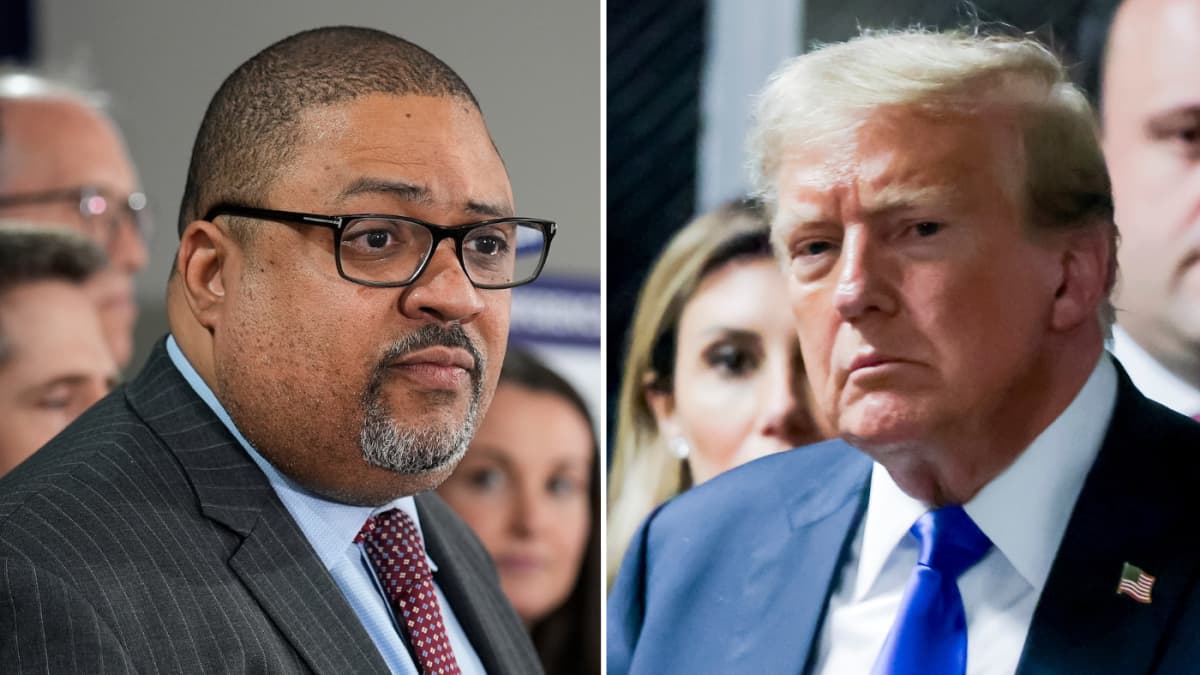
The district attorney of New York County, Alvin Bragg, wants his signature legal victory — hush money case against President Trump to stay in state court. The Democratic-dominated venue is where he secured 34 convictions of the 47th presidents for payments made to an adult film performer.
That is the upshot of a brief — the contents of which have not been reported — that Mr. Bragg filed on Wednesday to a federal district court judge of the Southern District of New York, Alvin Hellerstein, who is weighing whether to grant Mr. Trump’s request to move the case to federal court, a forum less hostile to the president. Judge Hellerstein, 92, is also presiding over the prosecution of the deposed president of Venezuela, Nicolás Maduro.
Judge Hellerstein ruled in 2023 that the case belonged in state court because “Reimbursing Cohen” — Mr. Trump’s erstwhile lawyer who handled the payments — “for advancing hush money to Stephanie Clifford cannot be considered the performance of a constitutional duty.” The presiding trial judge, Juan Merchan, also ruled that the case touched solely on “private acts.”
A panel of three judges from the Second United States Appeals Circuit ordered Judge Hellerstein to revisit the issue because he “did not consider whether certain evidence admitted during the state court trial relates to immunized official acts or, if so, whether evidentiary immunity transformed the state’s case into one that relates to acts under color of the presidency.” The appellate court made clear that it was not yet weighing in on the merits of Mr. Trump’s push to move the case to federal court.
Now Mr. Bragg writes that “Time has not improved” Mr. Trump’s “arguments. This Court already found no good cause for the defendant to remove this case a second time. It should reach the same conclusion again.” The prosecutor cites the president’s “lack of reasonable diligence and the extremely late stage of this criminal proceeding” as marshalling against a move to federal court.
Mr. Bragg also contends that “as a matter of state law, the criminal action here terminated with the defendant’s sentencing nearly a year ago. Removal at this late stage would disrupt a pending state-court appeal and introduce numerous logistical complexities that would be a barrier to merits review of defendant’s appellate claims.” Judge Merchan, in the days before Mr. Trump swore the oath of office for a second time, sentenced him to an “unconditional discharge” — meaning no further punishment, although the stigma of a felony conviction remains.
Mr. Trump has appealed those 34 convictions to New York state’s intermediate appellate court. The president contends that his convictions ought to be voided by the Supreme Court’s immunity ruling in Trump v. United States that official presidential acts are presumptively immune from prosecution. That appeal is separate from this petition in the SDNY to gain a hearing in federal court.
In Mr. Trump’s state appeal he argues that Judge Merchan’s jury instructions were unconstitutional. The judge instructed that to convict Mr. Trump of a felony, the jurors need only agree that he falsified business records in the service of a second crime, without needing to agree on what the second crime was. Mr. Bragg argues that the “state appellate courts—and ultimately the Supreme Court—are perfectly capable of adjudicating” Mr. Trump’s claims on appeal.
Mr. Bragg, a Democrat who resoundingly won reelection in November, wants Judge Hellerstein to double down on his earlier ruling that “the state criminal charges were based on entirely private conduct rather than any acts under color of the Presidency.” The removal statute allows for a move to a federal forum if a defendant can show that he was “acting within the scope of their official duties or with actual or apparent legal authority related to their office.”
The Library of Congress explains that the recourse of removal “seeks to provide a neutral federal forum to preserve the supremacy of federal law and prevent federal officers and their agents from being improperly sued or punished when they attempt to perform their duties.” Mr. Trump argues that his prosecution in ultramarine Manhattan – where he only got 22 percent of the vote in 2020 – was politically motivated and precisely the kind of action removal was intended to guard against.
The Second Circuit chose to “leave it to the able and experienced District Judge to decide whether to solicit further briefing from the parties or hold a hearing to help resolve these issues. We express no view and ‘neither rule nor imply’ that the District Court should resolve Trump’s motion … in any particular way.” Still, the order that Judge Hellerstein take another look suggests that the appellate court considered his initial inquiry insufficient.
Mr. Trump’s case for moving to federal court is due on January 21, with oral arguments scheduled for February 4.