
Feud Erupts Over Who Will Pay Trump’s Legal Fees in Fani Willis Prosecution: Can Taxpayers Fend off $17 Million Bill?
Georgia mounts a challenge to a statute that appears to provide for reimbursement in the event of a district attorney’s disqualification.
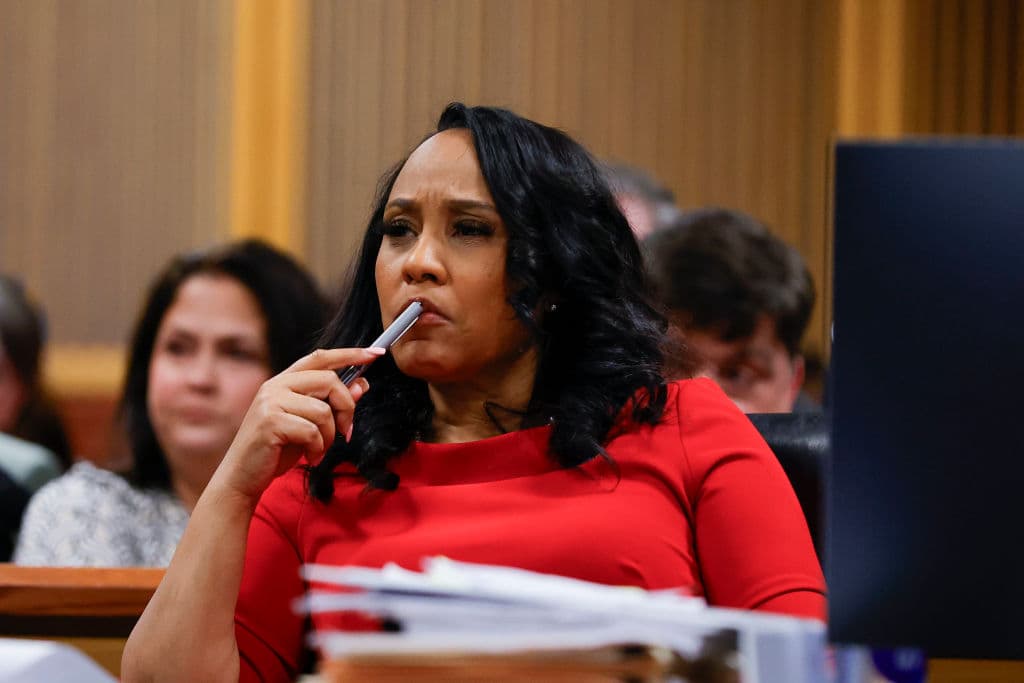
A battle is brewing over who should pay the tens of millions of dollars in legal fees racked up by the defendants in the criminal racketeering case brought against President Trump and 18 others by the district attorney of Fulton County, Fani Willis.
A new filing by the state of Georgia argues that the defendants’ — which include Mr. Trump, Chief of Staff Mark Meadows, and Mayor Rudolph Giuliani — demand for $17 million rests on constitutionally shaky ground, even after Peach State lawmakers passed a bill that seems to mandate that counties pay defendants’ bills when a prosecutor is disqualified.
The election interference case was dismissed after the Georgia Supreme Court left intact an appellate ruling that disqualified Ms. Willis from the case on the basis of her secret romance with her handpicked special prosecutor, Nathan Wade. The Georgia Court of Appeals found this the “rare case in which disqualification is mandated and no other remedy will suffice to restore public confidence in the integrity of these proceedings.”
While Mr. Wade was employed by Ms. Willis the two took vacations together to destinations like Napa Valley, Belize, and Aruba. Ms. Willis testified that Mr. Wade paid for those trips and she paid him back in cash. The two denied under oath that they began dating before he was hired, but evidence adduced by the defendants appears to show that they exchanged thousands of text messages and phone calls.
In recent months the two have been spotted together at LAX and during the roadside arrest of Ms. Willis’s daughter. Ms. Willis was reelected in a landslide in 2024. Mr. Wade has declared on television that workplace affairs are “as American as apple pie.”
After the disqualification ruling Georgia lawmakers passed a law that mandated compensation from counties for attorneys’ fees and other legal costs in criminal cases in which a district attorney has been disqualified if the case gets dismissed — circumstances that appear to match Ms. Willis’s. A trial court judge, Scott McAfee, found that her behavior emitted an “odor of mendacity.”
Ms. Willis’s office — meaning Fulton County taxpayers — paid Mr. Wade some $700,000 despite never having prosecuted a felony. Now they could be on the hook for a lot more. Georgia Prosecuting Attorneys’ Council Executive Director Peter Skandalakis, who replaced Ms. Willis — he could find no one else who wanted to assume her case, so he took it on himself — noted in a court filing on Wednesday that Mr. Trump alone is seeking some $6 million in fees, and that the defendants as a group want to be reimbursed to the tune of $17 million.
The Peach State law grants defendants “all reasonable attorney’s fees and costs incurred” in a case that resulted in disqualification and dismissal, and assigns to the trial judge the task of adjudicating the award. Mr. Skandalakis, though, writes in his filing that the law awarding fees could be fatally marred by “serious and potentially unconstitutional deficiencies,” notably an absence of sufficient due process protections for the counties required to pay.
Mr. Skandalakis, a Republican who dismissed the case, writes on Georgia’s behalf that the law “is probably unconstitutional because it leaves county governments — entities that are politically and practically separate from the elected District Attorney — responsible for paying costs that do not involve them, without any legal recourse to contest that responsibility.” The law also does not define a “reasonable hourly rate,” which can range widely
A different position is taken by Mr. Trump’s attorney in the case, Steven Sadow, who declares in a statement that “Mr. Skandalakis’ contentions are simply wrong.” Mr. Skandalakis also observes that the law requires a disqualification “due to improper conduct.” Georgia courts, though, ruled only that Ms. Willis’s conduct with Mr. Wade generated a “significant appearance of impropriety.” Mr. Skandalakis writes that in order to square that circle a judge “must find an appearance is the same as a completed act.”
The reimbursement law mandates that “Judges shall not investigate facts in a pending proceeding or impending matter independently, and in making adjudicative decisions shall consider only the evidence presented and any facts that may properly be judicially noticed.” Mr. Skandalakis argues that the “court would be required to make a decision based solely on the information provided by the lawyers” — meaning without input from Georgia.
Mr. Skandalakis argues that “Notions of due process found in the Georgia and Federal Constitutions afford all parties in a case notice of proceedings and the opportunity to be heard.” He acknowledges, though, that Georgia’s Supreme Court has held that “the State is not entitled to due process under the Fifth and Fourteenth Amendments to the United States Constitution.” Nevertheless, he contends that the state is owed the opportunity to “file a responsive pleading to any motion made for attorneys’ fees and costs.”
Mr. Skandalakis protests that “there is no requirement that the county government be given notice that attorney fees and litigation costs might be awarded in a given case. It will simply receive a bill out of the blue, with no opportunity to be heard and no recourse to avoid paying it.” This mechanism, the veteran district attorney writes, is “likely unconstitutional on its face.”