From ‘Alien’ to ‘Barbarella,’ MOMA Retrospective Showcases Special Effects Wizard’s Career

Should you have a hankering for kitsch long past its sell-by date, this is the place to be.
Via Park Circus
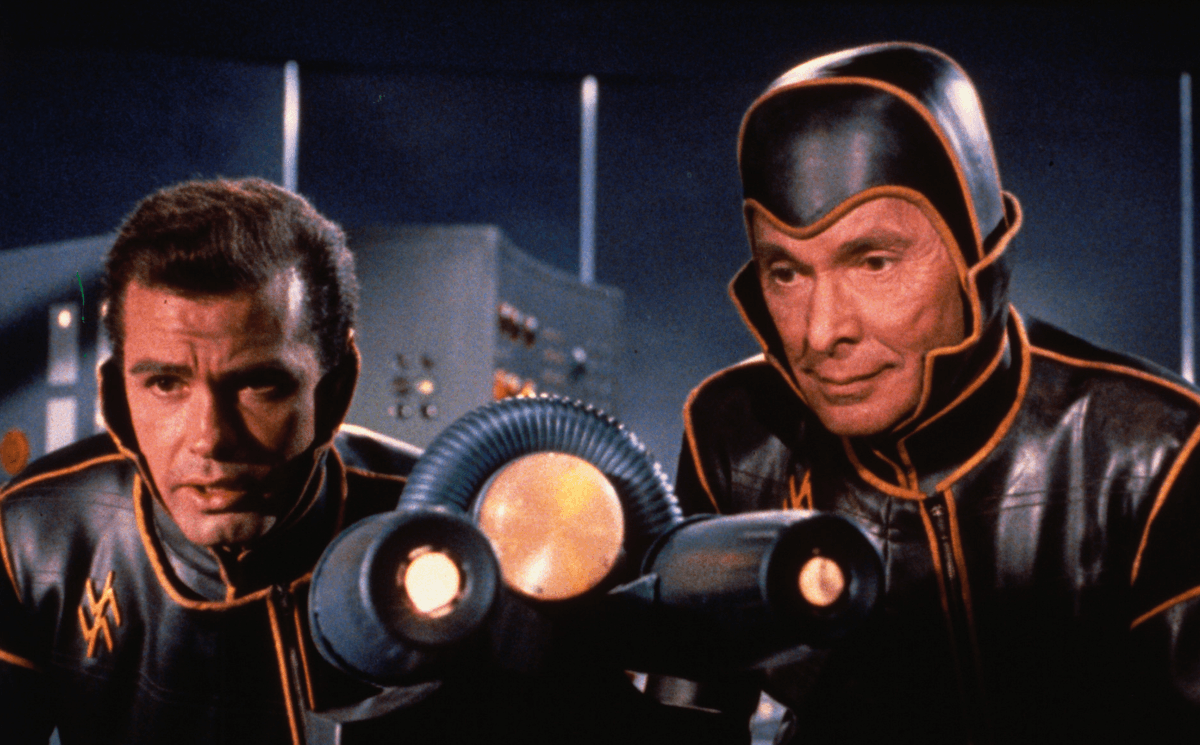
Angel Aranda and Barry Sullivan in ‘Planet of the Vampires’ (1965). Via Park Circus

The Museum of Modern Art, in collaboration with Cinecittà Studios in Rome, has organized a retrospective of films dedicated to “the man who made creatures,” Carlos Rambaldi (1925-2012). MOMA curator Rajendra Roy, with the assistance of the writer, director and programmer, Franciso Valente, has assembled 15 films that highlight the work of a three-time Oscar-winning special effects craftsman.

And a curious array of pictures it is. Rambaldi took home the gold statuettes for John Guillerman’s “King Kong” (1976), Ridley Scott’s “Alien” (1979), and Stephen Spielberg’s “E.T. the Extraterrestrial” (1982). He also worked on Mr. Spielberg’s “Close Encounters of the Third Kind” (1977), David Lynch’s doomed and disowned “Dune” (1984), and crafted what MOMA describes as an “unforgettable, scatological mechanical devil” for Pier Paolo Pasolini’s “The Canterbury Tales” (1972).

Reputable properties, more or less, but Rambaldi was an equal opportunity confabulator and had his hand in less highfalutin fare. Men of a certain age can thank him for making the plexiglass space suit worn by Jane Fonda in Roger Vadim’s “Barbarella” (1968). Though he didn’t adorn Monica Vitti in Joseph Losey’s “Modesty Blaise” (1966), Rambaldi added his talents to a movie our curators charitably extol for its “oddball spirit.” Should you have a hankering for kitsch long past its sell-by date, MOMA is the place to be. 

Why  Mssrs. Roy and Valente chose not to include Lucio Fulci’s “A Lizard in a Woman’s Skin” (1971) is a mystery, particularly given that the controversies it generated put Rambaldi’s skills into high relief. Not soon after the movie’s release, Fulci was charged with animal cruelty because of a scene that included dogs undergoing dubious scientific procedures. Fulci pleaded innocent, and Rambaldi wheeled the mechanical animals into court to demonstrate as much. Quite a feat, and now part of Italian legal standing.

Jane Fonda in ‘Barbarella’ (1968). Via Paramount Pictures

Science fiction buffs may raise their eyebrows at the inclusion of “Alien” and Mario Bava’s “Planet of the Vampires” (1965). Rambaldi’s contributions to the films aren’t the only commonality: the similarities between them have long been the subject of scuttlebutt amongst genre fans. They’re wildly different in quality and, not coincidentally, budget. Still, the storylines and settings could make the average cinema-goer scratch his head in puzzlement: Just how much did Mr. Scott and scriptwriter Dan Bannon poach from the Bava picture?

Captain Mark Markary (veteran character actor Barry Sullivan) is at the helm of the Argos when distress signals are received from a spaceship stranded on an uncharted planet. Deciding to investigate, Markary and his crew enter its orbit and, after a difficult landing, are subsequently transformed into homicidal maniacs. 

All and sundry recover from the transformation, but the same can’t be said of its sister ship, the Galliott: its members are dead, having presumably murdered each other. A decent burial doesn’t preclude them rising from their makeshift graves and pestering our heroes. All the while, a steady fog rolls in, the remnants of a past civilization are encountered, and a lurid range of colors permeate the surroundings.

Rambaldi’s contributions to Bava’s low-budget creature feature include miniatures used for spaceships, oversized fossils of alien creatures, and a planet whose bubbling, hothouse surfaces were created by hidden pots of polenta cooking on the boil. 

“Planet of the Vampires” is a stilted affair whose basic gist was improved upon by Mr. Scott with “Alien.” The latter remains an indelible monument of cinema, and a more rewarding place to sample the behind-the-scenes artistry of the man who was, pace Mr. Spielberg, “the biggest hero” of the films he worked on.


The New York Sun

© 2026 The New York Sun Company, LLC. All rights reserved.

Use of this site constitutes acceptance of our Terms of Use and Privacy Policy. The material on this site is protected by copyright law and may not be reproduced, distributed, transmitted, cached or otherwise used.

The New York Sun

Sign in or  create a free account

or
By continuing you agree to our Privacy Policy and Terms of Use