

Georgia Republicans Advance Plan To Eliminate State Income Tax by 2032

Democrats object, arguing the plan disproportionately favors the wealthy and jeopardizes education and healthcare funding.
Jeff Amy/AP
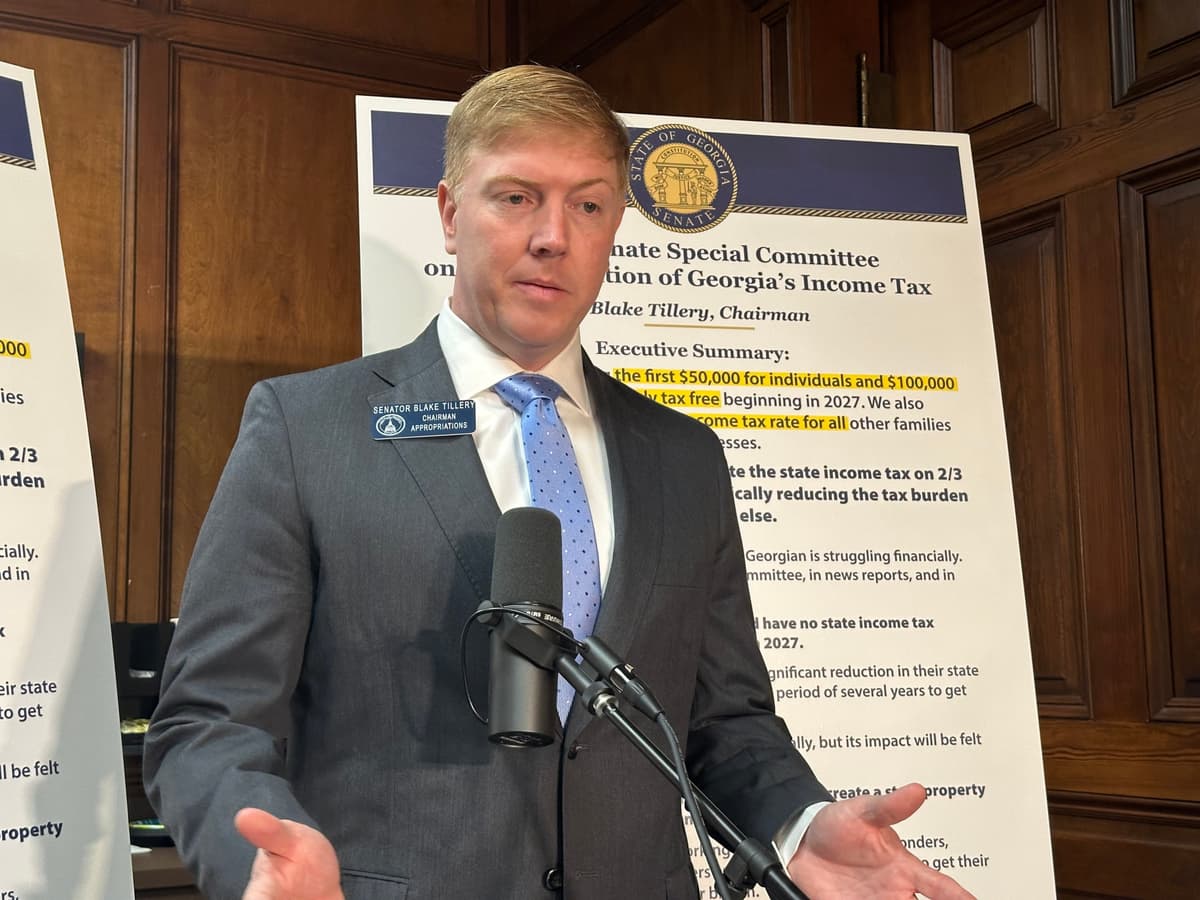
A Georgia state senator, Blake Tillery, speaks to reporters about a proposal to eliminate the state's personal income tax at Atlanta on January 7, 2026. Jeff Amy/AP

A special Georgia state Senate committee is advancing legislation to gradually reduce personal income tax to zero by 2032, a move that would fundamentally shift how the state generates revenue.

The proposal, which passed the committee on a 6-3 vote along party lines Wednesday, aims to eliminate the tax entirely over the next decade, with significant reductions planned for the near future. The committee specifically recommended that Georgia stop collecting personal income tax on the first $50,000 for individuals and the first $100,000 for joint filers starting in the 2027 tax year.

“We do believe that this is a fiscally sound, feasible plan that allows Georgia to keep up with its neighboring states but also provide immediate relief to Georgia taxpayers and hardworking families making less than $100,000 while giving a break to everyone,” said committee chairman Senator Blake Tillery, a Republican.

According to the committee, the threshold adjustment means two-thirds of working Georgians would not pay state income taxes starting in 2027. Republican leaders argue the move is necessary to help families struggling with inflation and to keep Georgia competitive with neighbors like Florida and Tennessee, which also do not tax state residents’ income.

Income tax currently accounts for roughly 44 percent to 47 percent of Georgia’s general revenue. The proposal includes safeguards, such as measures that would trigger reductions in income tax rates only if Georgia’s revenue reaches certain levels.

Current projections estimate that the first year of the proposal would cost the state $3 billion. Mr. Tillery outlined a funding strategy that involves using the state’s fiscal year 2025 budget surplus of  $1.8 billion and shifting capital expenditure funding strategies.

For the plan’s second year, Mr. Tillery proposed eliminating 10 percent of the state’s special interest tax credits to cover costs. He emphasized that the proposal does not include raising sales taxes or cutting public services.

The push to eliminate the income tax has been a central campaign promise for Lt. Gov. Burt Jones, who is pursuing a gubernatorial run.

“I look forward to building on the Committee’s valuable findings and commit to work with all members of the General Assembly on crafting a solution that responsibly delivers on my promise to let workers keep more of what they earn,” Mr. Jones told The Hill.

Democrats on the committee voiced strong opposition, arguing the plan disproportionately favors the wealthy and jeopardizes funding for essential services like healthcare and education. 

After the committee’s November meeting, Senators Ed Harbisonhe and Nan Orrock issued a statement criticizing the plan. “Republicans want to jack up taxes on the middle class to give rich people a massive handout. This handout will make raising a family, buying a house or running a business more expensive. Almost every Georgian would see their tax bill increase by a month’s worth of groceries,” they said.

“At the end of the day, they’re making the affordability crisis worse and saying they’re doing you a favor. Democrats on this committee are appalled by this wrongheaded, disastrous proposal.”.

If successful, Georgia would join a growing list of states moving away from income tax to attract residents and businesses. Currently, eight states have no personal income tax: Alaska, Florida, Nevada, New Hampshire, South Dakota, Tennessee, Texas, and Wyoming. Washington state also does not tax personal income, though it levies a capital gains tax.

Several other states are actively working to phase out their income taxes through conditional cuts and legislative triggers:

  • Mississippi: The “Build Up Mississippi Act” aims to cut the rate to 3 percent by 2030 and eliminate it by 2040, contingent on economic growth benchmarks.
  • Kentucky: A 2022 law established triggers to lower rates, with a reduction to 3.5 percent scheduled for 2026, though officials have expressed caution about fully reaching zero.
  • South Carolina: Lawmakers have enacted temporary rate reductions and are considering legislation to accelerate tax cuts contingent on revenue targets.
  • Iowa and Missouri: Both states have also set goals to abolish personal income tax in the coming years.


The New York Sun

© 2026 The New York Sun Company, LLC. All rights reserved.

Use of this site constitutes acceptance of our Terms of Use and Privacy Policy. The material on this site is protected by copyright law and may not be reproduced, distributed, transmitted, cached or otherwise used.

The New York Sun

Sign in or  create a free account

or
By continuing you agree to our Privacy Policy and Terms of Use