


IFC Center Spotlights ‘Cronos,’ Guillermo del Toro’s First Film, an Inconsistent Effort That Nevertheless Presaged Greatness

The movie has director’s indelible stamp — but is nowhere near as good as the movies that he’s subsequently put his name on.
Via the IFC Center
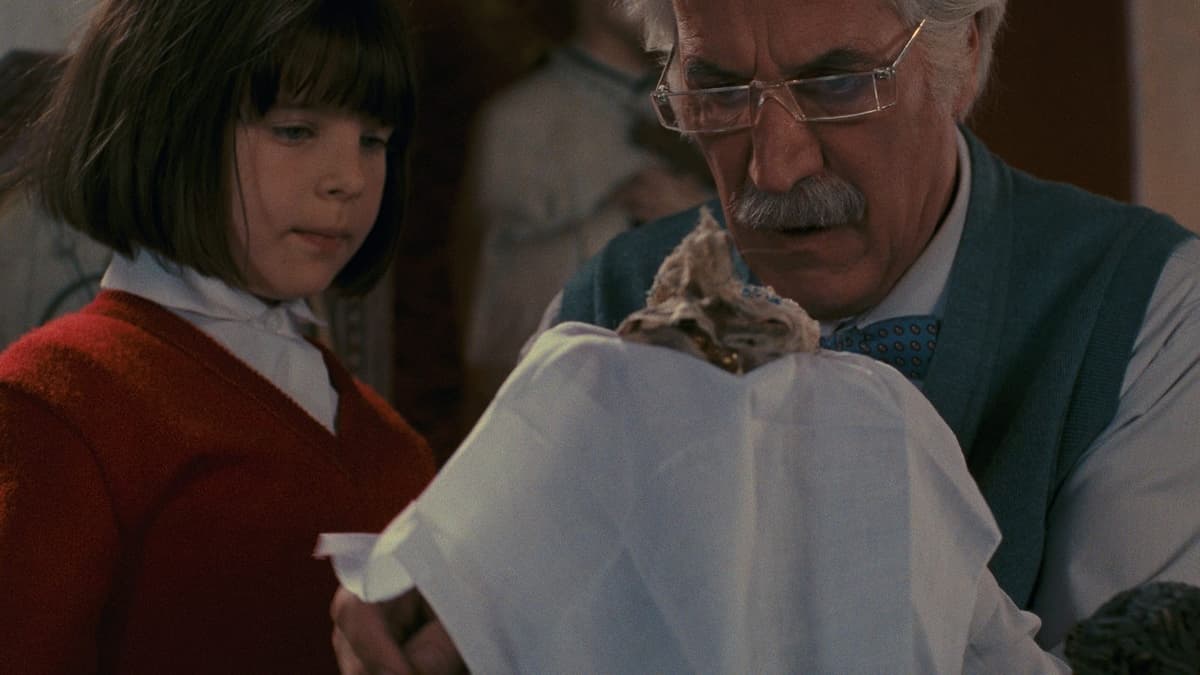
Tamara Shanath and Federico Luppi in 'Cronos,' 1992. Via the IFC Center

Among the curious fillips in “Cronos” (1992), the first feature film by a Mexican director, Guillermo del Toro, is a quiddity of character on the part of Angel de la Guardia (Ron Perlman). He’s ill-named, really, being a muscleman working for a wealthy uncle, the elderly and failing Dieter de la Guarda (Claudio Brook). Still, Angel has reservations about his nose. Thugs, too, can have issues with their self-esteem.

As Angel goes about doing dirty work for Tío Dieter, he’s not above asking the stray businessman or 8-year girl about what kind of amended nose would best suit his features. As divine comeuppance for Angel’s violent ways, his proboscis comes in for a fair share of battering during the run of “Cronos.” Mr. del Toro’s movies are nothing without a sense of humor. A dollop of comedy helps to mitigate the fantastic.

The IFC Center is hosting a revival of “Cronos” on the occasion of a 4K restoration, and on the heels of Mr. del Toro’s high-profile retelling of Mary Shelley’s “Frankenstein.” Hindsight being what it is, viewers can take an opportunity to see how consistent Mr. del Toro has been as a visionary, as well as to ascertain if he’s developed his skills as a filmmaker. There’s good news on both fronts: “Cronos” has the indelible del Toro stamp and is nowhere near as good as the movies that he’s subsequently put his name on.

Which isn’t to say that “Cronos” is a bad film. Like Mr. del Toro’s early masterwork, “Devil’s Backbone” (2001), and his arthouse breakout, “Pan’s Labyrinth” (2006), the picture pushes down hard on the mythic power of fairy tales and has, as its fulcrum, a child for whom love is stronger than fear. A sweeping strain of romanticism that typifies the director’s aesthetic is in plain evidence, not least in a color palette keyed to warm, earthy tones.

Federico Lippi in 'Cronos,' 1992.
Federico Lippi in ‘Cronos.’ Via the IFC Center

And, yes, there’s a monster on hand, a traditional bogey that’s been reconfigured for contemporary tastes. You’ll recall that Mr. del Toro riffed on Jack Arnold’s “The Creature From the Black Lagoon” (1954) for the Oscar-winning “The Shape of Water” (1917). Here, the legend of the vampire is given new fangs and, you’d best watch out because these fangs are sharp. 

In the picture’s preamble, we are told of a 16th-century alchemist who invented a tool that would provide its bearer with eternal life. This object is crafted from gold and modeled along the line of the scarab motif found in Egyptian reliquaries. The device fits neatly into the palm of a hand and contains gearwork whose intricacy would give pause to a Swiss watchmaker. At stray points in the film, Mr. del Toro takes us inside the mechanism and introduces us to the strange occupant within it, a diminutive creature that is part slug and part alien. It thrives on human blood.

Dieter de la Guardia knows about this device from the alchemist’s Leonardo-like notebooks in his possession. A kindly vendor in antiques, Jesús Gris (Federico Luppi), knows nothing about the “cronos” until a handful of suspicious characters start poking around his dusty Mexico City store. 

Up until then Gris, a Gepetto-like figure in physiognomy and mien, has had it pretty good, what with a patient wife (Margarita Isabel), a loving granddaughter (Tamara Shanath), and a business he clearly loves. When he discovers the mechanical whatzit inside of an effigy of the Virgin, things get interesting, life gets better, and, ultimately, everything goes awry. This is a horror movie, after all.

The first half of the film builds up nicely, laying out its mysteries to handsome effect. Our elderly hero is more naif than villain, and his gradual descent into vampirism is less indicative of evil than addiction. The second half of the film, and, especially, its conclusion, are less inventive, what with the egregious fisticuffs and by-the-book turnabouts in character. 

Javier Álvarez’s overbearing soundtrack doesn’t help, favoring, as it does, schmaltz over mystery. That Mr. del Toro let it dominate the proceedings counts, I think, as a rookie’s mistake. Consider “Cronos” a first step to greater things and allow for the requisite handicapping when deciding whether a trip to The IFC Center is in the cards.


The New York Sun

© 2026 The New York Sun Company, LLC. All rights reserved.

Use of this site constitutes acceptance of our Terms of Use and Privacy Policy. The material on this site is protected by copyright law and may not be reproduced, distributed, transmitted, cached or otherwise used.

The New York Sun

Sign in or  create a free account

or
By continuing you agree to our Privacy Policy and Terms of Use