Inside Venezuela After Maduro’s Fall: Fear, Armed Gangs, and an Uncertain Future

On the ground, as the shock and awe wear off, the reality for ordinary citizens is still bleak.
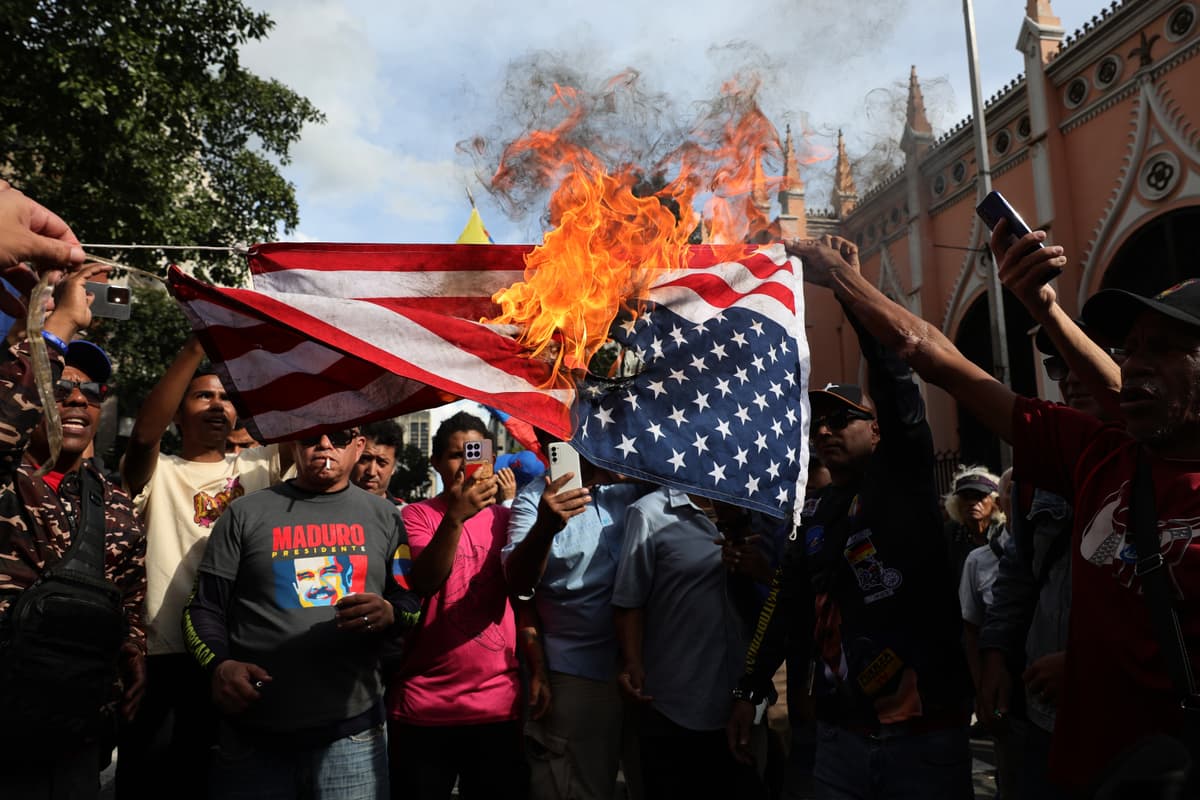
Jesus Vargas/Getty Images
Supporters of Nicolas Maduro burn a United States flag during a gathering near Miraflores palace at Caracas, Venezuela. Jesus Vargas/Getty Images

Days after the American military operation that seized Venezuelan dictator Maduro, the South American nation is still gripped by uncertainty and fear as a hardline regime loyalist takes power. Armed gangs terrorize neighborhoods, and Caracas is under heavy Maduro-regime surveillance.

Vice President Delcy Rodríguez was formally sworn in as acting president on Monday in a ceremony revealing deep geopolitical fault lines. The ambassadors of China, Russia, and Iran were first to congratulate Ms. Rodríguez, with China’s ambassador Lan Hu offering a highly-publicized embrace, followed by Russian Ambassador Sergey Melik-Bagdasarov and Iran’s Ambassador Ali Chegini. 

The three diplomats stood together during the ceremony, a stark reminder that despite American military dominance, Venezuela’s traditional allies are not ceding influence.

Ms. Rodríguez condemned what she called “an illegitimate military aggression” by Washington, and demanded Mr. Maduro’s release, declaring, “I come with sorrow for the suffering inflicted upon the Venezuelan people following an illegitimate military aggression against our homeland,” as she took the oath.

On the ground, as the shock and awe wear off, the reality for ordinary citizens is still bleak.

Streets of Fear and Armed Control

A Venezuelan source who requested to be identified only as Miguel for safety reasons describes a capital under heavy surveillance. 

“It seems there is a lot of surveillance in Altamira’s France Square — they are preventing any possible riot,” Miguel, an academic, tells The New York Sun, expressing worry about Ms. Rodríguez’s appointment as “an unexpected outcome and very hard to digest.”

Miguel notes armed gangs continue operating in even greater numbers and fears things will worsen under the Rodriguez regime. 

“People are avoiding speaking about (what happened) and trying to make life as normal as possible,” Miguel continues. “But people don’t believe that anything has changed with what happened last weekend — the extraction of the regime wasn’t completed.”

The colectivos are a critical variable. These far-left paramilitary groups have long served as the enforcement arm of the Chavista government. Even if the colectivos do not fight to defend Mr. Maduro, it’s hardly likely that they will evaporate anytime soon. These groups have fused political activism with criminal enterprise, establishing themselves as de facto authorities in neighborhoods across Venezuela.

“This isn’t the change we wanted, at least not yet,” a Caracas-based university student who asked to be identified only as Maria, tells the Sun. “People don’t want to leave their homes. The regime is still in control, and they are even more skeptical now.”

While anxiety continues to shape daily life in the capital, United States intelligence officials had reached a far more cold-eyed conclusion about where power actually lay.

The CIA’s Calculated Gambit

A classified CIA assessment briefed to President Trump concluded that senior Maduro loyalists, including Ms. Rodríguez, were better positioned to maintain stability than opposition leader María Corina Machado. The intelligence analysis determined that Ms. Rodríguez and other regime officials had military and elite support, while opposition representatives lacked the necessary institutional backing.

Mr. Trump dismissed Ms. Machado, the Nobel Peace Prize winner, whom many believed would lead Venezuela toward democracy. 

“I think it would be very tough for her to be the leader if she doesn’t have the support within, or the respect within the country,” Trump said in the hours after Mr. Maduro’s capture. 

Former American diplomats who served in Venezuela have noted the administration’s pragmatic approach prioritizes maintaining order over democratic transition. The essential structure of the Mr. Maduro government remains intact, with the same officials overseeing oil operations, police forces, and military command as before the weekend raid.

The operation that led to Maduro’s capture represented months of meticulous CIA work. The agency covertly installed a small team inside Venezuela in August, tracking Maduro’s patterns and movements. The assets included a CIA source operating within the Venezuelan government who assisted with tracking Maduro’s location ahead of his capture.

Multiple spy offices provided intelligence to the Special Operations Command. At the same time, the National Security Agency oversaw geolocation support and the United States Cyber Command participated in activities that helped shut down Venezuelan defense systems and power infrastructure.

Chairman of the Joint Chiefs of Staff, General Dan Caine, revealed the intelligence allowed tracking Maduro’s movements, dietary habits, and even his pets. This precision proved decisive when Delta Force operators descended on Fort Tiuna, successfully extracting Maduro and his wife before they could reach a reinforced safe room.

An Uncertain Path Forward

The decision to work through Mr. Maduro’s lieutenants, however, has drawn criticism across the board. Senator Tom Cotton, chairman of the Senate Intelligence Committee, acknowledged the uncomfortable reality. 

“We don’t recognize Delcy Rodriguez as the legitimate ruler of Venezuela,” Mr. Cotton said. “They have control over the military and security services. We have to deal with that fact. That does not make them a legitimate leader.”

The European Union also does not recognize Rodríguez’s legitimacy. Meanwhile, Ms. Machado has vowed to return to Venezuela and sharply criticized Ms. Rodríguez as “one of the main architects of torture, persecution, corruption, narco trafficking” and “the main ally and liaison with Russia, China, Iran.”

While a source close to the White House tells the Sun that there is confidence elections will take place in 2026, Mr. Trump has indicated that elections are not imminent. 

“We have to fix the country first. You can’t have an election,” Trump told reporters.

However, as Venezuela enters this uncertain chapter, the American military operation has yet to produce a clear political endgame. The democratic opposition is sidelined, armed gangs continue operating, and ordinary Venezuelans face an acting president who presided over repressive policies they hoped to escape.

“Right now, we don’t have a reason to celebrate,” Miguel added. 


The New York Sun

© 2026 The New York Sun Company, LLC. All rights reserved.

Use of this site constitutes acceptance of our Terms of Use and Privacy Policy. The material on this site is protected by copyright law and may not be reproduced, distributed, transmitted, cached or otherwise used.

The New York Sun

Sign in or  create a free account

or
By continuing you agree to our Privacy Policy and Terms of Use