
It Took a Year for Khomeini To Capture Tehran in 1979

The revolt against the Iranian regime appears to be far from over.
Keystone/Getty Images
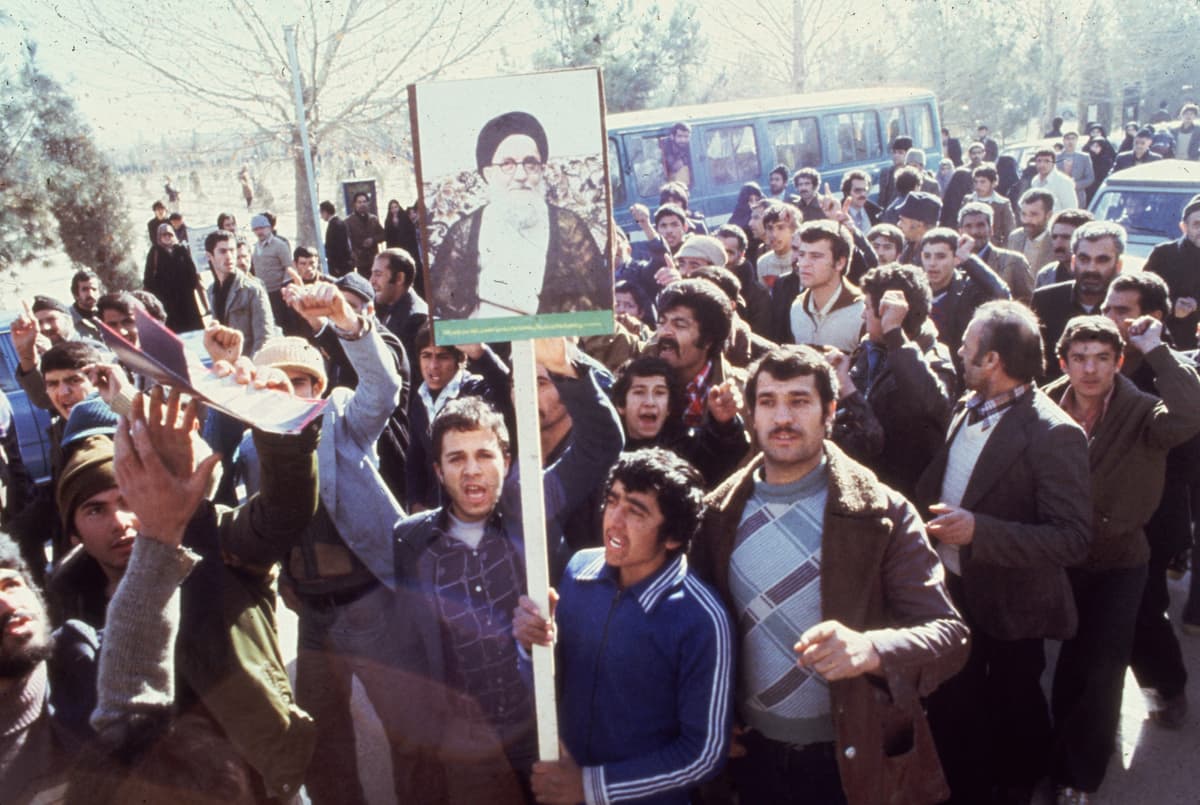
In 1979, demonstrators at Tehran call for the replacement of the Shah of Iran. Keystone/Getty Images

“The revolution will not be televised,” was the title of Gil Scott-Heron’s 1970s poem. While “not” has been omitted in popular culture, Islamic Republic thugs have opted for the original. Hiding bloody street scenes and piles of dead Iranian from the world’s cameras enables the mullahs to claim victory over Iranians seeking liberty. This is a moment to remember that it took a long year of unrest before Ayatollah Khomeini captured Tehran in 1979.

This year’s revolt against the Khomeinists is also far from over. Enforcers may have managed to apply a Band-Aid to the regime’s malignancy. Yet the “fundamentals of what ails Iran have not changed,” the policy director at United Against Nuclear Iran, Jason Brodsky, tells our Benny Avni. The ayatollahs are bad at governing. An ever-inflating rial is worthless. Water and electricity supplies are sporadic at best. Banks have collapsed. Is any of this fixable?

The latest protest movement started as a reaction to the regime’s incompetence. It is carried on, though, by people who were born into the Islamist revolution. They are sick and tired of being told how to live. The regime’s enforced religiosity has turned them into avowed secularists. Rather than chanting “death to America, death to Israel,” they are yearning for a society that would emulate those countries. Is it worth America’s while to help them?

“I hope there’s a diplomatic resolution,” special envoy Steven Witkoff says. President Trump insists that no one convinced him to cancel a planned strike on Wednesday. Rather, he said Friday, the mullahs’ cancellation of a scheduled 800 hangings “had a big impact” on his decision. The president struck similar conciliatory notes before striking Iran’s nuclear sites in June and again on the eve of snatching Nicolas Maduro from Caracas. 

As is often the case with the mullahs, cancelling planned hangings could be a temporary measure. Reports from Iran detail unspeakable torture at Evin and other prisons, where criminals were released to make room for anti-regime rebels. Also tortured are families of victims who were killed on Iranian streets. To retrieve bodies of their loved ones, relatives are reportedly forced to pay up to $5,000 — allegedly the cost of the bullets that killed them. 

Not all revolutions ended up as well as ours did. Bolsheviks, for one, gave the word a bad name. Throwing the mullahs out, though, could transform the Mideast and weaken Communist China by denying it discounted Iranian oil. Ending the Iranian people’s nightmare is worthwhile. Then, too, the regime is posting images of the shot that grazed Mr. Trump’s ear in 2024, vowing, “this time it won’t miss.” This is in their DNA, and won’t be negotiated away.


The New York Sun

© 2026 The New York Sun Company, LLC. All rights reserved.

Use of this site constitutes acceptance of our Terms of Use and Privacy Policy. The material on this site is protected by copyright law and may not be reproduced, distributed, transmitted, cached or otherwise used.

The New York Sun

Sign in or  create a free account

or
By continuing you agree to our Privacy Policy and Terms of Use