
Life Story of Four Sisters Tracks Early Decades of Film History
A biography of the Lane sisters recalls their roles in dramas, musicals, westerns, and gangster pictures alongside the likes of Dick Powell and Cary Grant.
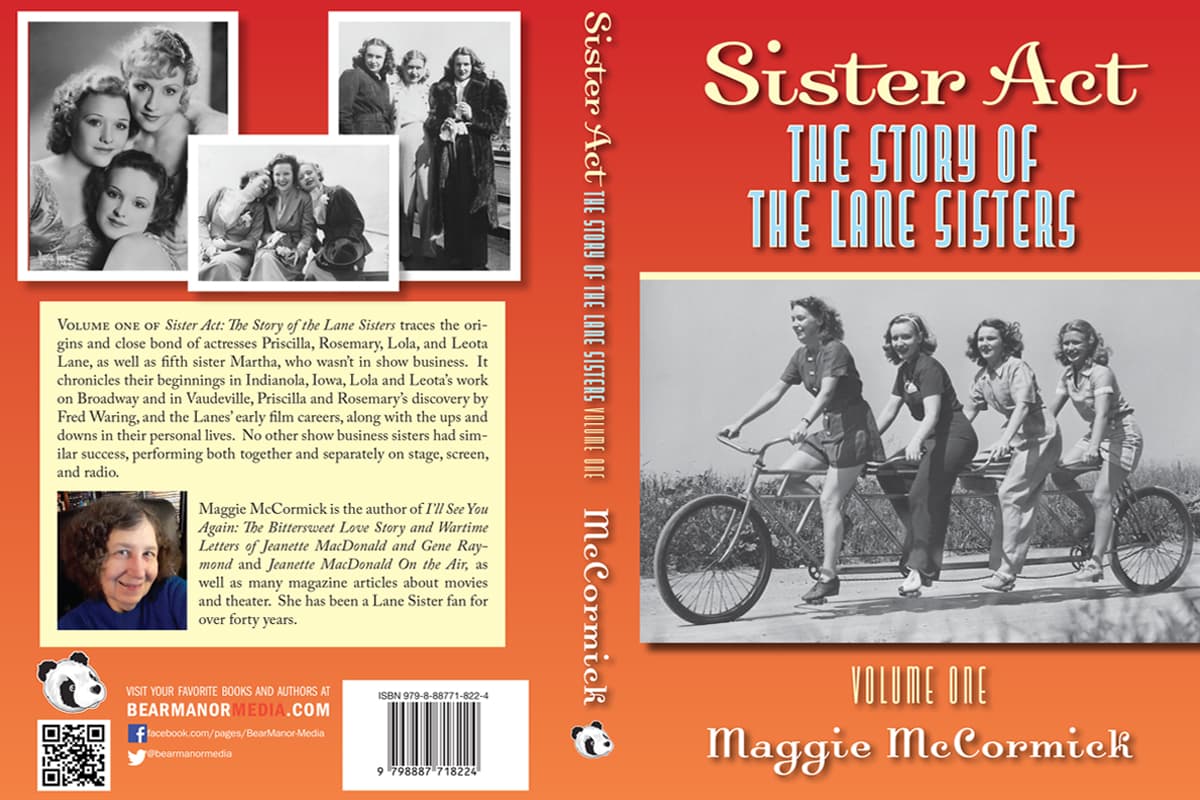
‘Sister Act: The Story of the Lane Sisters,” Volumes One and Two
By Maggie McCormick
BearManor Media, 460 pages, 346 pages
“Outside of the Barrymores, we do not know of another family in which talent runs so much in bunches,” Damon Runyon wrote in 1939 about Lola, Leota, Rosemary, and Priscilla. Movie buffs can still watch Priscilla (the best known sister) in films such as “Arsenic and Old Lace,” “Saboteur,” and “The Roaring Twenties,” on TCM, DVD, and YouTube.
The covers of Maggie McCormick’s two volumes — showing the sisters all on a quad tandem bicycle in full force (volume one) and then taking a spill (volume two) — forecast what happened to the sister act, from its early promise and energy to the post World War II years when the act crashed, so to speak. Each sister carried on nevertheless: Priscilla remained active in movies, Rosemary on Broadway, Lola involved in charity work, and Leota appearing in light opera and other musical shows.
Ms. McCormick’s group biography is the product of more than three decades of research piecing together information from many sources, including members of the Lane family who cooperated with the biographer and online sites that provided the impetus to complete the work. The result is the recovery of valuable film history and the family dynamics that brought the sisters together and then broke them up.
Ms. McCormick’s magazine cover appendix shows their worldwide appeal. They faded from popular memory after the 1940s as they retired. Look for the Lane sisters and you will see them featured in dramas, musicals, film noir, westerns, and gangster pictures — all in the family, you might say, which got its start in Indianola, Iowa. The photographs alone are to be treasured, beginning with formal, even stilted shots of the kind commonly taken in the turn of the 20th century Midwest and that make this book of importance to social historians.
The sisters seem ready for the camera in an early shot in which three of them appear on a ladder, self-composed for the annual August 1920 Junior Chautauqua in Indianola: “The church-oriented event included concerts, lectures, and poetry readings and was meant to educate, as well as entertain,” explains Ms. McCormick. Side-by-side childhood photographs of Rosemary and Priscilla are extraordinary. Rosemary looks directly at the camera with arms folded and looking quite self-confident, while Priscilla looks just as composed in a thoughtful pose as though thinking about her next move. Above the photograph Ms. McCormick comments: “Priscilla looked up to Rosemary” and made “all of her friends buy tickets” to the play Rosemary was acting in.
Later on, an amusing publicity shot has Lola and Leota in little-girl frocks perched with ropes around the arms of a gigantic looking wicker chair as though out for a ride. Stills from early sound films capture the sensationalism of Lola’s appearances in “Speakeasy,” “Fox Movietone Follies of 1929,” “The Girl from Havana,” “Let’s Go Places,” and “Three Hollywood Girls” starring Leota.
The focus then shifts to Priscilla in a fetching photograph from the early 1920s, posed gracefully next to a potted fern and already poised for a dance recital even as Rosemary begins her singing career on radio and in the theater, becoming pictured with famous dance bands like Fred Waring’s and with her first leading man, Dick Powell. By the mid 1940s Rosemary’s career was coming to an end as Priscilla’s picked up, putting her alongside several stars in Frank Capra’s direction of “Arsenic and Old Lace.” Volume 2 includes a wonderful shot of Priscilla kicking Cary Grant. She was the sister who had the longest lasting career in film.
Over the course of two volumes we see all the Lanes getting married, divorced, retiring and, in Priscilla’s case, making a comeback, featured in many stories about Hollywood history. Through the photographs alone you can see how the sisters aged and parted from one another and regrouped in a family saga that seems for all the glamour and glitz of their careers somehow fundamentally Midwestern. In the concluding chapter of volume 2, Rosemary is quoted in an epigraph, dated November 27, 1940: “We Lanes are all going to retire to a farm some day, eat everything we love and avoid, and grow comfortably fat.”
Mr. Rollyson has authored biographies of Marilyn Monroe, Dana Andrews, Walter Brennan, Ronald Colman, and the forthcoming “Our Eve Arden.”