
Major Questions Loom Over Future of Venezuela as It Enters a Post-Maduro Era

The operation had been planned since early December, with the U.S. government waiting for the right moment to execute. 
Ariana Cubillos/AP
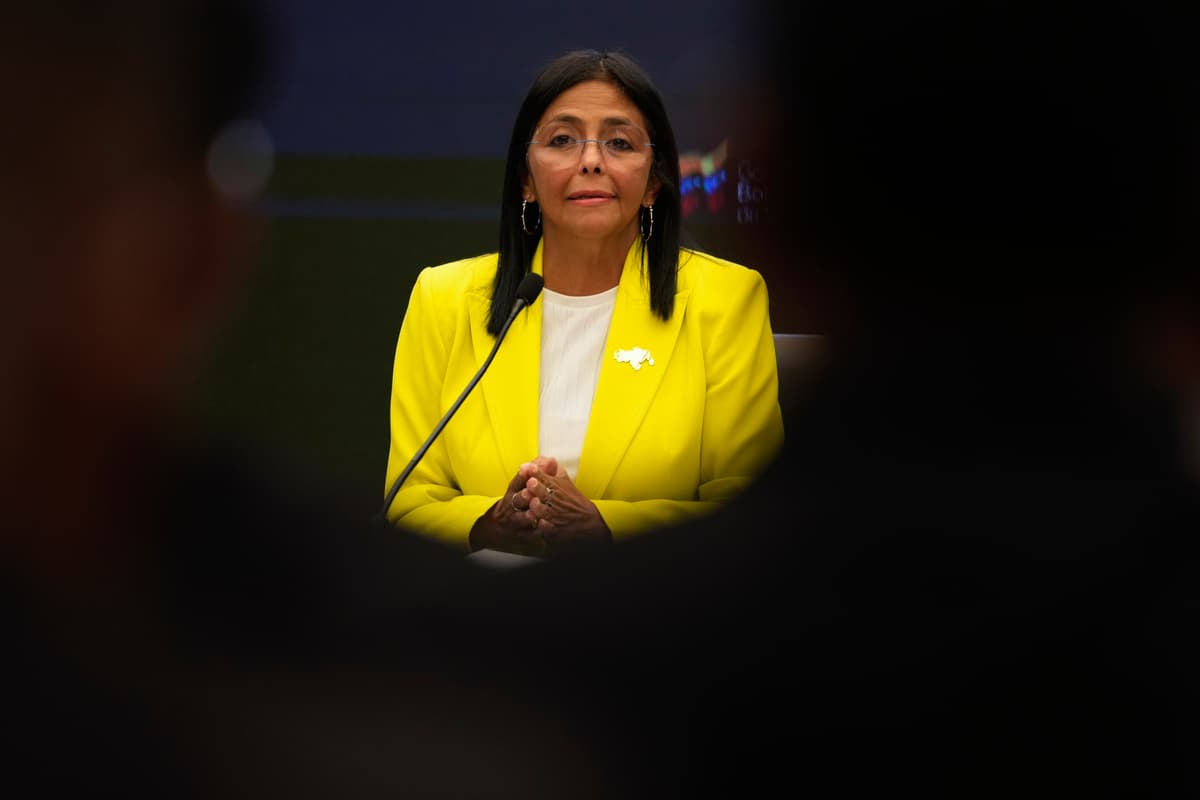
Delcy Rodriguez, sworn in Saturday to succeed Nicolás Maduro as president of Venezuela, holds a press conference at Caracas on March 10, 2025. Ariana Cubillos/AP

The images flooding social media from Venezuela’s capital tell two strikingly different stories: In some Caracas neighborhoods, thousands pour into the streets in jubilant celebration, waving flags and embracing strangers; but mere blocks away, storefronts are shuttered, the streets eerily quiet, residents watching and waiting.

“The streets are very calm in the zone I’m established in at the moment. Almost every store is closed, except a gas station full of cars,” a busy grocery store and pharmacies with long lines, a 30-year-old education professional in Caracas, Miguel Mendoza, told the New York Sun. 

“It’s hard to know if the regime will fall fast. People are being discreet right now. I’m feeling strange right now, still digesting what is happening.”

The reason for this cautious uncertainty: Nicolás Maduro, Venezuela’s authoritarian president for over a decade, was captured by United States forces in a dramatic nighttime raid. Mr. Maduro and his wife, Cilia Flores, were dragged from their bedroom in the middle of the night. President Trump later revealed that Mr. Maduro had been staying in a fortress-like compound with a reinforced safe room, yet was caught before he could reach it.

Mr. Maduro was betrayed by several well-placed figures within his inner circle who had been recruited weeks, possibly months earlier, by the CIA. The operation had been planned since early December, with the U.S. government waiting for the right moment to execute. 

The capture marks a stunning end to the rule of a man whose regime was widely documented for systematic human rights abuses, including arbitrary detention, torture, and extrajudicial killings. Under Mr. Maduro’s watch, Venezuela suffered economic collapse while critics and opposition figures faced brutal repression.

A Power Vacuum and Persistent Questions

The immediate question facing Venezuela following the dictator’s removal is to determine who actually controls the country now.

“So far, there has been no actual regime change. The Maduro regime is still in charge,” said a United States military source who went on background to discuss the complex reality with the New York Sun. 

Mr. Trump’s comments at a Mar-a-Lago press conference on Saturday have added layers of confusion to an already murky situation. His declaration that America will “run the country” until suitable leadership can be found took many Venezuela policy hands by surprise. 

Even more controversial were his remarks slighting the popularity  of opposition leader Maria Corina Machado, upsetting those in the administration’s inner circle who have worked closely with her over the years. The president spoke favorably about Vice President Delcy Rodriguez, the Maduro appointee who was sworn in on Saturday morning to lead the embattled nation.

A second Pentagon source noted to the Sun that the path forward will involve “setting up free elections, but the rest of the regime hasn’t fallen yet. Yet, all of that will fall to pieces pretty quickly.”

The transition into a new chapter is unlikely to occur without steep hurdles. 

“President Trump has publicly stated that the United States will temporarily manage Venezuela following Maduro’s capture until real elections can be organized,” the president of the Global Organization for Security and Intelligence, Johan Obdola, told the Sun. 

“That statement alone has radically altered the internal balance of power,” said Mr. Obdola, a former counter-narcotics commander in Venezuela. “It has removed the illusion of regime continuity and triggered a survival-driven scramble among remaining power holders.”

Mr. Obdola identified three simultaneous dynamics: Ms. Rodriguez attempting to preserve a facade of continuity despite her jeopardized position; intelligence services and armed colectivos becoming the de facto stabilizing force on the ground; and a military institution that is “psychologically fractured and operationally paralyzed.”

“Loyalty is no longer vertical; it is transactional,” Mr. Obdola said. “Senior officers and political figures within the regime are deeply exposed to international crimes, sanctions, narcotrafficking networks, and money laundering structures. Their primary calculation now is not whether to defend the regime, but how to negotiate their personal survival.”

In other words, the regime’s remaining power centers are no longer organized around command, ideology, or institutional cohesion, but around individual risk management. With the chain of command weakened, security actors on the ground are improvising, hedging, and cutting side deals, while senior figures quietly assess exit options, legal exposure, and potential guarantees. 

The result is a hollowed-out state in which coercive force still exists but strategic direction does not — creating short-term containment at the expense of long-term governability.

Regional Spillover and Military Realities

The ripple effects of Mr. Maduro’s forced exit extend far beyond Caracas. Colombian forces have mobilized along the border, a Colombian special operations soldier tells the Sun, preparing for a possible influx that could include regime loyalists attempting to flee.

Meanwhile, the operation inside Venezuela is “ongoing,” Mr. Trump stated, with assets ready for further actions. However, the scale of what would be required to stabilize Venezuela is daunting. The 1989 U.S. invasion of Panama, Operation Just Cause, required approximately 27,000 American troops, including forces already stationed in the country and additional units flown in during the opening days of the operation. 

At the time, Panama had a population of roughly 2.4 to 3 million people. Venezuela, by contrast, had a population of about 34 million, more than 10 times Panama’s at the time of the United States intervention. 

The military balance is similarly lopsided. Panama’s defense forces numbered approximately 12,000 to 15,000 personnel, many of them lightly trained, when U.S. forces moved in. Venezuela today fields around 110,000 to 125,000 active-duty troops, in addition to a large National Guard and regime-aligned militias that analysts estimate in the hundreds of thousands. 

The foreign presence in Venezuela further complicates matters. For years, China, Russia, Cuba, and Hezbollah have maintained varying degrees of influence and personnel in the country. 

“The question will be whether Trump will allow the Chinese, Russians, Cubans and Hezbollah to leave along with their weapons,” intelligence expert John Wood tells the Sun. 

The timing of the operation sent a particularly pointed message: a Chinese delegation was in Venezuela meeting with Mr. Maduro when Trump ordered the raid, highlighting the geopolitical chess match now underway. 

The Oil Question and Legal Challenges

Critics have questioned whether the operation was fundamentally about securing Venezuela’s vast oil reserves. Mr. Trump’s repeated mentions of oil during Saturday’s press conference have fueled such speculation. Venezuela sits atop the Orinoco Basin, one of the largest onshore oil reserves in South America, which Chevron and ExxonMobil have long eyed.

“It is about the largest on-land oil reserves in South America — the Orinoco Basin; Chevron and ExxonMobil want them,” Mr. Wood said. “From Trump’s perspective, all of these conflicts — Ukraine/Russia, Iran, Venezuela, Syria, Sudan, Libya, Nigeria — make the world dependent on U.S. oil and gas, at higher prices than before.”

The likes of Mr. Obdola, however, pushed back against the oil-centric interpretation.

“The argument that this is ‘really about oil’ is an overused and intellectually lazy trope,” he contended. “For over 20 years, Russia, Iran, China, and criminal networks have extracted Venezuela’s strategic resources in ways that were not transparent, not negotiated, and not accountable.”

From his viewpoint, “what we are witnessing is not a resource grab” but “the operational application of a hemispheric security doctrine that finally recognizes Venezuela as the primary destabilizing node in the region — a state that evolved into a platform for narcotrafficking, organized crime, irregular warfare, and hostile foreign influence.”

For months, State Department officials had avoided the term “regime change” on the grounds that Mr. Maduro was not recognized as the lawful leader. Yet his takedown was considered inevitable after he turned down multiple opportunities to leave voluntarily.

What Comes Next

The near-term risks for Venezuela are substantial. Mr. Obdola warns that the regime has built an “asymmetric defensive ecosystem” over the years — not just armed colectivos, but hardened irregular cells trained for guerrilla tactics and hybrid violence.

“The next phase won’t look like conventional war; it will look like hybrid disruption: sabotage, intimidation, proxy violence, and criminal opportunism,” Mr. Obdola cautioned. “The key is denying these actors space during the transition.”

For now, Venezuelans like Mr. Mendoza are left waiting, watching their neighborhoods with a mixture of hope and apprehension as a new chapter begins — one whose ending is unwritten.


The New York Sun

© 2026 The New York Sun Company, LLC. All rights reserved.

Use of this site constitutes acceptance of our Terms of Use and Privacy Policy. The material on this site is protected by copyright law and may not be reproduced, distributed, transmitted, cached or otherwise used.

The New York Sun

Sign in or  create a free account

or
By continuing you agree to our Privacy Policy and Terms of Use