Marco Rubio, After Maduro’s Capture, Works a Caribbean Rubik’s Cube

With many moving parts, Venezuela, and now Cuba, pose challenges.
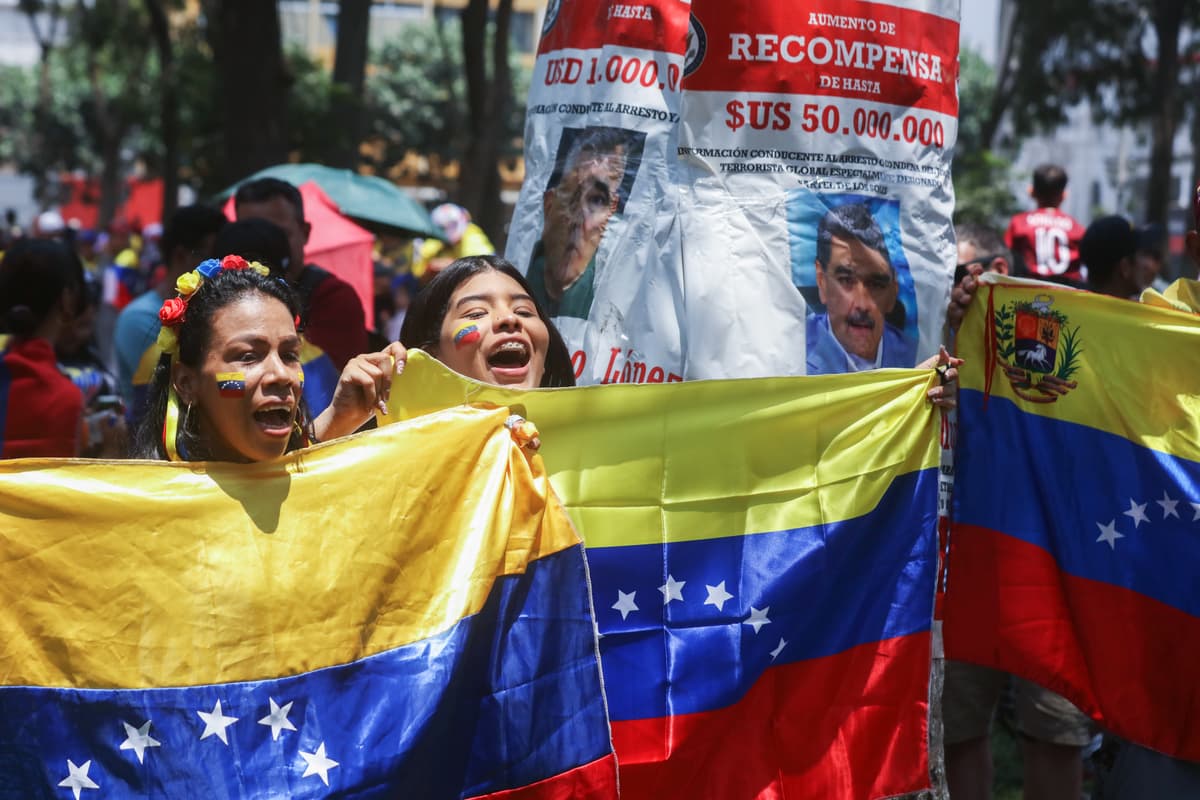
Mariana Bazo/Getty Images
Venezuelans at Lima, Peru on January 3, 2026 celebrate the capture of Nicolas Maduro by American forces. Mariana Bazo/Getty Images

Few Americans seem better qualified to serve as “Viceroy of Venezuela” than Marco Rubio. Fluent in Caribbean Spanish, he grew up in Miami, the son of Cuban exiles. His wife of 27 years, Jeanette Dousdebes Rubio, is the daughter of immigrants from Colombia, Venezuela’s sister nation to the west. 

For the past decade, Mr. Rubio has advocated regime change for Venezuela and Cuba. Today, Venezuela’s deposed president, Nicolás Maduro, sits in a Brooklyn jail cell. Yesterday, Mr. Trump told reporters that, cut off from cheap Venezuelan oil, Cuba, “looks like it’s ready to fall.” 

Mr. Trump predicted Cuba’s communist regime will fall without American military action. Cuba holds two days of mourning — today and tomorrow — for 32 Cuban soldiers and intelligence agents killed Saturday in the American raid that extracted Venezuela’s president and his wife, Cilia Flores.

To work on Cuba and Venezuela, Mr. Rubio, a potential Republican party candidate in 2028,  has at his disposal the full power of the United States government, the backing of President Trump, and the twin titles of Secretary of State and National Security Advisor. At age 54, Mr. Rubio never knew Cuba in its pre-communist days. He is old enough, though, to remember what Venezuela once was: The most prosperous nation in Latin America. 

People at Doral, Florida celebrate after President Trump announced Venezuelan President Nicolás Maduro had been captured.
People at Doral, Florida celebrate after President Trump announced Venezuelan President Nicolás Maduro had been captured. AP/Jen Golbeck

Venezuela floats on the world’s largest known oil reserves. Caracas trend-setters flew into Miami for ladies’ lunches or one-day shopping sprees. “Dame dos,” or “give two,”  was the refrain of Venezuelan shoppers who flooded Miami malls. A founding member of OPEC, Venezuela at times priced gasoline cheaper than mineral water and sent thousands of Venezuelans to American colleges on full scholarships.

It was hard work, but 27 years of socialist policies ruined it. Due to the nationalizations of American oil companies, political purges, and general incompetence, oil production plummeted to 20 percent of the level of 1999, the year the first socialist president, Hugo Chávez, took power. Last month, production was up to 1 million barrels a day, “only” 36 percent of the pre-socialist level. This month, neighboring Guyana, with only 3 percent of Venezuela’s 30 million people, is to produce more oil.

Faced with penury, Venezuelans voted with their feet in the largest migration in modern Latin American history. About 800,000 made it to America. Americans may think that is a lot, but it is only 10 percent of the 8 million Venezuelans who left their homeland. This weekend, on the news of Mr. Maduro’s arrest, the Venezuelan diaspora erupted in spontaneous celebrations at Buenos Aires, Madrid, and Miami.

CARACAS, VENEZUELA - SEPTEMBER 01: President of Venezuela Nicolás Maduro speaks during a press conference at Hotel Melia Caracas on September 01, 2025 in Caracas, Venezuela. Maduro stated that his government is targeted by 8 military ships and 1,200 misiles; what he called the largest threat on Venezuela in last 100 years. (Photo by
President Nicolás Maduro at a press conference on September 1, 2025 at Caracas, Venezuela. Jesus Vargas/Getty Images

Up and down Latin America, reactions split along left-right ideological lines. On Saturday, in front of the American embassy in Havana, Cuba’s president, Miguel Diaz-Canel, denounced American “state terrorism” and vowed: “For Venezuela, of course for Cuba, we are willing to give even our own life, but at a heavy cost [to the enemy].”

In Colombia, President Gustavo Petro yesterday taunted “Senor Marco Rubio” in a speech: “Brother, if you want to jail me, try and see if you can. If you want to put me in an orange uniform, try it. The Colombian people will take to the streets to defend me.”

Mr. Trump retorted: “Colombia is governed by a sick man who likes to produce cocaine and sell it to the USA — and he’s not going to keep doing it for much longer.” Colombia holds presidential elections in six months. Mr. Petro is constitutionally barred from seeking a second consecutive term.

Venezuela is surrounded on all sides by multi-party democracies. Much of the regional reaction is to urge Mr. Rubio to maneuver Venezuela back into the democratic fold. Watchdog groups say Mr. Maduro stole presidential elections in 2018 and 2024. 

Opposition leader Maria Corina Machado during an anti-government protest on January 9, 2025 at Caracas, Venezuela.
Opposition leader Maria Corina Machado during an anti-government protest on January 9, 2025, at Caracas, Venezuela. Jesus Vargas/Getty Images

Analysis of polling station results in the 2024 election indicate that he won only 31 percent of the vote and opposition leader Edmundo González won 66 percent. Mr. González, a soft spoken, 76-year-old former diplomat, was a stand-in for María Corina Machado, a popular conservative barred from running. Last month, Ms. Machado escaped Venezuela and traveled to Oslo, where she received the Nobel peace prize.

Asked if she supported an American invasion of Venezuela, she told reporters: “Venezuela has been already invaded. We have the Russian agents, we have the Iranian agents. We have terrorist groups such as Hezbollah, Hamas, operating freely in accordance with the regime.”

This week, Mr. Trump seems to want to see if Mr. Rubio can bring regime leaders around to a pro-American, pro-foreign investment stance. On Saturday, Mr. Trump said in his press conference that he could work with Venezuela’s vice president and oil minister, Delcy Rodríguez.

Yesterday morning, in an interview conducted with the Atlantic, Mr. Trump threatened that “if she doesn’t do what’s right, she is going to pay a very big price, probably bigger than Maduro.” A few hours later, Ms. Rodriguez, who now calls herself  “acting president,” posted a group photo with regime leaders, with this statement:  “We invite the U.S. government to work jointly on a cooperation agenda.”

Delcy Rodriguez, sworn in Saturday to succeed Nicolás Maduro as president of Venezuela, holds a press conference at Caracas on March 10, 2025. Ariana Cubillos/AP

Inflexibility by regime hardliners could push Washington to adopt what Mr. Trump calls  “a second and much longer attack.” Already, multi-million dollar bounties hang over the heads of two principals, Interior Minister Diosdado Cabello and Defence Minister Vladimir Padrino Lopez. Mr. Cabello recorded a statement Saturday: “Here there is only one president, whose name is Nicolas Maduro Moros. Let no one fall for the enemy’s provocations.”

To tighten pressure, Mr. Rubio yesterday said on ABC’s “This Week” that the United States has “a quarantine on their oil.” He added: “That means their economy will not be able to move forward until the conditions that are in the national interest of the United States and the interest of the Venezuelan people are met.”

The secretary of state, Marco Rubio, speaks during a news conference at the State Department on December 19, 2025. Julia Demaree Nikhinson/AP

In the recent past, fractures have appeared in Venezuela’s armed forces. Unlike neighboring Colombia, the country has no history of significant guerrilla movements. Venezuela’s last dictator, Marcos Pérez Jiménez, was deposed in 1958 by a military coup and street rioting. Now, the challenge for Mr. Rubio is to tele-guide Venezuela back to democracy, without opening the door to a civil war.

“The arrest of Nicolás Maduro is great news for the region,” Chile’s president-elect, Jose Antonio Kast,posted Saturday on X.  “Now begins a greater task. The governments of Latin America must ensure that the entire apparatus of the regime abandons power and is held accountable.” He called for “the safe and expeditious return of Venezuelans to their country.” 

On the other side of the Andes, Argentina’s president, Javier Milei, told local reporters:  “It’s the collapse of the regime of a dictator that was rigging elections, that in the last election was badly defeated and, despite that, he clinged on to power. That’s why I’d say that today’s news is excellent news for the free world.”


The New York Sun

© 2026 The New York Sun Company, LLC. All rights reserved.

Use of this site constitutes acceptance of our Terms of Use and Privacy Policy. The material on this site is protected by copyright law and may not be reproduced, distributed, transmitted, cached or otherwise used.

The New York Sun

Sign in or  create a free account

or
By continuing you agree to our Privacy Policy and Terms of Use