Nuclear Power Industry Positions Itself as Answer to AI’s Surging Energy Needs
‘Utilities are starting to recognize the massive increased demand for electricity that’s going to be coming,’ an industry leader says.
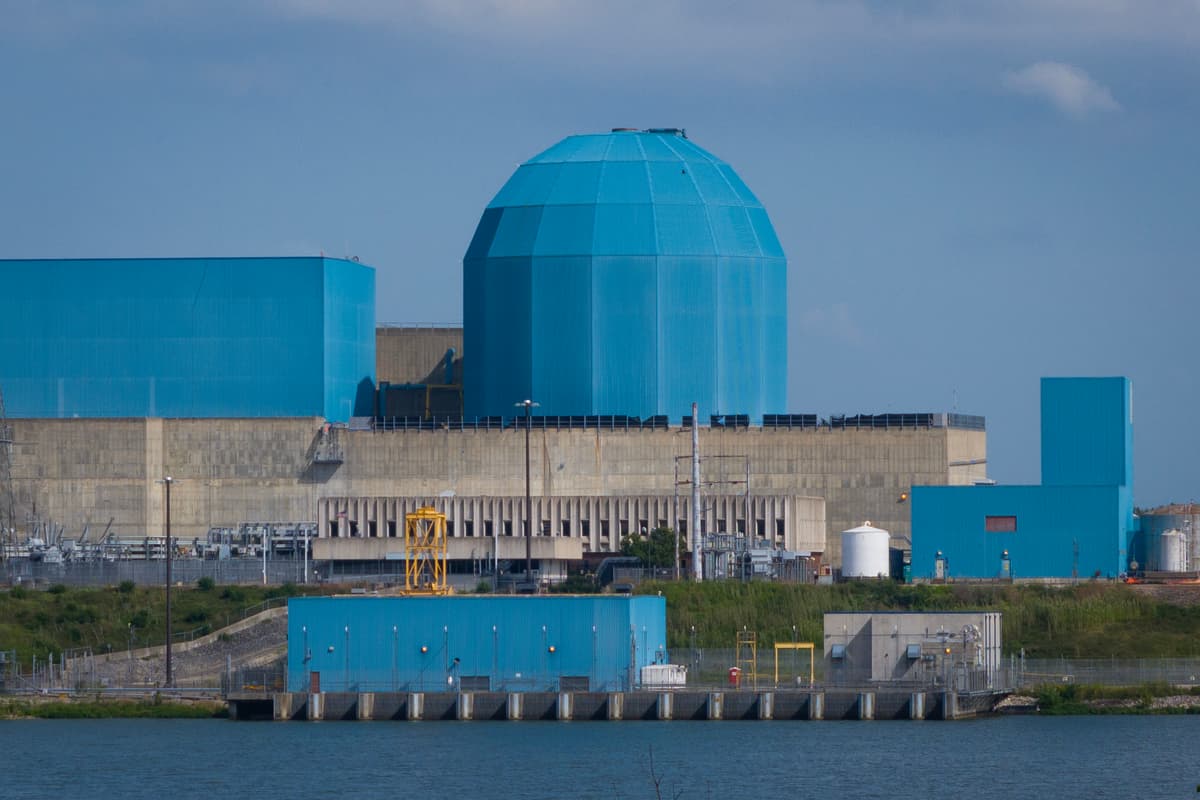

The nuclear industry is on the threshold of a renaissance in America as the AI revolution drives demand for ever more electric power.
“I’m very bullish, obviously, on the industry, but I’m not the only one,” the CEO of the United States Nuclear Industry Council, Todd Abrajano, tells The New York Sun. “You’re seeing it all across the spectrum now, and I think that’s a great thing.”
Mr. Abrajano’s group is focused on the commercialization and deployment of new nuclear technology and works with companies across the industry.
The International Energy Agency says energy consumption in America is expected to grow in the next three years by an amount equal to California’s current usage. The agency expects electricity generation from nuclear power to hit new highs every year through at least 2027.
“Utilities are starting to recognize the massive increased demand for electricity that’s going to be coming,” Mr. Abrajano says. “I mean, it’s basically already here.”
Much of the future energy production is expected to come from a new class of reactors known as Advanced Small Modular Reactors. These are smaller, require less capital investment, and can be located in places not suitable for larger nuclear plants. Such reactors are already operating in China and Russia but are still under development in America.
In May, President Trump issued four executive orders aimed at kickstarting domestic nuclear generation projects. Mr. Trump said he wants to re-establish the country as a global leader in nuclear energy and secure a reliable, diversified, and affordable energy supply.
One element of the initiative, the Reactor Pilot Program, aims to fast-track commercial licensing and expedite the development of advanced nuclear reactor technologies. The administration also hopes to simplify the current regulatory process, under which one company recently spent five years and $500 billion before getting Nuclear Regulatory Commission approval.
In August, the Department of Energy announced the selection of 11 pilot projects, including the Texas-based nuclear startup Last Energy. That company announced last week that it has raised $100 million to build a small reactor based on a unit designed for nuclear submarines.
The company hopes the reactors can be mass-produced to speed up the process of bringing new plants online. It is already building a pilot reactor outside of Austin at a site it is leasing from Texas A&M.
Another start-up in the program — Radiant Nuclear — announced last week it has raised more than $300 million for a portable reactor small enough to fit in a semi truck. It envisions small reactors that could replace diesel generators. The company says they could be used for disaster response and also as a portable energy source for the military.
Oklo — a third program participant — is testing a plutonium-fueled reactor to validate its use.
“One of the challenges and gates to deploying new nuclear is the shortfall in domestic nuclear fuel production across the fuel supply chains,” the CEO of Oklo, Jacob DeWitte, says. “The government has reserves of usable fuel materials, like plutonium, that can be used as bridge fuel for new reactors as the industry expands its supply chains.”
The Department of Energy hopes the program will have at least three reactor designs ready for testing by next July 4.
“It’s really exciting to be honest with you,” Mr. Abrajano says. “This is an industry that’s kind of had some fits and starts, multiple times, over the last several decades, but I think this time it’s real.”
Mr. Trump’s family is also jumping into the action. Trump Media & Technology Group and TAE Technologies announced last week that they are planning to merge with a goal of building the world’s first utility-scale energy-producing fusion power plant.
Fusion promises to create abundant carbon-free electricity without the potential risks of nuclear fission, which drives all existing nuclear power plants, but it is unproven as an economically feasible energy source
Other new conventional nuclear plants are coming online for the first time in 30 years in America.
The new Vogtle 4 reactor came online last year at an electric generating plant in Georgia. The fourth reactor makes the plant the largest nuclear plant in the country.
An unfinished nuclear power project in South Carolina that was abandoned in 2017 could finally be completed. A private company offered this month to pay the state-owned utility that owns it $2.7 billion dollars in exchange for keeping 75 percent of the power it generates.
Work is also underway to reopen shuttered facilities. The Palisades plant in Michigan that was decommissioned in 2022 is set to reopen as early as this month after securing a $1.5 billion Energy Department loan. The plant received new nuclear fuel in October after receiving authorization from the Nuclear Regulatory Commission.
The CEO of the plant’s owner Holtec, Kris Singh, said the work to restart the nuclear reactor “is a testament to the national consensus and our collective will to harness nuclear energy to meet the galloping demand for power in our country.”
Holtec is also working to build two smaller reactors at the site and hopes to bring them online in the early 2030s.
Decisions to close other plants are being reversed. Earlier this month, the California Coastal Commission came to an agreement with Pacific Gas & Electric to operate Diablo Canyon — the state’s only active nuclear power plant — for at least five more years. Governor Gavin Newsom persuaded the company to abandon a plan to close the plant this year.
Mr. Abrajano says many big companies that need a lot of power have made significant commitments in terms of decarbonization. They are looking for ways to get the power they need without emitting more carbon into the atmosphere, and see nuclear as the only way to get a reliable source of clean, sustainable power.
Tech giants like Amazon, Google and Meta are leading the push for the development of nuclear power plants. Microsoft is contracting Constellation Energy to restart the mothballed Unit One reactor at the Three Mile Island facility in Pennsylvania that went offline in 2019.
Unit Two — which suffered a partial meltdown in 1979 — will not be restarted. The Three Mile Island incident put the industry on the defensive for decades as the threat of a catastrophic event turned the public against nuclear power.
But support for nuclear has started growing again. “For a long time, the industry was underwater in terms of support,” Mr. Abrajano says. “But starting a few years ago, we started to see those numbers shift.” He says the percentage of Americans supporting the nuclear power industry now hovers in the mid-sixties.
Mr. Abrajano says today’s reactors are much safer than those built in the 1960s. “If you look at the safety, I think a lot of people are recognizing that it really is a safe electricity generator,” Mr. Abrajano says.
Morgan Stanley expects global nuclear capacity could more than double by 2050 and investments in nuclear power could reach $2.2 trillion in the next 25 years. That is up 40 percent from what it estimated a year earlier.
“The dual imperatives of decarbonization and energy security are making the nuclear renaissance a truly global investment theme,” a Morgan Stanley researcher, Tim Chan, said in a release.
All the money being spent to develop, build, and overhaul nuclear facilities does not guarantee that things will pan out.
The global consultants at HKA report nuclear construction has a “comparatively poor” record when compared to fossil fuel plants on cost issues. Problems have included construction delays, cost overruns, and skill gaps because the country has gone for so long without meaningful nuclear projects.
Mr. Abrajano expects some shakeup in the years ahead because of the sheer number of players who are jumping into the market.
“There’s always going to be winners and losers. I think we’re up to around 150 different designs, if not more,” Mr. Abrajano says. “It seems like every week there’s somebody else coming into the market with a new design, and look, I don’t think anybody thinks that all of those companies are going to ultimately be successful.”
Mr. Abrajano thinks the companies that will ultimately prevail are those that do a good job of making their way through the regulatory process.
Due to the amount of time it will take to put new nuclear power online, industry watchers expect natural gas to remain a dominant provider of energy for AI data centers for several years to come.
“We believe natural gas will be the primary near-term solution for powering AI data centers due to its speed to market, reliability and flexibility, while nuclear power represents a longer-term clean energy alternative that is likely to gradually increase in importance,” Morgan Stanley’s global head of sustainability research, Stephen Byrd, said.
“Gas and nuclear are likely to play complementary roles.”