One of the Great Yiddish Poets of the 20th Century — Avrom Sutzkever — Holds Court at Manhattan’s Hipster Haven
‘Night Stories’ in Alphabet City captures the heartbreaking beauty of verse born of the Holocaust.
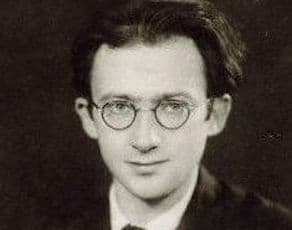

Any opportunity to encounter the work of the Yiddish poet Avrom Sutzkever is to be seized. That includes “Night Stories: Four Tales of Reanimation” now being staged at Wild Project at Manhattan’s Alphabet City by the Congress for Jewish Culture. The production, directed by Moshe Yassur and Beate Hein Bennett, is in Yiddish with English subtitles. The actors, adept in the byways of the mome-loshn, are Shane Baker and Miryem-Khaye Seigel.
Sutzkever’s life tracked the impossible Jewish experiences of the 20th century. He was born at Vilna, known then as “the Jerusalem of Lithuania” for its distinctive and eclectic Jewish excellence. After a spell in Siberia, Sutzkever returned to Vilna where he became a leading light, alongside the likes of Chaim Grade, in an avant-garde literary and artistic group known as Yung-Vilne. Sutzkever was always drawn more to aesthetics than politics.
Politics found Sutzkever, though, with the Soviet invasion of 1939 followed by the Nazi conquest of 1941. The poet performed heroic work in the ghetto as a cultural impresario and as a member of the “Paper Brigade,” hiding Jewish documents and art against the day when the Nazis would fall. Among the treasures saved by Sutzkever are a diary by Herzl and drawings by Chagall. Sutzkever’s mother and newborn son were murdered in the ghetto and at Ponar.
Sutzkever and his wife, Freydke, escaped to the forests and joined the partisans. In a twist that scarcely seems believable, Soviet Russia, conscious of Sutzkever’s fame as a poet, airlifted them to Moscow in 1944. Two years later he appeared at the Nuremberg trials to testify against the ruler of the Vilna Ghetto, Franz Mauer, who was known as the “Butcher of Vilnius.” By 1947 he was at Tel Aviv, the city he would call home for the rest of a long life.

The scholar Ruth Wisse, Sutzkever’s greatest critic, writes that for him “everything hangs on the precision of each Yiddish word.” In Commentary, she writes that ”the phoenix quality of Avram Sutzkever’s witness to his lost Atlantis cannot fail to provide a source of inspiration to anyone who ever doubted the mysterious creative continuity of vanished East European Jewry.” For Sutzkever, poetry is the “reliable counterforce to all that destroys.”
That “phoenix quality” — ashes mixed with resurrection — pervades “Night Stories.” Mr. Baker translated Samuel Beckett’s “Waiting for Godot” into Yiddish and captures aspects of Sutzkever’s dreamy absurdity. The first act is a poem, “Kindershe Hentlekh” or “Child’s Hands,” which imagines — or remembers — a child’s handprints on a cellar at the Warsaw Ghetto. What follows is a tragic meditation on the death of the child and his grandmother.
Sutzkever’s verse mingles images of ethereal beauty with language innovated in the ghetto. The poem catches the emergence of a new Yiddish word — susine, meaning horse meat. Usually prohibited by the laws of kashruth, the flesh became prized in the ghetto as a source of nourishment. Another kind of dubious nourishment is considered in “Lupus,” where a survivor summons from the shadows an ambiguous character from the war’s killing fields.
In exchange for precious jewels, Lupus, we learn, sold cyanide to his fellow Jews who could see no better path to ending their suffering. The poem’s speaker will use only an old kerosene lamp he bought at Jaffa. He reflects that “Electricity means electrified barbed wire, the electric chair; since such a chair exists, it may well be that someday soon, an electric bed, too, may become popular, with brides and grooms giving birth … to electric children.”
The speaker’s family wonders why he abstains “from turning on an electric switch. When I do, my nostrils revolt: they smell an odor of burning human flesh.” He recalls a moment in the war: “We envy only the fortunate among us, those born in silk shirts who hid a ring or a jewel and can still use their power to trade or beg a portion of death from the Cyanide Merchant.” The speaker goes to fetch “some slivovitz and two glasses.” When he returns, Lupus is gone.
“Where the Stars Spend the Night” is a love story whose images of the natural world — Sutzkever imagined his lost worlds as a “green aquarium”— reaches for the aquatic accomplishment of Shakespeare in “The Tempest,” where the Bard writes “Full fathom five they father lies / Of his bones are coral made.” Sutzkever writes “If you sink into the sea, sharks will butcher you and the coral will build a city on your golden bones.”
“The Blue Sweater” is a story of loss, but in a minor key. It is set before the cataclysm, and centers on a boy, modeled after Sutzkever, who moves to Warsaw from Vilna. Over the course of the tale he loses both the sweater knitted for him by his mother for Hanukkah as well as a portrait of him in the same garment. The painter, Chaim Uryson, was murdered at Bialystok. Like Sutzkever’s pen, his brush captured landscapes lost yet luminous.