Pakistan Offers Platter of Incentives To Get in Trump’s Good Graces

A careful courtship appealing to the president’s favorite subjects moves a once-scorned South Asian nation into a preferred partner.
WhiteHouse.gov
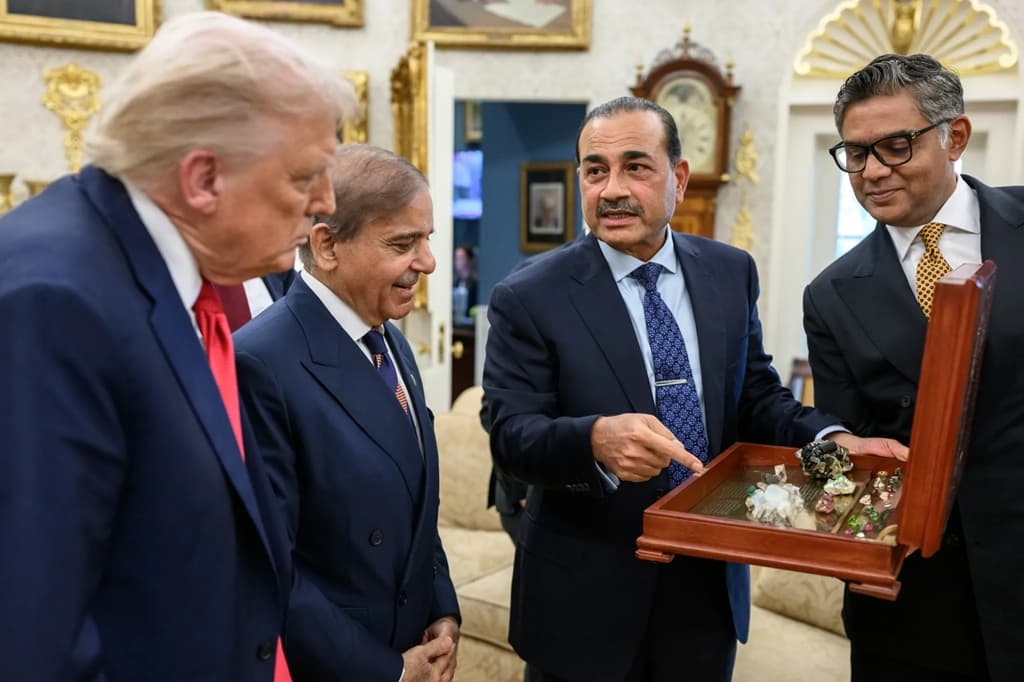
President Trump is shown rare earth minerals during an Oval Office meeting with Prime Minister Shehbaz Sharif and Field Marshal Asim Munir of Pakistan at Washington, September 26, 2025. WhiteHouse.gov

Despite President Trump once calling Pakistan a terrorist haven, Pakistan is now one of his most preferred South Asian partners — a role reversal that emerged thanks to Islamabad’s finesse on rare earth minerals, cryptocurrency deals, and carefully calibrated flattery.

The transformation has been striking. June 2025 marked the first time an American president met privately with Pakistan’s Field Marshal, Asim Munir, who is not the country’s head of state. Mr. Munir returned a few months later, this time presenting Trump with a polished wooden box filled with glittering mineral samples from Pakistan.

During his first term, Mr. Trump slashed over $1.3 billion in security assistance to Pakistan and accused the country of providing a haven to terrorists hunted in Afghanistan. His successor and predecessor, Joe Biden, never called either of Pakistan’s prime ministers during his term and described Pakistan as one of the most dangerous nations in the world following the chaotic 2021 Afghanistan withdrawal.

Today, Pakistan has secured one of the lowest tariff rates in any primary market, won designation of the Afghanistan-based Balochistan Liberation Army as a Foreign Terrorist Organization, and restarted a long-dormant counterterrorism dialogue. Pakistani officials have met with Mr. Trump at least three times this year, while Pakistan’s military awaits a new shipment of American-made missiles.

The Abbey Gate Opening

The rehabilitation of Islamabad began in March with a tactical victory when Mr. Trump announced that Pakistan had assisted in capturing the alleged mastermind of the 2021 Abbey Gate bombing at Kabul airport, which killed 13 American soldiers.

The arrest of the ISIS-K commander, Mohammad Sharifullah, near the Pakistan-Afghanistan border was the result of close coordination between the CIA and Pakistan’s Inter-Services Intelligence agency. The head of U.S. Central Command, General Michael Kurilla, praised Pakistan as a phenomenal counterterrorism partner, noting the arrest showcased Pakistan’s value to American interests. 

The operation gave Islamabad precisely what it needed: a concrete demonstration of usefulness at a moment when Washington’s attention had drifted away from South Asia.

Critical Minerals and China’s Shadow

Yet counterterrorism cooperation alone wasn’t enough. Pakistan needed to offer something that Mr. Trump personally cared about: leverage against China’s dominance in critical minerals. Mr. Munir’s presenting mineral samples to Mr. Trump at the September meeting catapulted Pakistan’s expediency. 

Missouri-based United States Strategic Metals signed a $500 million partnership framework with Pakistan’s military-run Frontier Works Organization that same month. The United States has already received the first shipment of antimony, copper concentrate, and rare-earth elements.

According to the Pakistani government, it owns $6 trillion worth of untapped minerals, including rare earth elements essential to defense systems, electric cars, and advanced electronics.

China controls 92 percent of global refined rare earth output, according to the International Energy Agency. Pakistan’s mineral reserves, concentrated in remote Balochistan province, which the terrorist group is attempting to break off from Pakistan, offer an alternative supply chain not controlled by Beijing.

Yet doubts remain about whether Pakistan can deliver. Most of Pakistan’s mineral wealth lies in Balochistan, where separatist insurgency has intensified, with nearly 500 attacks in 2024 killing more than 800 people.

“Balochistan is a powder keg with separatist attacks on mines and convoys spiking this year, turning trillion-dollar hype into a security nightmare,” the managing director of NestPoint Associates, John Thomas, tells the New York Sun. “Pakistan’s military can guard sites short-term, but without quelling the chaos, deliveries will drag, leaving America fairly empty-handed.”

The Cryptocurrency Connection

Pakistan’s courtship extends into another Trump family passion: cryptocurrency. In April 2025, Pakistan’s newly formed Crypto Council signed a letter of intent with World Liberty Financial, a decentralized finance platform in which Mr. Trump’s family holds a 60-percent stake.

The crypto deals have raised eyebrows at Washington. A nonresident senior fellow with the Atlantic Council, Alex Plitsas, tells the Sun that “concerns center on the timing of the agreements, which coincided with a period of United States-Pakistan diplomatic engagement.” 

Some observers and congressional inquiries have examined whether such business ties could introduce risks related to transparency in cryptocurrency transactions, given the sector’s challenges with regulatory oversight and illicit finance vulnerabilities,” he says. 

Mr. Thomas takes a more dismissive view of that position, however, observing that the crypto deals create no national security problem and “in fact it deepens the ties between American investors and Pakistan.”

Looking Good, Mr. President

Beyond tangible deals, Pakistan has also mastered the art of flattering Mr. Trump personally. After the president claimed credit for brokering a ceasefire between Pakistan and India following their May 2025 clash, Prime Minister Sharif promptly nominated Mr. Trump for the Nobel Peace Prize for the second time, despite India’s insistence that the ceasefire was bilateral with no American mediation.

The sycophancy doesn’t come cheap. Throughout this year, Pakistan significantly ramped up its lobbying efforts at Washington, spending millions of dollars on K Street lobbying firms to rebuild ties with the Trump administration and gain access to senior American policymakers. 

Islamabad paid roughly $5 million this year to retain six firms engaged in advocacy and strategic communications at Washington, with monthly expenditures estimated at $600,000 — approximately three times what rival India was reported to be spending on similar efforts. 

These contracts have included high-profile firms and ties to Trump-connected operatives, reflecting Pakistan’s aggressive push to influence American policy amid changing geopolitical dynamics.

Yet significant voices within the American foreign policy establishment remain deeply skeptical. During a recent House Foreign Affairs Subcommittee hearing, experts warned lawmakers about Pakistan’s historical use of terrorist proxies against India. 

Analysts and lawmakers have long bemoaned that a great deal of terrorism emanates from Pakistan and urged Washington to convince the Pakistani military to stop using terrorist groups as foreign policy assets.

“Evidence points to tactical adjustments rather than genuine, structural change,” Mr. Plitsas explains. “Pakistan has cooperated on specific U.S. priorities, arresting an IS-K leader linked to the 2021 Kabul attack, reviving counterterrorism dialogues, and acting against anti-state groups like TTP.”

However, Mr. Plitsas warns that “longstanding support for Afghanistan-focused proxies and India-focused ones persists, per U.S. assessments and expert analyses.” He notes that “historical patterns show selective action: cracking down when under pressure, recalibrating when scrutiny wanes.”

Mr. Thomas is even more blunt about whether Islamabad has changed its behavior of backing nefarious groups. 

“I don’t believe they have over the long run,” he says. “It’ll require the U.S. to remain vigilant and keep a stick in their back pocket.”

India Tensions and Sustainability Questions

Islamabad must also balance its new strategic relationship with Washington against its deep economic ties to Beijing — via the China-Pakistan Economic Corridor — and its tense detente with New Delhi and India’s prime minister, Narendra Modi. As America’s designated strategic partner in countering China, India currently faces unprecedented friction with Washington.

“Cozying up to Pakistan for minerals risks alienating Modi and bolstering Beijing’s Belt and Road stranglehold,” notes Mr. Thomas. “Trump’s right to grab resources from under China’s nose, but Pakistan’s deep CPEC ties mean we’re feeding the hand that bites us.”

Others contend that the damage to Washington-Delhi ties is overstated. 

“The pivot introduces tensions but does not fundamentally undermine the U.S.-India partnership or broader China strategy,” Plitsas tells the Sun. “India remains central to Indo-Pacific deterrence, the Quad, technology initiatives, and shared concerns over China far outweigh Pakistan’s tactical value.”

A senior fellow at the Middle East Institute, Marvin Weinbaum, suggests the relationship with Pakistan may have deeper strategic dimensions. 

“The White House and the Pentagon are once again viewing Pakistan primarily as a security partner,” Mr. Weinbaum tells the Sun. “That’s how the relationship functioned for decades; we needed Pakistan to balance the Soviet Union, then later in Afghanistan.”

The sustainability of the pivot remains the central question. 

“This is classic Trump deal-making,” Mr. Thomas says. “He’s made deals on minerals and crypto that play to his America First agenda, but it’ll fizzle fast under a less deal-savvy administration.”

Mr. Plitsas agrees that the “pivot is largely transactional and personality-driven, making it unlikely to endure unchanged beyond the Trump administration.”

Yet Mr. Weinbaum cautions that “another administration could just as easily decide we’ve gone too far, that we’ve alienated India, and that we need to readjust.”

For now, Pakistan has achieved what many considered impossible just two years ago: becoming a regular presence at the White House.


The New York Sun

© 2025 The New York Sun Company, LLC. All rights reserved.

Use of this site constitutes acceptance of our Terms of Use and Privacy Policy. The material on this site is protected by copyright law and may not be reproduced, distributed, transmitted, cached or otherwise used.

The New York Sun

Sign in or  create a free account

or
By continuing you agree to our Privacy Policy and Terms of Use