

Midwest Primary Results Could Foretell Rise of a DSA-Backed Presidential Nominee in 2028
By MICHAEL BARONE
|Wilfred Owen’s poems constitute the output of a brief adulthood entirely consumed by the consciousness of war, in a generation of men who would be utterly devoured, as a demographic, by that war.

Published:
Updated:
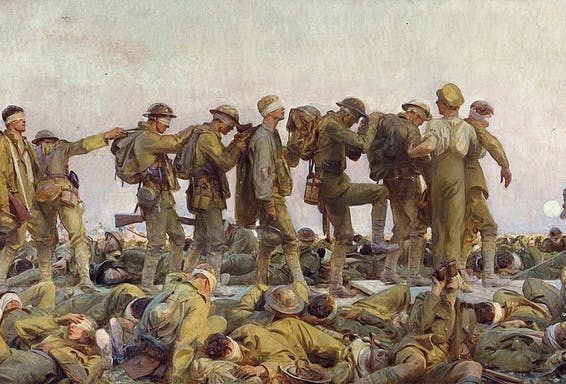
Born on March 18, in 1893, Wilfred Owen (d. 1918) has become one of the famous casualties of World War I. Killed in action at twenty-five, a week before the Armistice that ended the war, he seems to have been born to fulfill the bleak prophecies of his poems. These poems constitute the output of a brief adulthood entirely consumed by the consciousness of war, in a generation of men who would be utterly devoured, as a demographic, by that war. Owen published only five poems in his lifetime, with today’s Poem of the Day, “Futility,” one of them.
In this battlefield poem, a soldier lies dead at the feet of comrades who have won through the carnage, this time. Over the body, one of these survivors addresses the others. Each ababccc septet in this nameless soldier’s voice, with its middle five tetrameter lines couched between opening and closing lines in trimeter, meditates on a level of futility. First, there’s the futility of waking the dead, the futile hope that the sun, which had always awakened him before, will touch him to consciousness now. In the second stanza, the speaker’s sense of hopelessness expands to the level of existential despair. If this waste of life is the outcome of every sunrise, then what’s the point of the sun’s coming up at all?
By MICHAEL BARONE
|
By SALENA ZITO
|
By JOSEPH CURL
|
By ALEX ZDAN
|
By DAVID JONES
|
By JOSEPH CURL
|
By GARY GASTELU
|
By LUKE FUNK
|Born on March 18, in 1893, Wilfred Owen (d. 1918) has become one of the famous casualties of World War I. Killed in action at twenty-five, a week before the Armistice that ended the war, he seems to have been born to fulfill the bleak prophecies of his poems. These poems constitute the output of a brief adulthood entirely consumed by the consciousness of war, in a generation of men who would be utterly devoured, as a demographic, by that war. Owen published only five poems in his lifetime, with today’s Poem of the Day, “Futility,” one of them.
In this battlefield poem, a soldier lies dead at the feet of comrades who have won through the carnage, this time. Over the body, one of these survivors addresses the others. Each ababccc septet in this nameless soldier’s voice, with its middle five tetrameter lines couched between opening and closing lines in trimeter, meditates on a level of futility. First, there’s the futility of waking the dead, the futile hope that the sun, which had always awakened him before, will touch him to consciousness now. In the second stanza, the speaker’s sense of hopelessness expands to the level of existential despair. If this waste of life is the outcome of every sunrise, then what’s the point of the sun’s coming up at all?
Already have a subscription? Sign in to continue reading
Cancel anytime
By continuing you agree to our Privacy Policy and Terms of Service.