

Reworked Gloria Swanson Vehicle From Silent Era Adds a Page to Film History

‘Queen Kelly,’ though sometimes risible, is never less than convincing and is certainly never boring.
Via Milestone Films and Film Forum
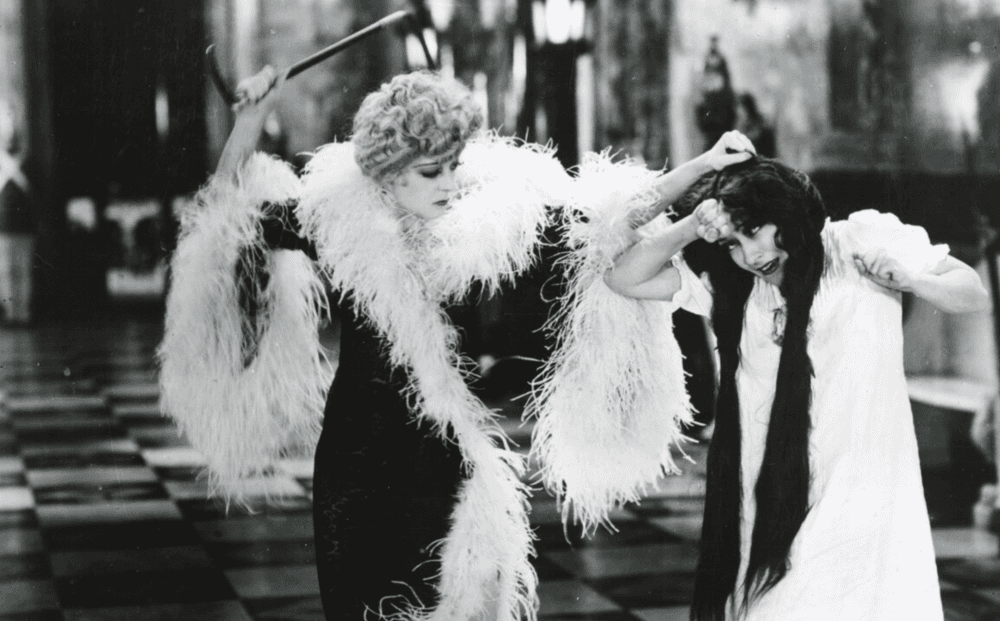
Seena Owen and Gloria Swanson in Queen Kelly’ (1929). Via Milestone Films and Film Forum

A pivotal scene in Billy Wilder’s “Sunset Boulevard” (1950) features wayward screenwriter Joe Gillis (William Holden) sitting side by side with faded film legend Norma Desmond (Gloria Swanson). They’re in a screening room located at her lavish Beverly Hills mansion watching a film from Norma’s heyday; in it, we see a close-up of the young actress, bathed in candlelight and offering a prayer to an effigy of the Virgin and Child.

Norma enthuses to Joe about the power of the silent cinema: “We didn’t need dialogue. We had faces!” The clip they see could’ve been taken from any number of Swanson films of the 1920′ — she was, it should be remembered, a celebrity of some magnitude — but her co-star in “Sunset Boulevard,” Erich von Stroheim, suggested to Swanson and Wilder that it be taken from “Queen Kelly” (1929).

There was not a little irony in the choice. “Queen Kelly” was the straw that broke von Stroheim’s back in Hollywood. Not as an actor — he would go on to a successful career in character roles — but as a director. 

Among the thematic undercurrents of “Sunset Boulevard” is a bitter self-referentiality. Von Stroheim’s character, Max von Mayerling, may be Desmond’s man-servant but he was once a director of the highest rank. 

Fiction, here, is inseparable from truth: Von Stroheim was one of cinema’s original auteurs, a man whose gifts were undeniable and excesses renowned. The niceties of budgeting, censorship and scope were beneath him: If a picture needed to be 7seven hours long it would be seven hours long, dammit. “Queen Kelly,” along with “Sunset Boulevard,” will be undergoing a revival starting this Friday at Manhattan’s Film Forum.

Swanson hired von Stroheim to helm “Queen Kelly” on the strength of his genius, and ultimately canned him as “a madman.” Making a silent film just as the talkies were beginning to enter theaters was a gamble Swanson and her producer, political patriarch and not-so-secret paramour Joseph Kennedy, well knew. Still, they moved forward, with von Stroheim providing a storyline about a student at a convent school, Patricia Kelly (Swanson), who is romanced by a prince (Walter Byron).

Gloria Swanson in ‘Queen Kelly’ (1929).
Gloria Swanson in ‘Queen Kelly’ (1929). Via Milestone Films and Film Forum

The rub is that Prince Wolfram is betrothed to Queen Regina V (Seena Owen), the ruler of an invented European nation who is not of right mind. Upon discovering Kelly in the arms of her fiance, the queen goes into a frenzy, putting the whip to her rival, and chasing her out of the palace. Soon thereafter a heartbroken Kelly receives news that a beloved aunt (Sylvia Ashton) is dying, and would like to see her niece before going on to her great reward. 

Kelly travels to Tanzania — where her relation has, presumably, been occupied with missionary work — only to find that she’s been affianced, as part of her aunt’s dying wish, to Jan Fryheid (Tully Marshall). One look at Fryheid is enough for us to know that Kelly’s aunt is no judge of character. Forget that the good sir looks like he’s escaped from the back reaches of “The Cabinet of Dr. Caligari;” Fryheid drinks, smokes, thieves, and consorts with a pair of licentious and conniving women. Things don’t look good for the former convent girl.

Things did go badly for Kelly — so much so that Swanson, with Kennedy in full agreement, pulled the financing out from under von Stroheim. A loss of $800,000.00 was deemed preferable to an entertainment that would’ve gone on to cost considerably more and would’ve never flown with the censors. Swanson did what she could to salvage the footage, hiring a journeyman director, Richard Boleslawski, to tie up the picture’s loose ends. The results were desultory.

The version that will be playing at Film Forum has been cobbled together by Dennis Doros of Milestone Films. Using still photographs, stock footage and von Stroheim’s original scripts, Mr. Doros has done heroic work on an extravagantly absurd melodrama, an entertainment whose cinematic sparkle does much to ground its wilder tangents. 

As such, “Queen Kelly,” though sometimes risible, is never less than convincing and is certainly never boring. Von Stroheim’s film might have ended up a fool’s errand, but what’s left of it is an important addition to the canon.


The New York Sun

© 2026 The New York Sun Company, LLC. All rights reserved.

Use of this site constitutes acceptance of our Terms of Use and Privacy Policy. The material on this site is protected by copyright law and may not be reproduced, distributed, transmitted, cached or otherwise used.

The New York Sun

Sign in or  create a free account

or
By continuing you agree to our Privacy Policy and Terms of Use