
Sydney Sweeney and Amanda Seyfried Fail To Elevate Paul Feig’s ‘The Housemaid’
How well the film succeeds as a psychological shocker can be gleaned from the response of a rambunctious audience with whom this reviewer attended a sneak preview: They weren’t having it.
Two movies have come from South Korea with the title “The Housemaid,” each of which involve a significant measure of sex — as if erotic potential were a chief item listed on the curriculum vitae of domestic help. Kim Ki-young’s 1960 film is a claustrophobic tale of erotic obsession that is no less compelling for its cartoonishness, while Im-Sang Soo’s 2010 picture equates sex with class animus and is cited, by one critic, as “proof that you can be too horny.”
What these films might say about Korean culture is a good question. But what does Paul Feig’s “The Housemaid” tell us about American culture? The picture has been adapted from a novel by Freida McFadden, the pseudonym of a physician specializing in brain trauma. Thanks to the mercantile reach of TikTok, the good doctor has racked up significant sales and has since written a number of “Housemaid” sequels. There is, it appears, good money to be made in randy charwomen.
The title character in Mr. Feig’s film is portrayed by Sydney Sweeney. Readers may recall that the bosomy actress was the subject of an internet kerfuffle about eugenics and white supremacy stemming from a “good jeans” ad in which she modeled for American Eagle Outfitters. Previously, Ms. Sweeney had prominent roles on two HBO series, “The White Lotus” and “Euphoria.” Having little patience for the glib cynicism of the former or the Gen Z nihilism of the latter, I’ve invariably confused Ms. Sweeney for a country singer and songwriter, Sunny Sweeney.
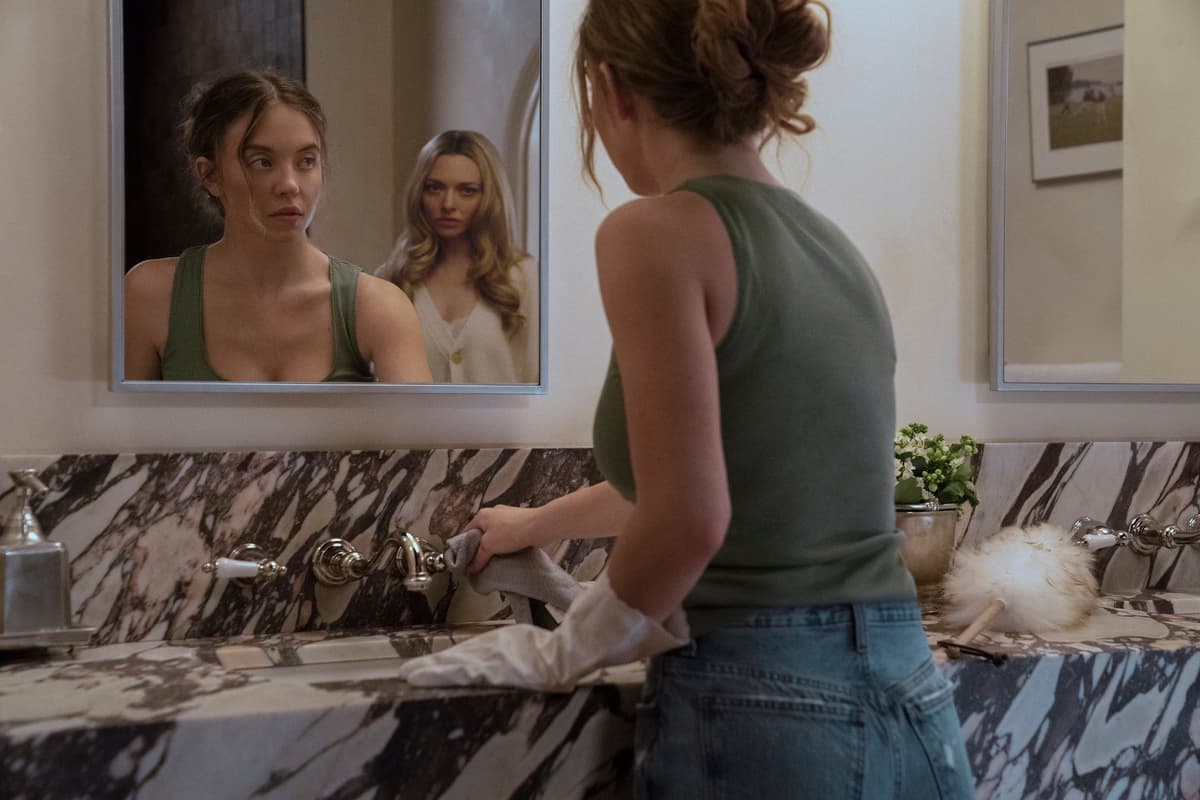
Whether Sidney can sing is unknown, but she proves an affable enough presence in “The Housemaid.” Mr. Feig allows us the courtesy of judging the quality of her genes in several operatic nude scenes with the hunky leading man, Brandon Sklenar. Lest one fear that Ms. Sweeney and her physiognomy are being exploited by the suits in Hollywood, please know that she also serves as executive producer on the movie, as does her co-star, Amanda Seyfried.
Mr. Feig brings to this venture a background in comedy, having created a cult TV series, “Freaks and Geeks,” and directing a number of high-profile, woman-centric features including “Bridesmaids” (2011), “The Heat” (2013), and the reboot of “Ghostbusters” (2016). This time around, the auteur invokes Nancy Meyers, Oscar-winning screenwriter of “Private Benjamin” (1980) and director of, among much else, “The Parent Trap” (1998) and “What Women Want” (2000). Funny and playful are the bywords here.

So, too, is thrilling. In crafting “a narrative meticulously designed to fly madly off the rails,” Mr. Feig drops the H-bomb — that is to say, “Hitchcock.” His picture is rife with skullduggery, as a young woman with a chequered past, Millie Calloway (Ms. Sweeney), is hired as a housemaid by a high-strung Long Island socialite, Nina Winchester (Ms. Seyfried). The mansion Nona shares with her virile husband and moody daughter, respectively Mr. Sklenar and Indiana Elle, is a not-so-distant relative of Mandalay, the estate that figures prominently in Hitch’s “Rebecca” (1940).
The Bates home in “Psycho” (1960) is recalled as well, though not as an opulent showcase but as a labyrinth of secrets. Hitchcock famously set down a rule that disallowed audiences to enter the theater after that movie had started, a stricture that Mr. Feig and Ms. Sweeney and Ms. Seyfried might’ve liked to implement: “The Housemaid” is predicated on a series of narrative feints intended to keep viewers on the edges of their seats. Critics writing about the film will have to tread a veritable minefield of spoilers.
How well it succeeds as a psychological shocker can, I think, be gleaned from the response of a rambunctious audience with whom I attended a sneak preview: They weren’t having it. At all. Every work of art is manipulative to one extent or another, but “The Housemaid” is so transparent in its machinations that it could almost be mistaken for a parody. The laughter from the crowd seemed indicative less of the picture’s cleverness than an acknowledgment of how much it was being had.
As such, the picture is spectacularly vulgar, a lowest-common-denominator entertainment brimming with irony but weirdly bereft of self-awareness. Post-feminists in training will likely cite “The Housemaid” as a footnote in their doctoral theses on the popularization of misandry. Movie fans in the mood for a good thriller will seek out the two Korean features mentioned above. For all of their faults, those housemaids get business done and do so with considerably less condescension.