The Constitutional Casuistry in the Big Beautiful Bill

A provision in the law appears to run afoul of a bedrock element of the Constitution — the limit to but two years on any appropriation for military spending.

AP/Evan Vucci
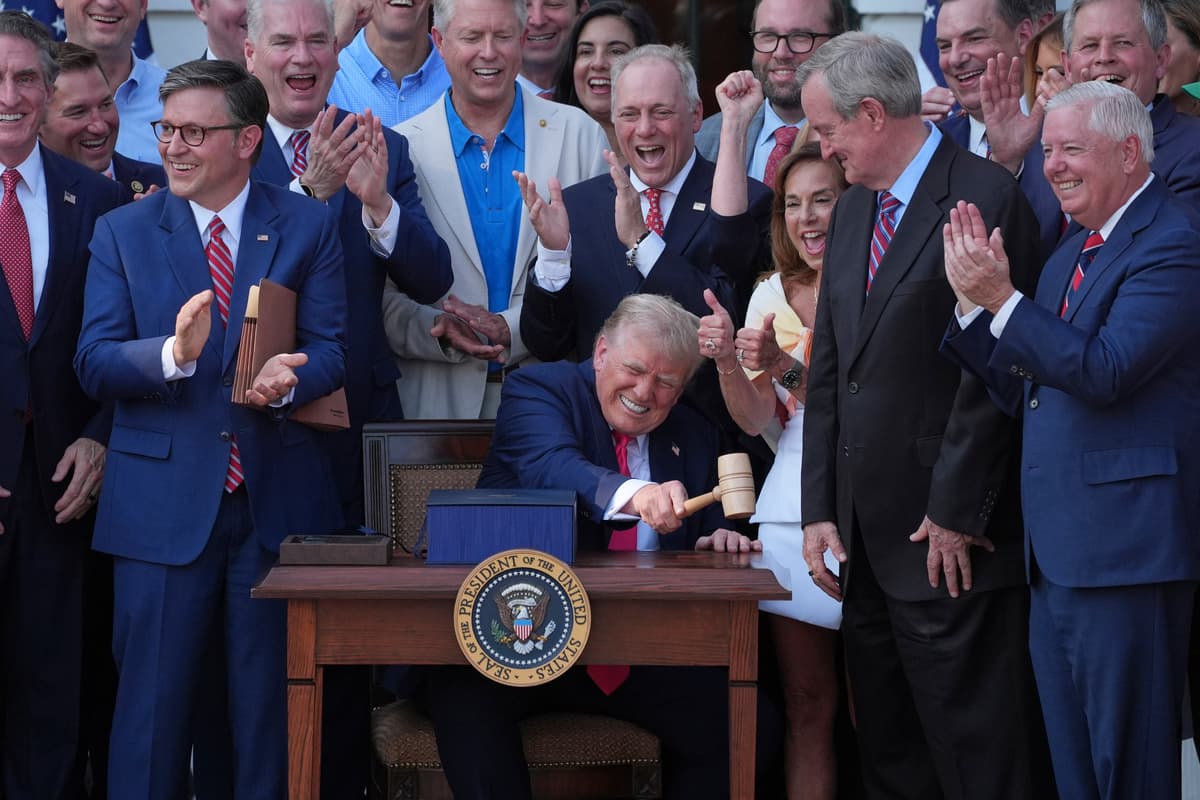
President Trump after signing the Big, Beautiful, Bill at the White House, July 4, 2025. AP/Evan Vucci

Call it a case of “Casual Unconstitutionality.” That, at least, is how a Georgetown Law professor, David Super, is describing a problematic provision in the One Big Beautiful Bill that President Trump signed into law on July 4 as Air Force jets wheeled overhead. The bill raises Professor Super’s hackles because it appears to run afoul of a bedrock element of the Constitution — the limit to but two years on any appropriation for military spending.

An appropriation is budgetary jargon for legal permission to spend money — “to make payments from the U.S. Treasury for specified purposes,” the House says. The offending measure lurks in Section 20011 of the GOP budget law. It states that “there are appropriated to the Secretary of Defense for fiscal year 2025” some $1 billion “to remain available until September 30, 2029,” for “the deployment of military personnel.”

The funds are earmarked for “support of border operations,” along with “operations and maintenance activities” for the border, as well as “counter-narcotics and counter-transnational criminal organization mission support,” among other purposes. That’s all well and good. What would foment fretting among the Framers, one imagines, though, is the law’s appropriation of military money until 2029. By our count that adds up to four years.

The Constitution, in Article I, section 8, gives Congress power “To raise and support Armies,” but with a caveat. When it comes to military spending, “no Appropriation of Money to that Use shall be for a longer Term than two Years.” Mr. Super contends, with a certain degree of understatement, that “the four-plus years that section 20011’s appropriation is available would seem to exceed that limit rather directly.”

We don’t want to make too much of this budgetary faux pas. The sum involved is a mere bagatelle amid the trillions of dollars expended under the budget bill. The two-year limit, though, reflects the Framers’ fears of a standing army. That alarm has ebbed, and subsequent legal interpretations have okayed, say, long-term military contracts for procurement of “aircraft and aeronautical equipment,” the Congressional Research Service reports.

Yet per Mr. Super, the Section 20011 spending falls “in the personnel, operations and maintenance category,” and is as a result “subject to the two-year limitation.” So how did Congress pass what looks like an unconstitutional law? Mr. Super wonders whether the provision was drafted by a committee unfamiliar with the two-year limit. He suggests that Congress just doesn’t place a “particular premium on adherence to the Constitution.” 

Failing a fix by Congress, there are avenues for the measure to be challenged in federal court, Mr. Super tells us. The grounds would depend on “who is seen as being in the zone of interest protected by the provision” of the Constitution, he says. So, someone who, say, “encounters army personnel funded by that appropriation,” he suggests, could have a legal basis to challenge the validity of the military activity that results from the spending.

Another prospective legal case, he says, could arise via the military personnel themselves funded by the long appropriation. The idea of ratifying military appropriations every two years, Mr. Super tells us, helps to confirm among the soldiery the sense that the spending “reflects the will of the people.” The idea of an indefinite appropriation of military dollars, he imagines a soldier arguing, “takes that away from me.”

Lack of standing, though, has tended to hamstring attempts by taxpayers or other private citizens to challenge spending decisions made on Capitol Hill. That curb on courts’ powers would put the onus on Congress, which can rewrite this provision in the law, Mr. Super says, adding that “I think they should.” After all, the law professor tells us, with due levity, “a little walk of shame when you violate the Constitution is not too much to ask.”


The New York Sun

© 2025 The New York Sun Company, LLC. All rights reserved.

Use of this site constitutes acceptance of our Terms of Use and Privacy Policy. The material on this site is protected by copyright law and may not be reproduced, distributed, transmitted, cached or otherwise used.

The New York Sun

Sign in or  create a free account

or
By continuing you agree to our Privacy Policy and Terms of Use