
‘The Donroe Doctrine’

President Trump, in a jumble of words after the raid on Caracas, starts to define his foreign policy legacy.
Joe Raedle/Getty Images
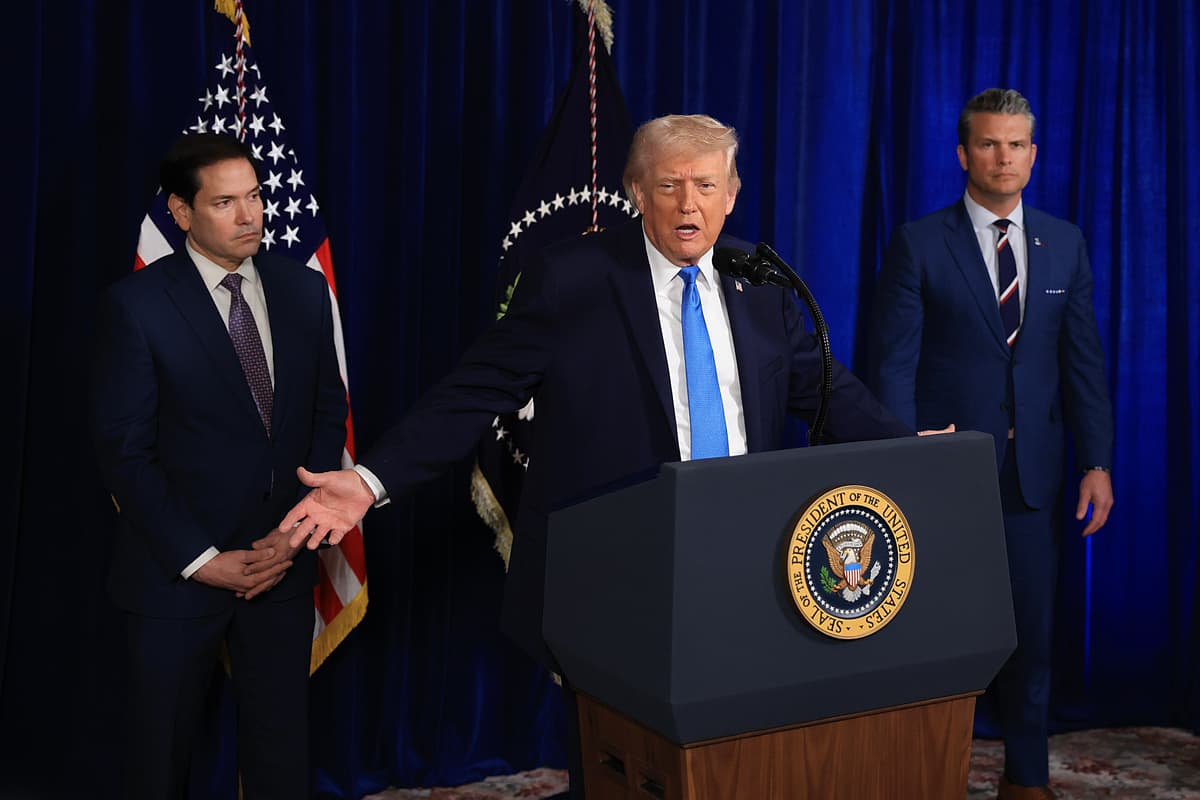
President Trump during a news conference at his Mar-a-Lago club on January 3, 2026. Joe Raedle/Getty Images

The phrase that sticks with us from President Trump’s press conference in respect of Venezuela is the rebrand he’s touting for the more than 200-year-old Monroe Doctrine — the “Donroe Doctrine.” It’s a classic Trump sobriquet, a contraction of Donald and Monroe. What, though, constitutes the difference between the original, nickel-plated Monroe Doctrine as declared by our fifth president and the doctrine of our 47th one? 

The Monroe Doctrine was articulated on December 2, 1823, in a message to Congress from President Monroe. Right there we can spot one difference. Monroe sent a marker. It declared, per the James Monroe Memorial Foundation, “that the Western Hemisphere was no longer open to European colonization and that any attempt by foreign powers to interfere with the affairs of newly independent American nations would be considered a hostile act.” 

In the early 1800s, the Monroe Foundation reminds, the global backdrop was turbulent. In Latin America, Spanish colonies were declaring their independence, while European monarchies, as the Foundation puts it, “hinted at helping Spain reclaim its former colonies, while Russia pressed its expansion down the Pacific coast. At the same time, Britain proposed a joint declaration discouraging European intervention.”

The Monroe Foundation uses the word “guided” for the role that Secretary of State John Quincy Adams carried out for Monroe. The path for which they struck was, the Foundation says, “an independent American policy” that was rooted in “self-determination, national confidence, and regional stability.” Says the Foundation: “What began as a practical warning became one of the most enduring principles of U.S. foreign policy.”

The thing about a doctrine — as opposed to, say, a treaty — is that it’s not part of the supreme law of the land. You’ve got, say, your Nixon Doctrine of arming our allies so they can do their own heavy lifting. You’ve got your Reagan Doctrine, which forsook peaceful coexistence with the USSR for a rollback of Soviet Communism. You’ve got your Bush Doctrine of preemptive war and unilateral action, not America first so much as American alone.

So far, so good for Mr. Trump, who, in a presidential message last month associated himself with the Monroe Doctrine and what he called a “Trump corollary” to it. He issued that message as his administration was secretly preparing the raid that took place yesterday. All of Venezuela’s  actions, he reckoned Saturday, “were in gross violation of the core principles of American foreign policy dating back more than two centuries” to “the Monroe Doctrines.”

Mr. Trump called the Monroe Doctrine “a big deal” that he’d just “superseded,” adding “by a lot.” Declared he: “They now call it the ‘Donroe’ Doctrine.” He concluded his reference to Monroe by asserting that “other administrations have neglected or even contributed to these growing security threats in the Western hemisphere.” His administration, he said, is “reasserting American power in a very powerful way in our home region.”

Since Monroe declared his doctrine, there have been lively defenses of it in terms echoed by Mr. Trump. In 1904, President Theodore Roosevelt, in his state of the union message, suggested that our adherence to the Monroe Doctrine could “force the United States, however reluctantly, in flagrant cases” of wrongdoing by others “to the exercise of an international police power.” Asserting the Monroe Doctrine, he said, America has acted in “our own interest.”

We get that there will be a debate about whether Mr. Trump overstepped boundaries respected by other presidents. Yet the history suggests that there’s been a lot of support over the generations for Mr. Trump’s view of this. The Supreme Court, moreover, has allowed American authorities to bring, even by force, criminal suspects back to the United States. It’s going to be difficult to suggest that anyone is surprised to see a president do so.


The New York Sun

© 2026 The New York Sun Company, LLC. All rights reserved.

Use of this site constitutes acceptance of our Terms of Use and Privacy Policy. The material on this site is protected by copyright law and may not be reproduced, distributed, transmitted, cached or otherwise used.

The New York Sun

Sign in or  create a free account

or
By continuing you agree to our Privacy Policy and Terms of Use