

The Fed’s Supreme Court Moment
The Nine will have a chance next week to clarify the president’s authority over a supposedly independent central bank.
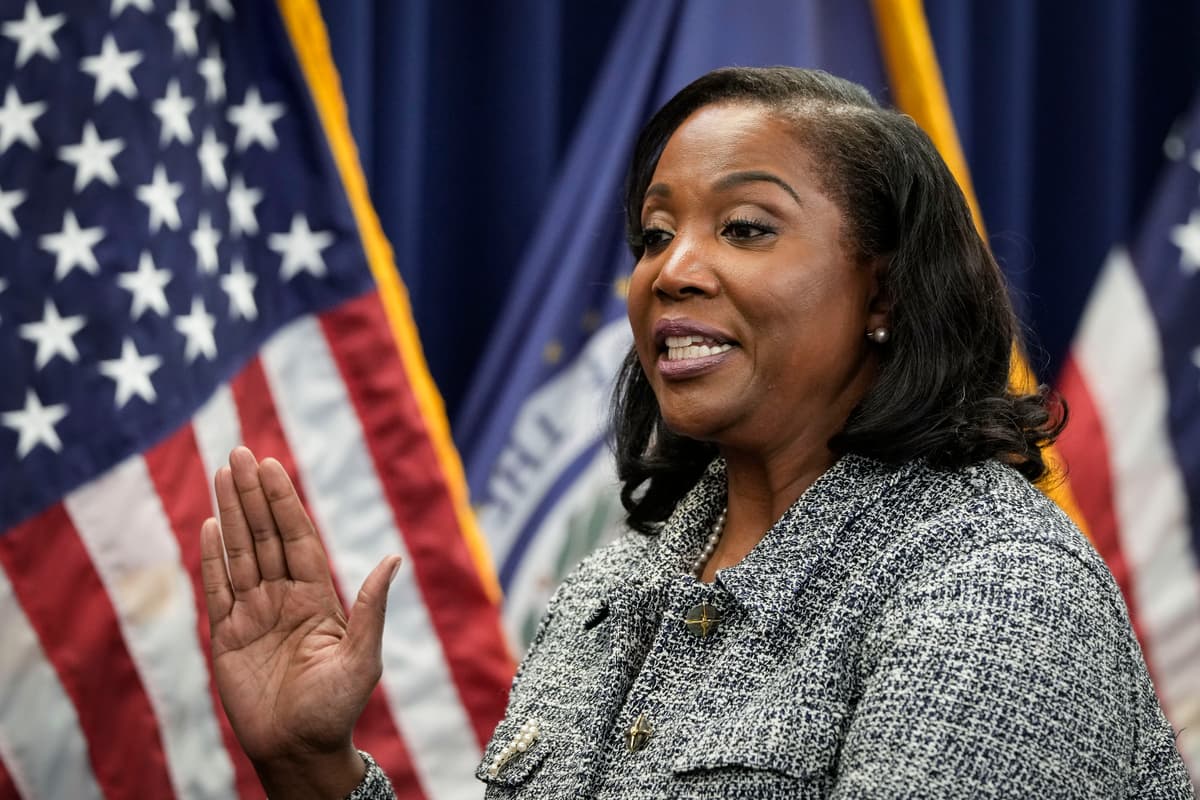
The federal criminal probe of the Fed chairman, Jerome Powell, will likely cast a shadow over next week’s Supreme Court arguments in the case of another board member of the central bank, Lisa Cook. Both Ms. Cook and Mr. Powell face legal scrutiny from President Trump. In the case of Ms. Cook, Mr. Trump seeks to fire her from the Fed. The dispute gives the Nine a chance to clarify the president’s authority over a supposedly independent central bank.
Mr. Trump, pointing to alleged financial improprieties by Ms. Cook, contends that he has legal cause to fire her from the Fed. Ms. Cook denies any wrongdoing. More broadly, though, a president’s constitutional power to fire any decision-making executive branch official would seem to suggest he wouldn’t need any specific “cause” to fire Ms. Cook. Justice Antonin Scalia reckoned that defying the president was “cause” enough to warrant termination.
This broad presidential power over personnel was the crux of a case heard by the Nine in December. In Trump v. Slaughter, Mr. Trump seeks to terminate a board member, Rebecca Slaughter, of another purportedly independent agency, the Federal Trade Commission. That agency, a kind of sibling of the Fed, was created in 1914 to be a nonpartisan arm of the federal government. That was a year after the central bank itself was enacted.
The Progressive-Era impulse that animated the creation of both the Fed and the FTC, in any event, is crosswise with the Constitution’s requirement of separated powers. Congress formed these and like agencies with the notion that they would be above the political fray, and thus not directly accountable to the president. Yet the result was to fuel the rise at Washington of a bureaucracy that answers to no one, in effect. There followed the metastasis of the Deep State.
In Slaughter, the court’s conservative majority appeared, on the basis of the questioning during oral arguments, to be poised to hand Mr. Trump a victory in his effort to gain control of the FTC. That would amount to a step toward the restoration of the constitutional balance of power that has been off-kilter since Democratic Congresses and presidents forged the welter of agencies that help to constitute the Deep State.
In Cook,the prospects are murkier. For the case touches on whether Mr. Trump has met the legal standard, set by Congress, for firing Ms. Cook. Beyond that, the high court has evinced hesitation about treating the Fed like any other agency of the federal government. In a ruling in May, the high court tried to palm off the idea that the Fed was an exception to the principle of the unitary executive that otherwise applies to personnel matters.
In that preliminary ruling in Trump v. Wilcox, the Nine allowed Mr. Trump to proceed with the firing of two “independent” agencies, the National Labor Relations Board and the Merit Systems Protection Board, while litigation was under way. Yet the court, in its unsigned order, cautioned that the logic of the Wilcox precedent would not necessarily apply to the central bank. So what, if anything, makes the Fed different from any other federal agency?
The high court ruling in Wilcox reckons that the Fed “is a uniquely structured, quasi-private entity that follows in the distinct historical tradition of the First and Second Banks of the United States.” The two banks, because they served as the depository for federal dollars, played such a powerful role in the economy that President Jackson termed the Second Bank a “monster.” The battle over its existence became known as the Bank “War.”
Yet neither bank exercised under law the regulatory tasks delegated by Congress to the Fed. Nor ought the Fed’s complexity, which often lets the central bank elude accountability, mask its functional role as a federal agency. That role, by the logic of the Constitution, gives presidents the power to supervise it, like any other agency. As a result it’s hard for the Nine to escape the logic that Mr. Trump has the authority to fire all or any of the Fed’s board members.