The Glenn Miller Orchestra, Last of the Big Bands, Is Swinging After 80 Years

It turns out that the ‘new sound’ survives its famous bandleader.
Via Glenn Miller Orchestra
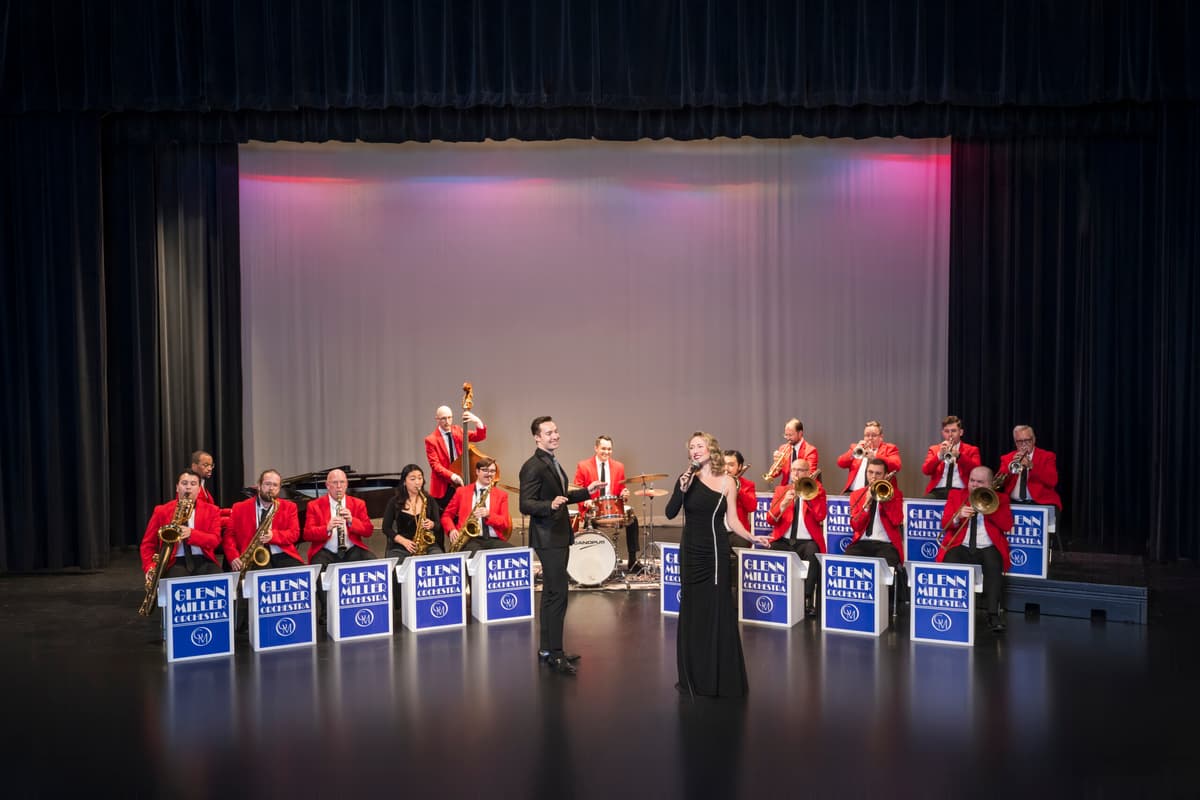
The Glenn Miller Orchestra featuring Music Director Erik Stabnau and vocalist Jenny Swoish. Via Glenn Miller Orchestra

Time travel, physicists assure us, is impossible. Yet The Glenn Miller Orchestra offers 200 opportunities a year to visit the 1930s and 1940s. Links in an unbroken chain started in 1938, the musicians keep alive the “new sound” of their titular trombonist from the heyday of big bands.

This columnist arrived at the Tarrytown Music Hall at Tarrytown, New York, on a recent evening with cautious optimism. A mediocre baritone horn player in his youth, he feared finding that the Miller name was being slapped on to sell tickets. Piano, woodwind, brass, bass, and drum might just go through the motions.

Instead, the musicians — of all ages and from across America — were tight and faithful to the source. Passion showed on their faces and blared from their instruments. A Nashvillian singer, Jenny Swoish, performed the vocals in a style straight out of the era.

“A band ought to have a sound all of its own,” Miller said of bucking contemporary music trends. “It ought to have a personality.” As a boy, he traded a mandolin for what the band’s website describes as “an old, battered horn” and experimented for hours. “Pop and I used to wonder,” his mother said, “if he’d ever amount to anything.”

Bandleader Glenn Miller in the 1940s. Via Wikimedia Commons

Miller spent so much time auditioning that he flunked college but became one of the most influential band leaders of the 20th Century. He did so despite having his life cut short at 40 in 1944. While the bandleader was serving with the Glenn Miller Army Air Forces Orchestra in World War II, the major was killed when his plane disappeared over the English Channel without a trace.

As a nod to Miller’s service, the orchestra pauses each night to ask veterans to stand and be recognized. The sight of aged men leaning heavy on canes and younger ones in period uniforms was met by thunderous applause in the 140-year-old music hall.

In 1954’s “The Glenn Miller Story,” James Stewart plays the trombonist. His co-star, George Tobias — as the Boston booker, Si Schribman, who gave the upstart his break — captures why the orchestra holds its magic. “If you can get a style the kids like,” he says of the band, “it can go on for years, maybe. No matter who is in it, it keeps right on going.”

Miller’s arrangement of “Little Brown Jug,” an 1869 drinking song, demonstrates how he rewrote the old to craft the timeless. The director of the 18-piece band, Erik Stabnau, hosted the evening with obvious affection for these traditions. “Moonlight Serenade,” he noted, opens and closes every performance as it has for over 80 years.

Glenn Miller leading his band in the early 1940s. Via Wikimedia Commons

“Pennsylvania 6-5000,” Mr. Stabnau explained, “gets its title and lyrics from” the “longest single running phone number in New York City,” dialing the former Hotel Pennsylvania, once across the street from Penn Station. The tune “outlasted” the Hotel Pennsylvania, which fell to the wrecking ball two years ago. “It just goes to show,” he said, “you can’t stop Glenn Miller or his orchestra.” 

During an intermission, Mr. Stabnau, Ms. Swoish, and some of the musicians mingled with the audience, connecting with others who love the Miller experience. When the band struck up again, couples danced in the aisles.

Once, big bands roamed America in herds like the buffalo. Today, The Glenn Miller Orchestra is the last of their breed; so, its set list paid tribute to other greats like Benny Goodman and William “Count” Basie. They also performed holiday standards like “White Christmas” and “Sleigh Ride.”

When the band struck up “Moonlight Serenade” a second time, indicating the evening’s end, there were murmurs at the absence of Miller’s most enduring and influential piece. This, too, was showmanship. Ms. Swoish asked if the throng wanted just one more song. Cheered on, the band delivered “In the Mood.”

“You’re too young to be here,” one audience member said to this columnist, a joke that testifies to a sound that’s ageless. The Glenn Miller Orchestra is a living monument to Miller’s chasing his dream against all opposition, believing he “had swell ideas and wonderful musicians” even when “the hell of it” was “no one else did.”


The New York Sun

© 2025 The New York Sun Company, LLC. All rights reserved.

Use of this site constitutes acceptance of our Terms of Use and Privacy Policy. The material on this site is protected by copyright law and may not be reproduced, distributed, transmitted, cached or otherwise used.

The New York Sun

Sign in or  create a free account

or
By continuing you agree to our Privacy Policy and Terms of Use