

Tom Stoppard, a Playwright for the Ages — and a Jewish One in His Old Age — Dies at 88
The author of ‘Rosencrantz and Guildenstern Are Dead’ and ‘Leopoldstadt’ was the greatest dramatist of his time.
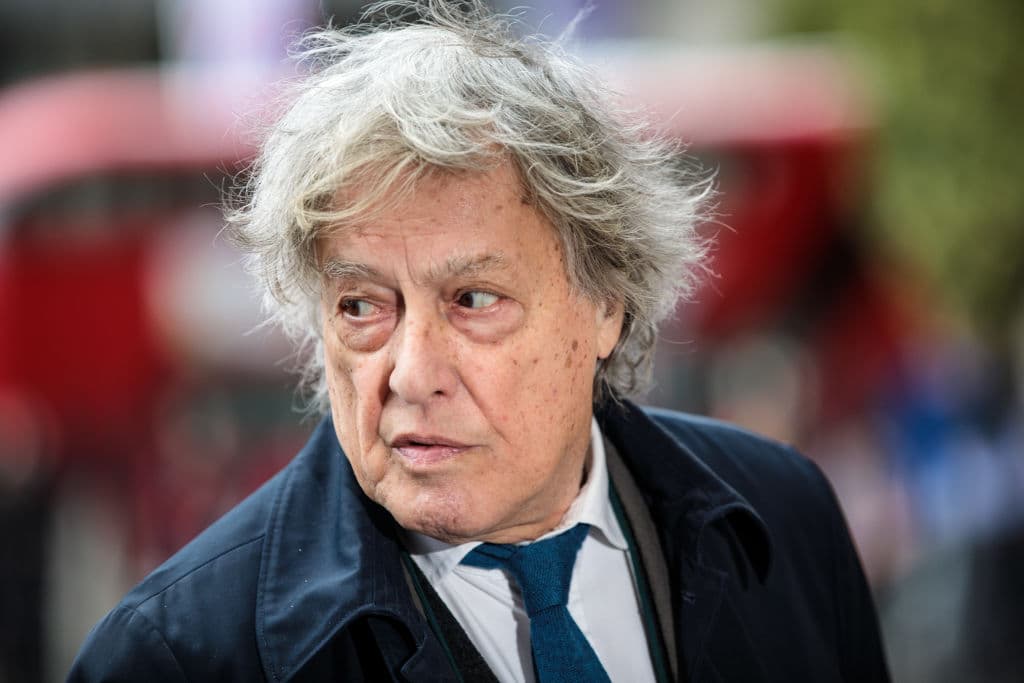
With the death of Tom Stoppard another literary giant of the 20th century exits stage right. Stoppard, a playwright of ideas if there ever was one, was 88. Born in Czechoslovakia, he was a Jewish refugee from Hitler who spent three years at a boarding school in the Himalayas before arriving in England. John Podhoretz reckons that “No one in this era produced more, better, or more consistent work over a longer period of time than Stoppard.”
Stoppard’s breakthrough came in 1966, with “Rosencrantz and Guildenstern Are Dead.” In it he approaches Shakespeare’s “Hamlet” from an oblique and sly angle, imagining the Bard’s greatest play from the perspective of its most hapless characters. There is a chill that feels imported from Beckett, and one reviewer, after seeing it at the the fringe of the Edinburgh Festival, reckoned that it leaped “from depth to dizziness.”
“Rosencrantz” won a Tony Award, the first of five for Stoppard. He would return to Shakespeare three decades later, writing the screenplay for “Shakespeare in Love.” That film, starring Gwyneth Paltrow and Joseph Fiennes, romped to seven Academy Awards, including one for Stoppard. He told the New Yorker in 1977 that he “disliked Abstract Expressionism,” and his work was always heady, expository, and intellectual. His was a thinking man’s theater.
John Milton wrote that “the mind is its own place,” and Stoppard’s imagination ranged across history. “Arcadia,” from 1993, is set at an English estate, its action unfolding in 1809 and two centuries later. It is shot through with the encyclopedic knowingness of a George Eliot novel. Nine years later came “The Coast of Utopia,” a three part, nine hour epic set in 19th century Czarist Russia that counts as characters Karl Marx, Alexander Pushkin, and Ivan Turgenev.
Stoppard, whose own schooling was limited, loved writing about writers and revolutionaries. “Travesties,” from 1976, is set at Zurich in 1917 and is haunted by memories of James Joyce and Vladimir Lenin, who both found footholds in Switzerland during that pivotal year. “The Invention of Love,” from 1997, features no less a roster of wits than A.E. Housman, John Ruskin, Oscar Wilde, and Walter Pater. Stoppard was no austere minimalist in his premises.
Stoppard was every bit the English eminence. He was knighted by Elizabeth II in 1997 and awarded the Order of Merit, a personal gift of the Sovereign, three years later. He died in Dorset, as English a setting as can be imagined. In 2012, though, a novel by a Croatian author, Dasa Drndic, features a character lashing Stoppard for ignoring his heritage in favor of his “lovely English language and his one and only royal homeland.”
A decade later Stoppard told the Times that the book hit him like a thunderbolt, reprimanding him “enough already with the charmed life, you had this family, which you seem to have forgotten.” The product of that remembering was Stoppard’s final play, “Leopoldstadt,” which premiered in the first days of 2020 and the final days before the Covid-19 pandemic. Loosely autobiographical, it amounted to a belated reckoning with Stoppard’s Jewishness.
“Leopoldstadt” tells the story of a Viennese Jewish family between the years of 1899 and 1955. Stoppard stages all the great questions of Jewish modernity — Zionism and socialism, conversion and assimilation. This critic judged in 2022 that “To be a Jew in ‘Leopoldstadt’ is unmitigated bad news, an identity to shed in good times and shun in bad ones. Mr. Stoppard’s play delivers little of the joy of Jewish life, and plenty of its travails.”
Stoppard, in offering an unflinching account of the trials of the diaspora — Vienna was the city of Hitler as well as Herzl — wrote a work that after October 7, 2023, cannot help but be read as a warning as well as a lament. Mr. Podhoretz calls “Leopoldstadt” the most “explicitly Zionist work of art of our time” and reckons that in writing it Stoppard “did good for his people and for the West.” He wasn’t Shakespeare, but he was finally, and at long last, himself.