Trump Administration Eases Guidelines on Alcohol Consumption as Younger Americans Opt for a Sober Lifestyle

The more relaxed guidelines come as younger Americans are choosing to forgo alcohol citing health and financial reasons.
Christian Petersen/Getty Images
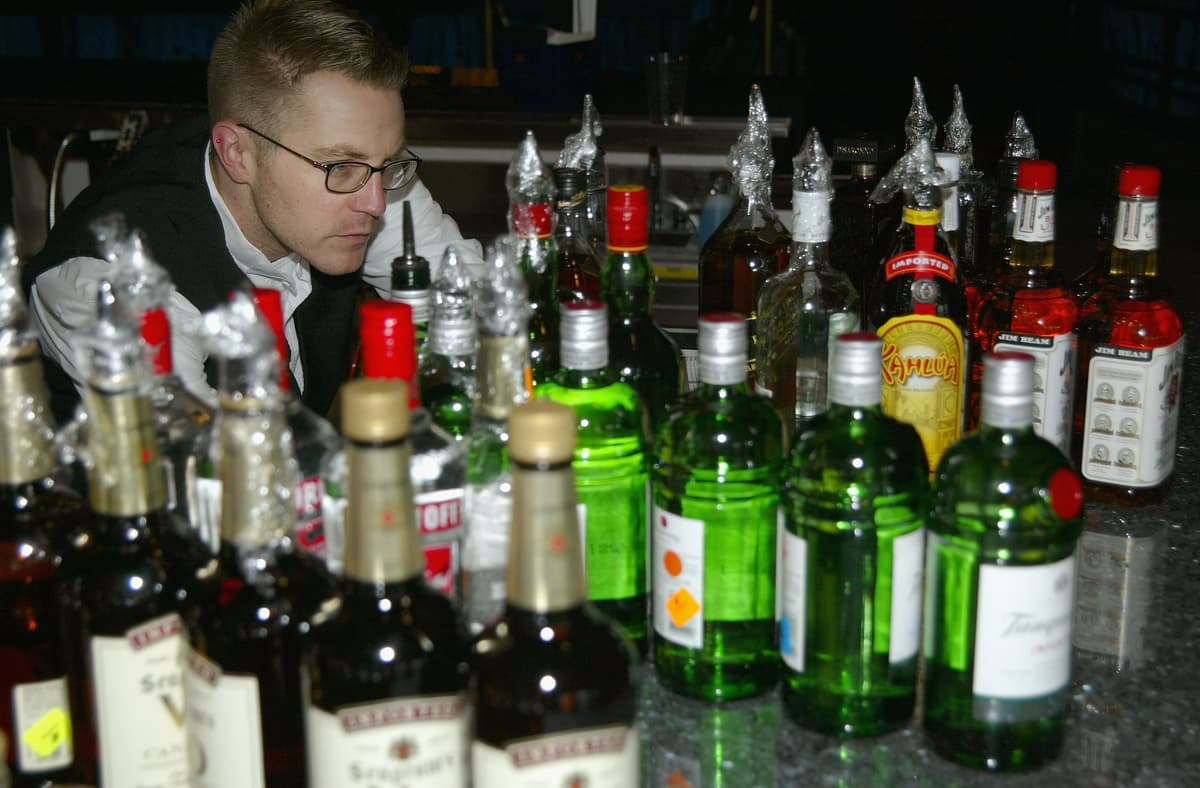
A vendor examines his alcohol inventory prior to the start of the 2005 NBA All Star Game at Denver, Colorado on February 20, 2005. Christian Petersen/Getty Images

The Trump administration is loosening its guidelines on alcohol consumption, saying it is a “social lubricant” that helps people socialize, but that Americans shouldn’t be having martinis with their eggs and bacon in the morning. 

Several Trump administration officials unveiled new dietary guidelines on Wednesday including the updated recommendation for alcohol consumption. The guidance removes a previous recommendation that adults limit their alcohol consumption to one drink a day for women and two drinks a day for men. 

The administrator for the Centers for Medicare and Medicaid Services, Dr. Mehmet Oz, said, “Alcohol is a social lubricant that brings people together.”

“In the best-case scenario, I don’t think you should drink alcohol, but it does allow people an excuse to bond and socialize, and there’s probably nothing healthier than having a good time with friends in a safe way,” Dr. Oz said. 

He pointed to “blue zones,” where life expectancy is higher, such as Okinawa, saying, “You look at the blue zones, for example, around the world, where people live the longest. Alcohol is sometimes part of their diet. Again, small amounts.”

While the guidelines remove the recommended limit, Dr. Oz said the “implication is don’t have it for breakfast.”

The new guidelines have drawn criticism from organizations that aim to reduce alcohol-related deaths. The chief executive of the Alcohol Policy Alliance, Mike Marshall, said in a statement, “The new federal guidelines are a big win for the alcohol industry and their advocates in Congress. The scientific evidence is clear: alcohol is a toxic, addictive carcinogen that kills about 178,000 Americans each year.”

“Given how deeply alcohol is embedded in American life, the public deserves clear, honest information about the risks of drinking so they can make the best decisions for themselves, their families, and their communities,” he added.

A coalition of alcoholic beverage trade associations said in a statement that the new guidelines “reaffirm” the recommendation that alcohol be consumed in moderation, adding that such advice is “underpinned by the preponderance of scientific evidence.”

The American Heart Association says that “no research has proven a direct cause-and-effect link between drinking alcohol and better heart health.” It warns that one or two drinks a day “may worsen” high blood pressure for people who already have high blood pressure. It also says that “heavy alcohol consumption,” or more than four drinks, is “consistently associated with significant cardiovascular conditions,” such as coronary artery disease. The AHA says that studies have also “linked alcohol consumption to an increased risk of cancer, including cancers of the liver, mouth, throat, esophagus, colorectal, and breast.”

Regardless of the  guidance, a growing number of Americans are choosing not to drink. In a survey released by Gallup in August, only 54 percent of Americans said they consume alcohol, the lowest percentage in nearly 90 years. According to Gallup, there have been fewer than 10 times since 1939 — when it first started tracking Americans’ drinking behavior — that the percentage of Americans who drink fell below 60 percent. In 2022, the percentage was 62 percent, and in 2023 it was 58 percent. 

Among those drinking less are Gen Zers, born between 1997 and 2012. From 2001 to 2023, Gallup reported an 11 percent decrease among adults 18-34 who said they had a drink in the past week. 

The shift comes as younger Americans are more concerned about the health effects of drinking. Gallup reported that in 2023, 52 percent of Americans said they think moderate drinking is unhealthy, up from 34 percent in 2018. In the latest survey it was 53 percent.

The decrease in drinking has seen the emergence of a different form of social connection known as “soft clubbing,” in which people gather at venues such as cafes or bakeries, usually in the morning, and socialize without alcohol. Eventbrite reported a 92 percent increase in “sober-curious” events between 2024 and 2025. 

Young Americans say they find the events to be safer, more economical ways to socialize, and healthier, too. 

The head of Eventbrite’s Community and Trends, Roseli Ilano, said in a statement, “This movement isn’t about giving something up — it’s about choosing more.”

“More presence, more intention, more joy. Gen Z is redefining what it means to go out, and they’re turning to experiences that nourish the body and soul as much as they entertain.”

While young Americans are drinking less, Gallup found that the percentage of adults 18-34 who said they smoke marijuana had risen to 25 percent in 2023 from 14 percent in 2013. 

As young Americans tend to avoid booze, several distilleries filed for bankruptcy in 2025, a pattern blamed partly on the decrease in alcohol consumption. The Distilled Spirits Council of the United States also blamed the financial troubles on tariffs, saying in its mid-year report that spirit exports in the second quarter of 2025 were down 9 percent.
A bourbon maker, Jim Beam, said last year that it is temporarily stopping production at one of its distilleries due to decreased demand.


The New York Sun

© 2026 The New York Sun Company, LLC. All rights reserved.

Use of this site constitutes acceptance of our Terms of Use and Privacy Policy. The material on this site is protected by copyright law and may not be reproduced, distributed, transmitted, cached or otherwise used.

The New York Sun

Sign in or  create a free account

or
By continuing you agree to our Privacy Policy and Terms of Use