Trump Redraws the Oil Map, and the Middle East Is Watching

Analysts say an American incursion into Venezuela’s oil sector could have implications for Gulf economies and Tehran’s regional standing.

AP/Matias Delacroix
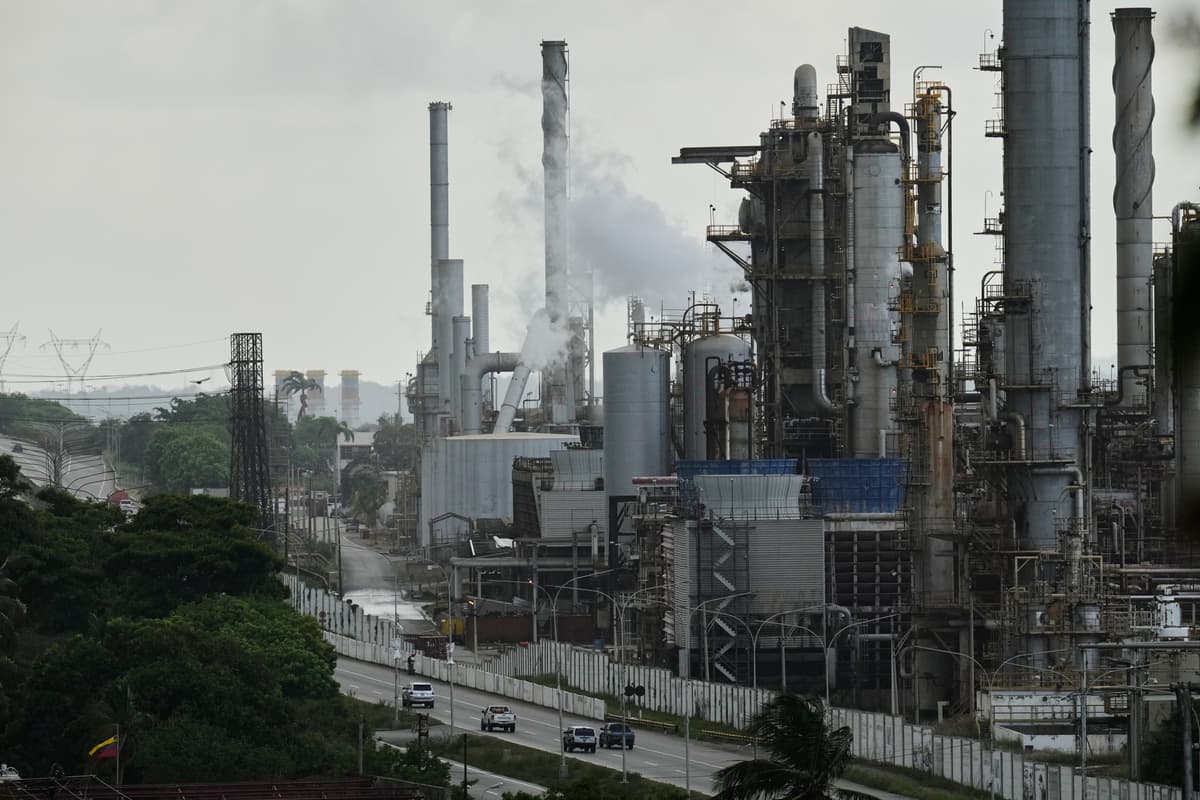
Vehicles drive past the El Palito refinery in Puerto Cabello, Venezuela. AP/Matias Delacroix

While Europe, Russia, China, and South American countries were quick to react to the capture of Nicolás Maduro, Gulf countries have largely kept silent. 

Qatar is so far the only country to publicly react, expressing concern while offering its help to reach an “immediate peaceful solution” in Venezuela. Yet how exactly could an American takeover of Venezuela impact the Middle East?

Venezuela is believed to hold the largest oil reserve in the world, amounting to some 300 billion barrels. Yet it barely produces one million barrels a day. President Trump said that Mr. Maduro’s regime was pumping “almost nothing by comparison to what they could have been pumping.”

The president told NBC News on Monday that oil companies could be “up and running” in Venezuela in less than 18 months: “I think we can do it in less time than that, but it’ll be a lot of money,” he said.

“A tremendous amount of money will have to be spent, and the oil companies will spend it, and then they’ll get reimbursed by us or through revenue,” he said.

If the United States follows through on its promise to take over oil fields, it could have a significant impact on the world’s energy market, including the Gulf countries, which still rely heavily on income from oil exports. 

“It might challenge the Saudi role but it will take a lot of time. Oil in Venezuela is different from Gulf oil. It’s much more expensive to extract in Venezuela,” Dr. Yoel Guzansky, senior fellow at Israel’s Institute for National Strategic Studies tells the New York Sun.

With oil prices already dropping 18 percent in 2025 over concerns of oversupply, an influx of Venezuelan oil is almost certainly a concern for Gulf states, according to Ahmed Khuzaie, a political consultant from Bahrain. 

“Of course the Gulf states are worried because that will mean they will have to readjust their margins, which will affect their way of life,” Mr. Khuzaie told The New York Sun. The silence from Gulf nations stems from an aversion to clashing with Mr. Trump with whom they all have a strong relationship, both experts said. 

“Nobody wants a fight with Trump,” Mr. Khuzaie said, while Mr. Guzansky said Qatar is once again looking to get involved in the conflict as a mediator: “This is always what they want. They push themselves into any conflict in the world.”

Mr. Guzansky cautions that it’s currently “premature” to properly assess how, when and if the U.S. will take over oil production. “It might take years. Some of the installations need to be recovered; they are old and not sufficient. It will take time for American companies,” he said.

A senior fellow at Foundation for Defense of Democracies and Britain’s former ambassador to Yemen, Edmund Fitton-Brown, assesses that Saudi Arabia will be the least worried of all the Gulf states over Mr. Trump’s oil adventure in Venezuela.

“The Saudis have accommodated much bigger strategic fluctuations than this one in the oil market over time. So I think the Saudis will be one of the more relaxed countries in this connection,” Mr. Fitton-Brown told The New York Sun.

It’s not just the prospects of more oil on the market that could affect the Middle East. Venezuela under Mr. Maduro was among a handful of solid allies that Iran had left, making his departure and an American takeover of the country a setback for Tehran. 

“This weakens Iran. It’s lost another ally, and has been losing allies hand over fist for the last year and a half or so. So I think that’s very positive,” Mr. Fitton-Brown said. 

Mr. Khuzaie also believes that the Gulf states see the removal of another ally of Iran as a positive development, but warns that the regime in Tehran has a tendency to lash out through proxies when it feels pressured. In this instance, activating the Houthis to attack ships in the Hormuz Strait is one option, he said. 

Mr. Fitton-Brown also projects that the Houthis could launch attacks in the Hormuz Strait again as they are a “classic case of people who really don’t care” and to “make a point.”

“It wouldn’t surprise me if they were to start attacking ships in the Red Sea then as a way of making that point. But what’s the strategic effect of that?” he said. 

With a chilling warning by Mr. Trump, who said earlier this week that the America would be ready to intervene if Iranian demonstrators are killed, Mr. Khuzaie said Tehran is “studying” what happened to Mr. Maduro, fearing that the same could happen to Supreme Leader Ayatollah Khemenei.  

An assessment Mr. Fitton-Brown shares: “I think the main value of the threat that he made was probably just to put the Khamenei regime off balance and worried because they know that when he makes threats, he often carries them out.”

While neither expert predicts any immediate or earthshattering changes in America’s relationship with Gulf states following the removal of Mr. Maduro or the prospect of more oil on the world market, the signal has already been sent — and from Riyadh to Tehran, it will not be ignored.


The New York Sun

© 2026 The New York Sun Company, LLC. All rights reserved.

Use of this site constitutes acceptance of our Terms of Use and Privacy Policy. The material on this site is protected by copyright law and may not be reproduced, distributed, transmitted, cached or otherwise used.

The New York Sun

Sign in or  create a free account

or
By continuing you agree to our Privacy Policy and Terms of Use