

Trump Starts His Move To Reform the UN
An order issued by the president Wednesday defunds and withdraws America from — for starters — 31 organizations of the world body.
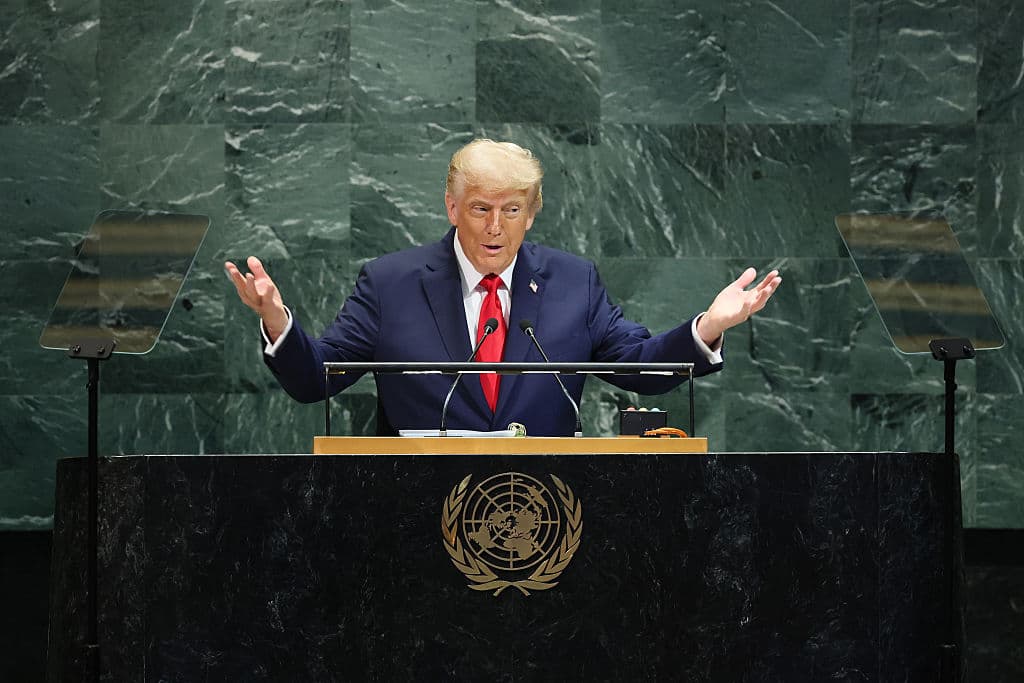
“Reform” is so often repeated at the United Nations that change could only begin once that word is deleted from its vocabulary. Short of a drastic surgery, the bloated, increasingly ineffective, and America-averse institution could perish. President Trump’s decision to sever ties with dozens of UN agencies is a start. Critics cavil over the loss of global leadership or environmental catastrophes. Yet should America finance all UN shenanigans?
Mr. Trump’s order Wednesday defunds and withdraws America from “international organizations, conventions, and treaties that are contrary to the interests of the United States.” The list includes 31 UN organizations and 35 other groups. “Review of additional international organizations remains ongoing,” Secretary of State Marco Rubio writes on X. “We will stop subsidizing globalist bureaucrats who act against our interests.”
One item on the list, the UN Framework Convention on Climate Change, is the focus of many critics’ ire. America is the first country to withdraw from that convention. Like the Paris Accord, from which Mr. Trump bolted in his first term and again last February, the UN and other global climate bodies seem to be reversing Don Quixote’s tactic, tilting ineffective windmills against a warming globe.
The spokesman for Secretary-General Antonio Guterres, Stephane Dujarric, retorts that “as we have consistently underscored, assessed contributions to the United Nations regular budget and peacekeeping budget, as approved by the General Assembly, are a legal obligation under the UN Charter for all Member States, including the United States.” Regardless, he vows that “all UN entities will go on with the implementation of their mandates.”
Yet must America abide by General Assembly writs? That is the same body that since the 1960s votes annually to condemn America’s Cuba embargo with near-unanimity. A body that condemned Israel 15 times in 2025, more than all other countries combined. As a former ambassador there, John Bolton, wrote, “The only consolation, at least to date, is that this global virtue-signaling has not yet included burning the U.S. ambassador at the stake.”
Mr. Bolton famously said that it wouldn’t make any difference if the top floors at the Turtle Bay building were removed. Sure enough, on the day that he entered that landmark UN building, in August, 2025, a fire scare forced the top ten floors to evacuate. No one noticed, other than the Sun’s Benny Avni. Mr. Bolton has long argued that rather than blindly obey UN assessments, Washington should pick and choose for what it pays.
“We will be insisting on a principle I don’t consider too revolutionary,” Mr. Bolton said in a 2008 debate with another former ambassador, Richard Holbrooke, at Brown University. “We should pay what we want, and we should get what we pay for,” he said. During his stint as ambassador, Mr. Bolton added, he realized that “marginal reforms won’t work.” Now his vision of voluntary, rather than assessed, UN contributions is beginning to take shape.
The climate convention is on the chopping block. So are UN Women, the Population Fund, the Conference on Trade and Development, the International Energy Forum, the Register of Conventional Arms, and the Peacebuilding Commission, to name a few. These promote policies that in some cases are opposed by most Americans, and in others, like, say, abortion, are contested. Should the UN get the final say-so on these?
America funds 22 percent of the UN’s regular budget and 26 percent of peacekeeping. Communist China, which for decades had paid far below the size of its economy, is now responsible for 20 percent of the regular budget. Its officials are seizing top agencies. As America’s generosity shrinks, critics say we’d lose global influence. Yet how influential would a communist-led UN be? Are UN denizens at Turtle Bay prepared to move to Beijing?