
Uneven Temper and Tone Mar Prudovsky’s ‘My Neighbor Adolf’
The film meanders promiscuously between the sickly sweet and the blatantly profane.
Leon Prudovsky’s “My Neighbor Adolf” is a film that doesn’t quite know what it is or what it wants to be. Take note that the name in the title ends not with a “ph” but an “f,” and then consider what historical figure co-writers Mr. Prudovsky and Dmitry Malinsky are referring to all the same. The aim was to create “a Hasidic parable … typical for the pre-Holocaust Jewish world.” The trouble is that the film is a product of a post-Holocaust world riven with its own insecurities and dangers. Mr. Prudovsky’s morality tale is an equivocal, somewhat clueless affair.
“My Neighbor Adolf” begins with an idyllic afternoon in “1934 Eastern Europe.” We overhear the kibitzing of a family: Three generations discuss the next move in a game of chess and the health benefits of smoking. All the while we watch as slender female hands mix oil with crushed eggshells as a means of fertilizing a rose bush. An awkward photo of a comfortable family is taken. When the flash goes off we are transported to “South America 1960.”
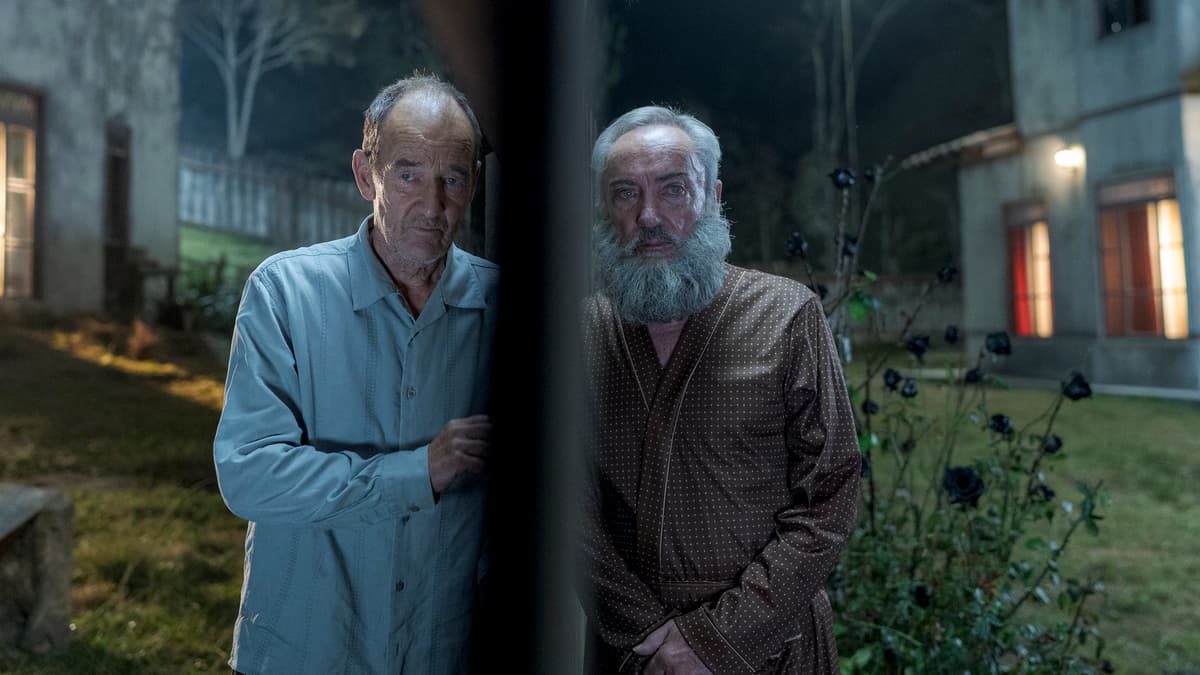
It is there that we meet Malek Polsky (the Scottish actor David Hayman) or, rather, we re-meet him: the younger Malek (Jan Szugajew) was the persnickety, somewhat dandy-ish father seen in the preamble. Things are different now: Our protagonist lives alone at a fenced-off homestead in the rolling hills of Colombia, a cranky old man who has problems urinating and doesn’t suffer anyone gladly. Malek reads the paper, tends to an outcropping of black roses, and harumphs at the machinations of wanna-be chess players.
The aforementioned family photo serves as Polsky’s talisman: all of its members, save himself, were killed in the death camps. A life of isolation is what is required and, though it’s not explicitly stated, deserved. This less than idyllic existence is interrupted by Frau Kaltenbrunner (Olivia Silhavy), a lawyer working for a client interested in purchasing the house next door. When it turns out that Polsky must cede part of his property due to zoning records on file, he is aghast: the narrow plot of land contains the prized rose bush.
He also has suspicions about the tenant next door, Hermann Herzog (Udo Kier). Predisposed to not look kindly upon Germans, Polsky bristles when a cadre of them arrive to deliver what look to be pricey furnishings to Herzog’s home. Seen and heard from a distance, the neighbor proves a disagreeable presence given to abrupt bursts of anger. He’s an amateur painter, and doesn’t allow the smoking of cigarettes on his property. As for Herzog’s dog, Wolfie: it doesn’t like Polsky, not a bit.

Our protagonist becomes convinced that Herzog is none other than the former chancellor of the German Reich, whose body, we are told, was never recovered after his suicide in April of 1945. When a local Israeli representative (an officious Kineret Peled) dismisses the claims as those of an addled survivor, Polsky takes matters into his own hands. He sets up a camera on the sly, trespasses on his neighbor’s home under cover of the night, and otherwise tries to gather concrete evidence that Herzog is, in fact, Hitler.
When Herzog discovers that Polsky is something of a chess master, he increasingly encroaches on the old man’s time. Games are played and a bond starts to form between … friends?
Historians can chime in on whether Hitler ever picked up a rook in his life, but a general viewer can comment on how believable Kier is in the role of the former führer — that is to say, not at all. Notwithstanding the extravagance by which the Herzog character disguises himself, a lush beard and mild CGI fail to distract from the movie star under their auspices. That’s the least of it: “My Neighbor Adolf” is a film of uneven temper and tone, meandering promiscuously, as it does, between the sickly sweet and the blatantly profane.
Messrs. Prudovsky and Malinsky attempt to navigate this treacherous dynamic by introducing a plot element that strains an already beggared story. Łukasz Targosz tries to paper things over with a score that is, in equal parts, saccharine and schmaltzy. A curious venture, this movie, and too reckless for its own good.