United States Intercepts Chinese-Owned Tanker Following Trump’s Venezuela Blockade Order

The second such seizure follows a Trump administration directive imposing a strict blockade on sanctioned oil vessels traveling to and from the country.

Jesus Vargas/Getty Images
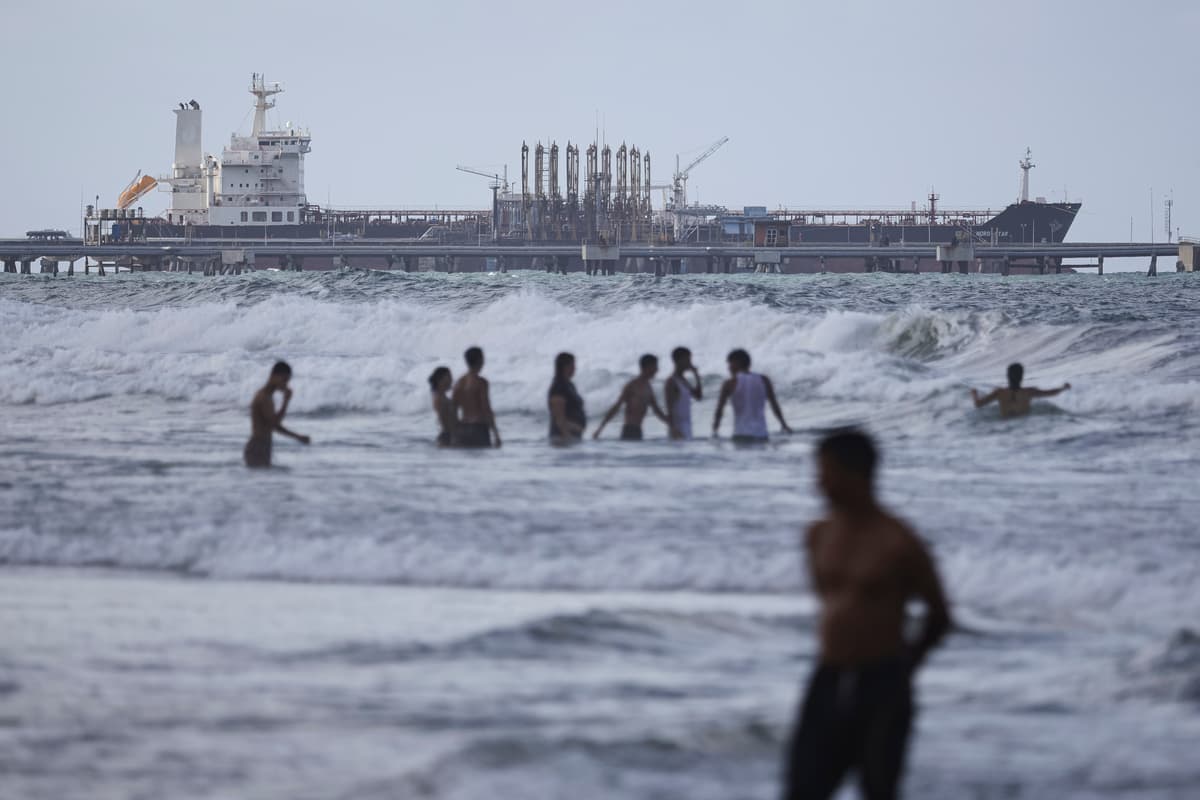
Swimmers take to the sea as an oil tanker remains anchored outside a refinery at Puerto Cabello, Venezuela, on December 18, 2025. Jesus Vargas/Getty Images

Tensions in the Caribbean escalated on Saturday as United States forces intercepted and boarded a Chinese-owned oil tanker, according to news reports.

The operation comes just days after President Trump issued a directive ordering a strict blockade on sanctioned oil vessels traveling to and from Venezuela.

The vessel intercepted Saturday, identified as the Centuries, is a 333-meter-long supertanker flying a Panamanian flag, Bloomberg News reported. Sources familiar with the matter told Bloomberg the ship was carrying up to 2 million barrels of Venezuelan crude oil, to which a Chinese company holds the title. The interception reportedly took place in international waters off Curaçao, a Dutch Caribbean island.

It was the second such seizure of a tanker in recent weeks and follows a forceful declaration from the White House regarding Venezuela’s oil exports. “I am ordering A TOTAL AND COMPLETE BLOCKADE OF ALL SANCTIONED OIL TANKERS going into, and out of, Venezuela,” Mr. Trump said on Tuesday.

However unlike the Skipper, which was seized on December 10, the Centuries is not believed to be subject to American sanctions.

The seizures follow a significant U.S. military build-up in the region. Mr. Trump’s pressure campaign against the Venezuelan president, Nicolás Maduro, has intensified, with reports of more than two dozen military strikes on vessels in the Pacific Ocean and Caribbean Sea. These strikes have reportedly resulted in more than 100 deaths.

Mr. Trump has indicated that American land strikes on the South American nation may be imminent. In response, Mr. Maduro has charged that the military posturing is a precursor to a military attempt to seize control of the OPEC nation’s oil reserves, the world’s largest.

The aggressive enforcement has created an effective embargo. Since the seizure of the Skipper — which had been under sanctions for its ties to Iran — Venezuelan crude exports have plummeted. Loaded vessels carrying millions of barrels are currently idling in Venezuelan waters to avoid interception, Bloomberg reported.

Since energy sanctions were imposed in 2019, traders have largely relied on a “shadow fleet” of tankers that disguise their locations as they transport oil. China remains the largest buyer of Venezuelan crude, accounting for roughly 4 percent of its imports, Reuters reports.

“International law states a ship may be boarded if there are reasonable grounds to believe it is not legitimately registered to the state whose flag it is flying,” the New York Times reports. “The U.S. official said that the Coast Guard was trying to determine if the tanker’s Panama registration was valid.”

While three officials confirmed to Reuters that the U.S. Coast Guard led Saturday’s operation, the Coast Guard and Pentagon referred inquiries to the White House, which had not yet responded. Venezuela’s oil ministry and state oil company, PDVSA, had also remained silent on the incident.


The New York Sun

© 2025 The New York Sun Company, LLC. All rights reserved.

Use of this site constitutes acceptance of our Terms of Use and Privacy Policy. The material on this site is protected by copyright law and may not be reproduced, distributed, transmitted, cached or otherwise used.

The New York Sun

Sign in or  create a free account

or
By continuing you agree to our Privacy Policy and Terms of Use