Why Iran’s Most Powerful Military Force Refuses To Abandon the Regime
The country’s rulers have spent the last five decades preparing for just this moment.
As protests continue to ripple across Iran, one question dominates the calculations of analysts watching the Islamic Republic’s stability: where are the military defections that could tip the regime toward collapse once and for all?
Despite weeks of sustained demonstrations that have drawn comparisons to the final days of other authoritarian regimes, Iran’s security apparatus — particularly the powerful Islamic Revolutionary Guard Corps — has shown no indication of the mass fracturing that typically presages regime change.
The absence of significant defections stands in stark contrast to historical precedents. When Tunisia’s Ben Ali fell in 2011, the army’s refusal to fire on protesters proved decisive. Egypt’s Hosni Mubarak met a similar fate days later when military commanders declined to crush Tahrir Square demonstrations.
Even Syria’s Bashar al-Assad faced substantial military defections in the early months of that country’s uprising, though his regime ultimately survived through Russian intervention and Revolutionary Guard support.

Iran’s rulers appear to have learned from these examples. The regime has spent decades constructing overlapping security structures specifically designed to prevent the kind of military rebellion that toppled the Shah in 1979, a revolution the current leadership knows intimately, having orchestrated it themselves.
“The IRGC hasn’t defected en masse because it’s a self-sustaining mafia with billions in black-market wealth, oil profits, and total control over repression,” managing director and co-founder of Nestpoint Associates, John Thomas, tells the Sun. “In short, they are paid mercenaries. Loyalty is bought with money and enforced by fear.”
The Architecture of Loyalty
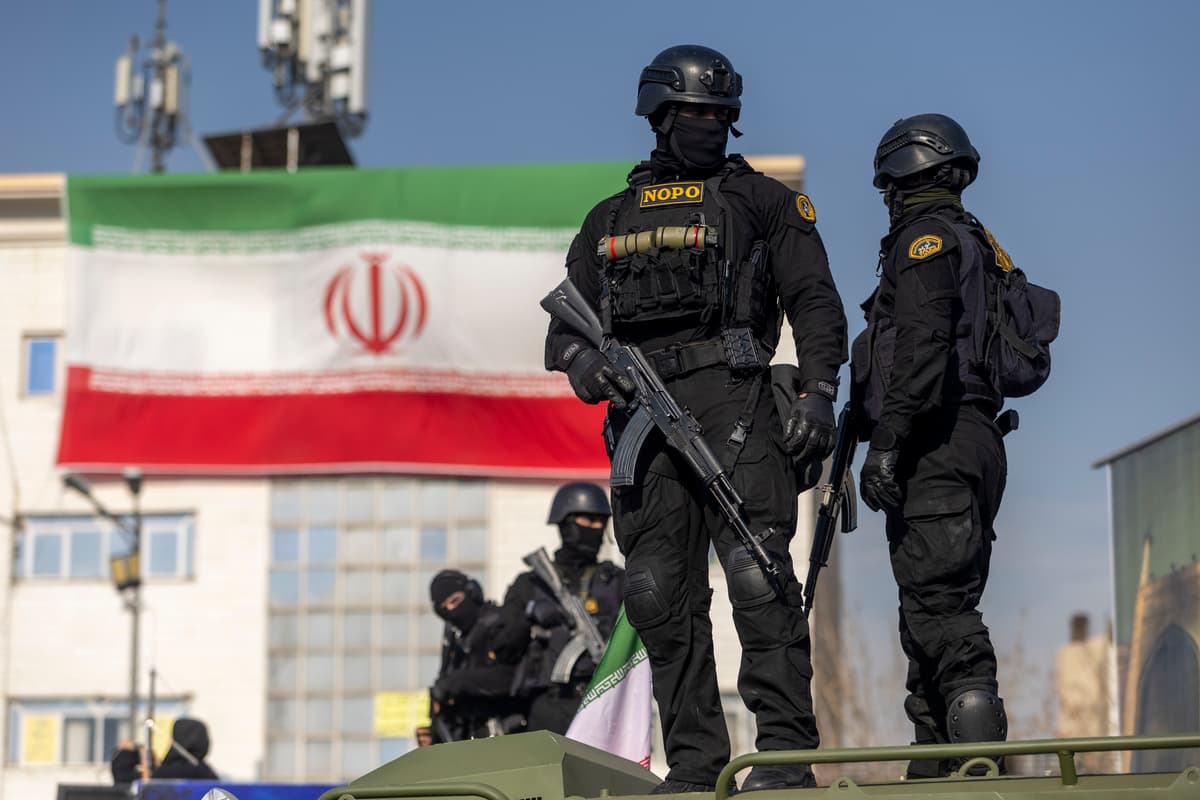
The Islamic Revolutionary Guard Corps represents far more than a conventional military force. Established in the revolution’s immediate aftermath, the IRGC operates as an ideologically indoctrinated parallel army, deliberately positioned to counterbalance the regular Artesh forces inherited from the Shah’s era.
With up to 190,000 active personnel, the Guards control vast economic enterprises, command external operations through the Quds Force, and maintain the Basij paramilitary organization that fields hundreds of thousands of additional mobilized forces.

The IRGC and the Artesh are two separate military forces. The Artesh, the regular army, is responsible for conventional defense, while the Islamic Revolutionary Guard Corps is tasked with protecting the regime and enforcing ideological loyalty.
Although the two forces sometimes operate together, most notably in Syria, where Artesh units have fought under IRGC leadership, they are institutionally separate, with different chains of command. This separation is deliberate. By keeping the IRGC alongside, rather than merged with, the regular army, the regime ensures that its most loyal force is always in a position to supervise and counterbalance the Artesh.
This architecture is designed not just for coordination, but for control. The IRGC has created a system in which defection is almost structurally impossible. Interlocking commands, shared intelligence networks, and a surveillance apparatus ensure that Guards personnel monitor regular forces and that regular forces monitor Guards personnel.
The economic dimension also reinforces these structural controls. IRGC commanders and senior officers control construction conglomerates, telecommunications networks, and smuggling operations worth billions of dollars.
Khatam al-Anbiya Construction Headquarters, the Guards’ primary engineering arm, has secured contracts for dams, highways, and oil facilities across Iran. These financial stakes create powerful disincentives for defection among the officer corps who benefit from the system.
The Praetorian Bargain
The Revolutionary Guards’ continued loyalty, however, reflects more than organizational structure or economic interest. The force’s identity is inseparable from the Islamic Republic itself. Unlike a conventional military, which is meant to serve the country regardless of who is in power, the IRGC was created for a single purpose: to protect the Islamic Revolution and uphold Iran’s system of clerical rule under the velayat-e faqih.

This system places a senior Shiite cleric—the Supreme Leader—above all branches of government, giving him ultimate authority over the military, judiciary, and security services. The IRGC’s loyalty is therefore not just to the state, but to the religious authority and ideology at the heart of the regime.
This ideological dimension creates what analysts call a “Praetorian bargain,” named for the purple-cloaked imperial unit that guarded the Roman emperors. In the case of the IGRC, the Guards understand that regime collapse means their own institutional destruction. Western governments, regional adversaries, and Iranian opposition groups have all designated the IRGC as a terrorist organization and promised accountability for human rights violations.
For senior commanders implicated in decades of repression, both domestically and across the Middle East, defection offers no safe harbor.
Fear of punishment is reinforced by something else: the benefits of staying loyal.
“Even as Iranians demand the end of the Ayatollah era of their country, rank and file operatives of the IRGC desperately hang on,” global risk analyst Dennis Santiago tells the Sun. “It is important to remember that the IRGC created a privileged class that poor people could aspire to become in Iran. This was wealth. This was power. This was prestige and pride.”

Mr. Santiago notes that for many Guard members, the stakes are deeply personal.
“If the regime falls, they know they and their loved ones will bear the brunt of inevitable street justice,” he continues. “That’s a pretty hard ask, even for people who can see, better than most, that something is deeply wrong with the governance of their country.”
The Guards have also demonstrated tactical flexibility in managing the current crisis. Rather than deploying overwhelming force that might trigger broader military resistance, security forces have employed calibrated repression — arresting protest leaders, disrupting communications, and using targeted violence while avoiding Tiananmen-style massacres that could fracture military unity.
This calculated approach appears designed to wait out the protest movement while maintaining cohesion among security forces.
“The IRGC hasn’t fractured en masse because it was built as a parallel regime-protection force, not a conventional army,” intelligence expert and president of Terra Nova Strategic Management, Ian Bradbury, tells the Sun.

“Recruits are vetted for loyalty to Khamenei, senior officers benefit directly from the system’s economic and political rents, and discipline is enforced through a combination of ideology, patronage, and ruthless coercion.”
Yet Mr. Bradbury cautions against assuming permanent stability.
“Elite loyalties remain contingent,” he underscores. “Sudden shocks, such as military setbacks, targeted decapitation of leadership, or fractures within the regime itself, could rapidly shift the calculus of self-preservation. History shows that elite defection rarely unfolds gradually; it often appears sudden and unpredictable.”
For now, however, the IRGC’s cohesion remains firmly in place.
“Until the cash runs dry or the leadership is systematically eliminated, the ranks will hold,” Mr. Thomas asserts, noting that sustained protests over time, ramping up pressure, and high-profile defections could eventually fracture IRGC cohesion. “So far, the money hasn’t dried up.”
The international community, nevertheless, continues to watch for cracks in Iran’s military monolith. But the Islamic Republic’s rulers have spent 44 years preparing for precisely this moment. Whether that strategy succeeds may ultimately depend less on military loyalty than on how long Iranian society can sustain its resistance against a security apparatus that, for now, shows no signs of standing down.
“The IRGC’s cohesion is durable, but not immutable,” Mr. Bradbury adds.