
Will Mamdani Come After the Private Property of New Yorkers?

Concerns grow after one of his appointees turns out to be an opponent of treating ‘property as an individualized good.’
Amir Hamja, pool/Getty Images
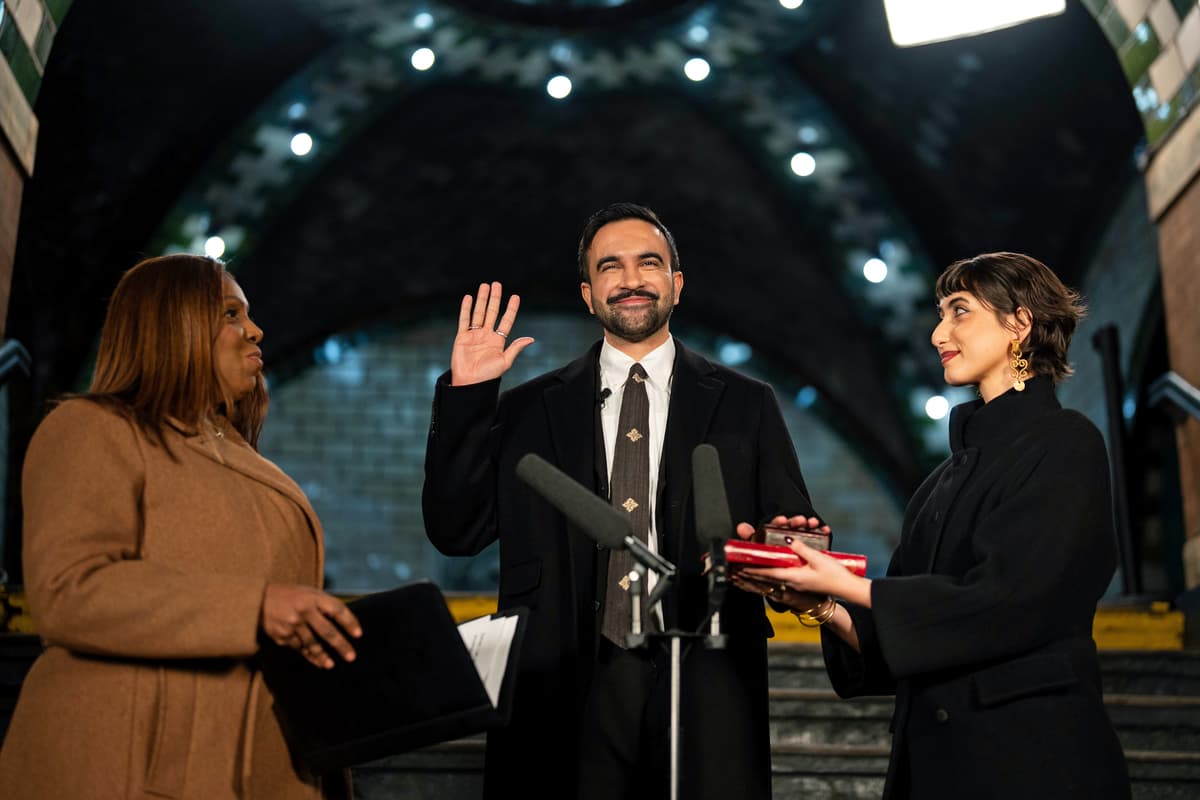
Mayor Zohran Mamdani is sworn in by Attorney General Letitia James, left, alongside his wife Rama Duwaji, right, at the former City Hall subway station on January 1, 2026. Amir Hamja, pool/Getty Images

Does Mayor Mamdani believe in private property rights? That is the question that emerges in the wake of resurfaced posts on social media from his new director of the Mayor’s Office to Protect Tenants, Cea Weaver. Ms. Weaver, like Hizzoner a card-carrying member of the Democratic Socialists of America, laments in a post from 2019 that “For centuries we have treated property as an individualized good and not as a collective good.”

Ms. Weaver has it precisely wrong. President John Adams rightly determined that “Property must be secured, or liberty cannot exist.” Friedrich Hayek reasoned that “The system of private property is the most important guarantee of freedom, not only for those who own property, but scarcely less for those who do not.” Walter Lippmann called private property “the original source of freedom” and reckoned that “It still is its main bulwark.”

Ms. Weaver argues that “transitioning” toward treating property as a “collective good” requires that “we think about it differently and it will mean that families, especially white families but also some POC,” short for people of color, “families who are homeowners as well are going to have a different relationship to property than the one they currently have.” She has also called private property, “ESPECIALLY homeownership,” a “weapon of white supremacy.”

Quoth Ms. Weaver in 2018: “Seize private property!” In 2017, she urged people to “Elect more communists,” for whom property held in private is anathema. Lest anyone think that these sentiments are entirely alien to Mr. Mamdani, his inaugural address last week waxed poetic about the “warmth of collectivism” and decried the “frigidity of rugged individualism.” We called those formulations “Orwellian newspeak.”

We have often written in these columns about the death of press freedom in the Soviet Union. That happened when the Bolsheviks, who had seized the press in Russia, refused, on Lenin’s say-so, to return to the owners of the country’s press the printing equipment, racks of type, rolls of paper,  and barrels of ink that the Bolsheviks declared to be property of the Revolution. That story is told in John Reed’s towering report, “Ten Days That Shook the World.”

It’s too soon to know what the new Mamdani administration is going to seize from New Yorkers. It is not too soon to say that there is no way to infringe on property rights without infringing on the rights of New Yorkers, rich and poor alike. The founding managing editor of the Sun, Ira Stoll, reckons that it would be “a real disaster for America if its largest city becomes like revolutionary Iran or Venezuela, places where property rights were imperiled.”

Ms. Weaver in 2020 said that “we have to get out of this trap of private property.” If this is Mr. Mamdani’s vision for “affordability,” it is a movie whose ending we have seen before, from Moscow to Pyongyang to Havana to Caracas. As Mr. Stoll warns, “even as central planners and anti-Israel political leaders come under pressure or are ousted around the world, one is taking power in New York City.”     


The New York Sun

© 2026 The New York Sun Company, LLC. All rights reserved.

Use of this site constitutes acceptance of our Terms of Use and Privacy Policy. The material on this site is protected by copyright law and may not be reproduced, distributed, transmitted, cached or otherwise used.

The New York Sun

Sign in or  create a free account

or
By continuing you agree to our Privacy Policy and Terms of Use