Closer Relations Between Trump and Netanyahu Can Benefit the Mideast

An American-backed military action against Iran’s missile program would represent a shift in Washington’s policy.
Joe Raedle/Getty Images
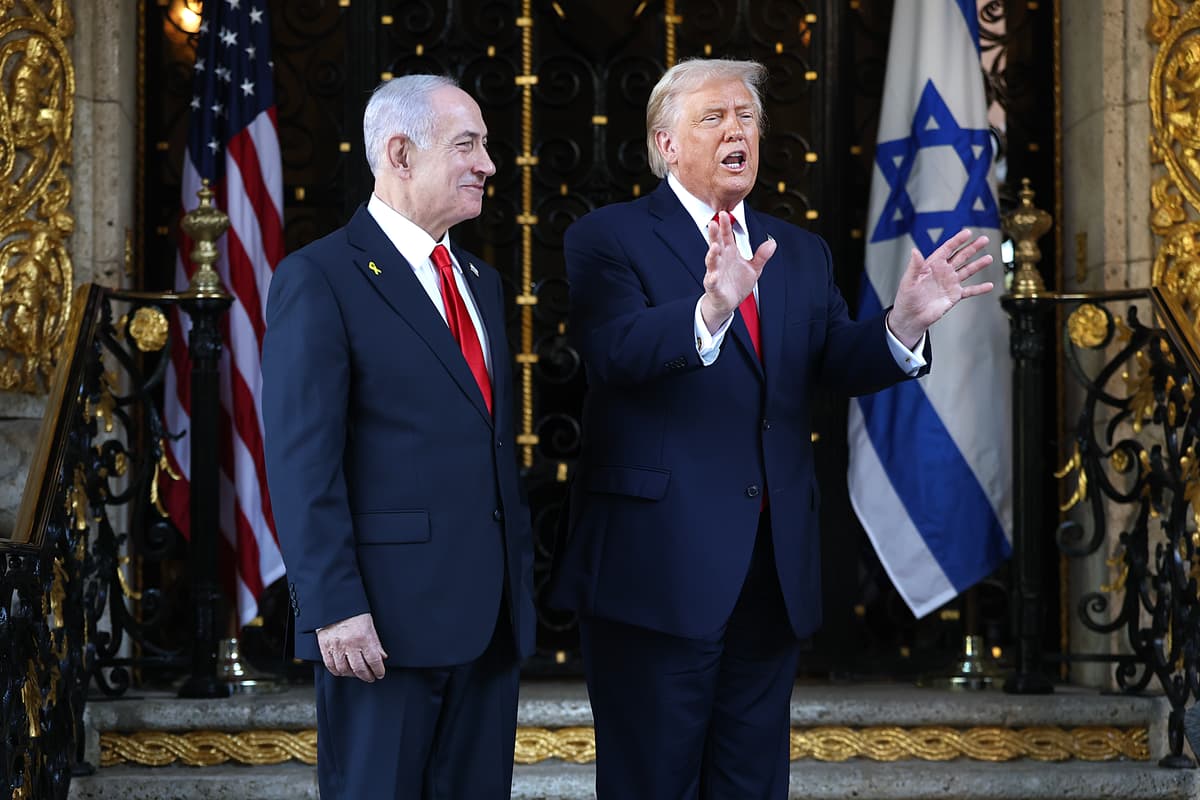
President Trump talks to the media as he welcomes Prime Minister Benjamin Netanyahu to his Mar-a-Lago club on December 29, 2025 at Palm Beach, Florida. Joe Raedle/Getty Images

Generations of American Mideast watchers have argued that progress in the Middle East depends on balancing Israel’s interests with those of its enemies. Creating a “daylight” between America and Israel gained currency in the Obama era. After October 7, 2023, it became an article of faith among leading Democrats, as well as many some well-placed Republicans.

The one glaring exception is President Trump.    

Hosting Prime Minister Benjamin Netanyahu at Mar-a-Lago on Monday for a sixth meeting since January, Mr. Trump seemed eager to deepen Israeli-American ties. He made an effort to dispel recent reports of a supposed growing anger among his top aides at the “hothead” Israeli premier. Instead, he praised Mr. Netanyahu as a “wartime leader” without whom Israel would not have survived the last two years of war. 

Unidentified White House officials have long attempted to put a damper on the mutual admiration that the American and Israeli leaders often express. Sure enough, reports attempted to dampen their Monday chummy press conferences. These accounts, sourced to Washington officials, claim that in truth Mr. Trump’s closest advisers are increasingly frustrated with the longest serving Israeli prime minister.

Powerful public comments that Israel and America see eye to eye on most things, though, are significant even if disagreements behind closed doors are as profound as detractors claim. Televised events such as the Monday meeting tell both allies and foes that a national and personal alliances guide policy, rather than Washington gossip about enmity.    

Israel is entering an election year, with a vote for the new Knesset that will determine the next premier expected in September. Mr. Trump repeated his advocacy of a pardon for Mr. Netanyahu, who is under indictment on several charges. Most recently, several close associates of the premier are facing allegations of receiving funding from Qatar, a Hamas supporting country that spreads anti-Israel venom around the world.

Mr. Trump refuses to join a chorus of Mr. Netanyahu’s Israeli and global critics. “If you had eight out of ten prime ministers in his position right now,” the President said Monday, “maybe you wouldn’t have Israel any longer.” The world knows it, he added, and so do Israelis. There “even the haters have a lot of respect for him. There’s a lot of jealousy about him.”

Mr. Netanyahu doubled down on the compliments, promising that in May, when Israel celebrates independence day, he will make Mr. Trump the first foreign winner of the prestigious Israel Prize. Awarding the prize “reflects the overwhelming sentiment of Israelis across the spectrum,” he said. At one time, he added, many believed that “America can advance its interest in the Middle East if it opens a lot of daylight between it and Israel. And President Trump has done the exact opposite.” 

Such warm mutual praise contrasts hot-and-cold relations Mr. Trump maintains with other world leaders, including President Volodymyr Zelensky, who visited Mar-a-Lago on Sunday. Beyond compliments Mr. Trump is defying advisers, and sometimes his own instincts, to adopt some of Mr. Netanyahu’s policies, especially on Iran and Gaza. 

At the same time, Jerusalem increasingly eyes Turkey as a menace. President Recep Tayyip Erdogan, who Mr. Trump considers a friend, emerges as a well-armed competitor, eager to confront Israel economically and undermine its interests militarily. One potential arena where Israel and Turkey could clash is Syria, where a former Jihadist leader and Ankara protege, Interim President Ahmed al-Sharaa, is highly praised by Mr. Trump.   

Below are the top challenges for Israel that Mr. Netanyahu often highlights, and how Mr. Trump approaches them — both publicly and in action. 

Gaza

Mr. Trump’s top negotiator, Steve Witkoff, and son in law, Jared Kushner, are widely reported to advocate moving fast toward rehabilitation of Gaza. One plan they recently introduced to regional allies involves turning the Strip into a self-sustaining beach resort fueled by high-tech and Artificial Intelligence.

Democrats, meanwhile, are concerned that promises of rebuilding of the Strip and deliveries of mass aid to Gazans “are not happening,” as a Pennsylvania representative, Madeleine Dean, told CNN. 

Israel, whose troops remain in more than 55 percent of Gaza territory, is witnessing a Hamas resurgence in areas it has left. As long as the terrorists are armed and can assert their authority, they say, any attempts at rebuilding Gaza are doomed.

In public statements, Hamas officials boast they would never disarm. As a cold and rainy winter hits Gaza, armed Hamas men are demanding a monthly $800 rent from residents, even though they live in globally-supplied tents. 

“We talked about disarmament, and they’re going to be given a very short period of time to disarm,” Mr. Trump said Monday. Siding with Israel, he threatened Hamas with “hell” if it defies his peace plan. The plan, which Hamas signed onto back in September, demands an end to its rule in Gaza and relinquishment of all its weapons. Mr. Trump added that more than half of all Gazans would leave the Strip if they had a chance to do so. 

Iran

Alarms rise in Israel over intelligence that the Islamic Republic is rebuilding much of its ballistic missile manufacturing facilities and replenishing its arsenal. According to a report on an anti-regime news site, Iran International, the Iranians are also developing missiles tipped with chemical and biological agents. Back in June, Tehran launched barrages of missiles, including highly accurate ones, on civilian and military targets in Israel.

Until now Mr. Trump seemed completely satisfied with America’s and Israel’s action in the 12-day war that “obliterated” Iranian nuclear capabilities. At the same time he declined to address the threat that Iran’s conventional arms present to Israel and other American allies.

Would Mr. Trump greenlight military action against the Islamic Republic? “If they will continue with the missiles, yes,” he said on Monday. If Iran renews its nuclear program as some intelligence reports indicate, he added, “the consequences will be very powerful, maybe more powerful than the last time.”

Such statements are “a historic shift in U.S. policy, if acted upon,” the policy director at United Against Nuclear Iran, Jason Brodsky, tells the Sun. “It’s unprecedented for an American president to publicly threaten military action against Iran’s missile program. That has been reserved traditionally for Iran’s nuclear program.”

While Mr. Trump also expresses the hope that Iran would agree to negotiate away its ballistic missile arsenal, Tehran is quick to reject such initiatives. “Iran’s ‌missile capability and defense are not containable or permission-based,” a top adviser to the Supreme Leader, Ali Shamkhani, said Monday. “Any aggression will face an immediate, ‌harsh response beyond its planners’ imagination.”

Turkey

President Erdogan often uses anti-Israel and antisemitic rhetoric to boost his stance at home and abroad. Turkey has long dropped Ata Turk’s secularism. Regionally, it is emerging as a top supporter of the Muslim Brotherhood and Islamist terrorists like Hamas. Jerusalem, in response, is tightening relations with Greece and Cyprus, creating a regional counterweight to Ankara’s expansionist designs. 

The American president, in contrast, says that Mr. Erdogan is “a very good friend of mine.” With Mr. Netanyahu at his side, Mr. Trump adds that Turkey and Israel are “not going to have a problem,” since Mr. Erdogan has “done a fantastic job,” and “I’m with him all the way.” He even added that he’d considered approving the sale of F-35 jets to Turkey despite objections from Israel and its Washington supporters.

“It is puzzling to hear Trump’s ongoing praise of Erdogan and the trust he places in Turkey,” an Ankara watcher at the Foundation for Defense of Democracies, Sinan Ciddi, tells the Sun. Praising the Turkish president, he adds, is “a missed opportunity for the White House to stand shoulder to shoulder with Israel against the rising threat that Turkey presents to Middle East stability, and the dangers it presents to U.S. national security interests.” 

Syria

“The new president of Syria is working very hard to do a good job,” Mr. Trump says, adding, “you’re not going to get a choir boy to lead Syria.” Speaking of Messr. Netanyahu and Sharaa, he added, “I hope they’re going to get along.” Israelis, though, are concerned about the former leader of the Al Qaeda Syrian branch and his Islamist Ankara backers.

“We want to make sure that the border area right next to our border is safe,” Mr. Netanyahu says. “Druze, but other minorities, especially the Christians, should be protected as well in Syria.” Is that feasible in the new Syria?

This week an Israeli research center, Alma, published a paper on Syria’s new school textbooks. “Ahmed Shahraa is creating a new Islamist generation in Syria that will establish a Taliban State in Syria, just across the Israeli border,” Alma’s founder, Sarit Zehavi, says. 

Mr. Trump might be overly enthusiastic about creating a new, peaceful Mideast. Mr. Netanyahu, in contrast, sees perils that could threaten his country. Despite those differences, the two leaders avoid public spats. At times they almost complete each other’s sentences. Their alliance returns Israel to the center of America’s Mideast policy. To date, it has worked for the benefit of both countries.


The New York Sun

© 2025 The New York Sun Company, LLC. All rights reserved.

Use of this site constitutes acceptance of our Terms of Use and Privacy Policy. The material on this site is protected by copyright law and may not be reproduced, distributed, transmitted, cached or otherwise used.

The New York Sun

Sign in or  create a free account

or
By continuing you agree to our Privacy Policy and Terms of Use