
Flyers, Suspending Announcer for Vulgar Quip, Offer a Gut-Check Moment for the Culture

The penalty over a ribald joke reflects how profanity that is routine in podcasts, music, and movies can earn hefty fines when said over the air.
AP/Jeffrey Barnes
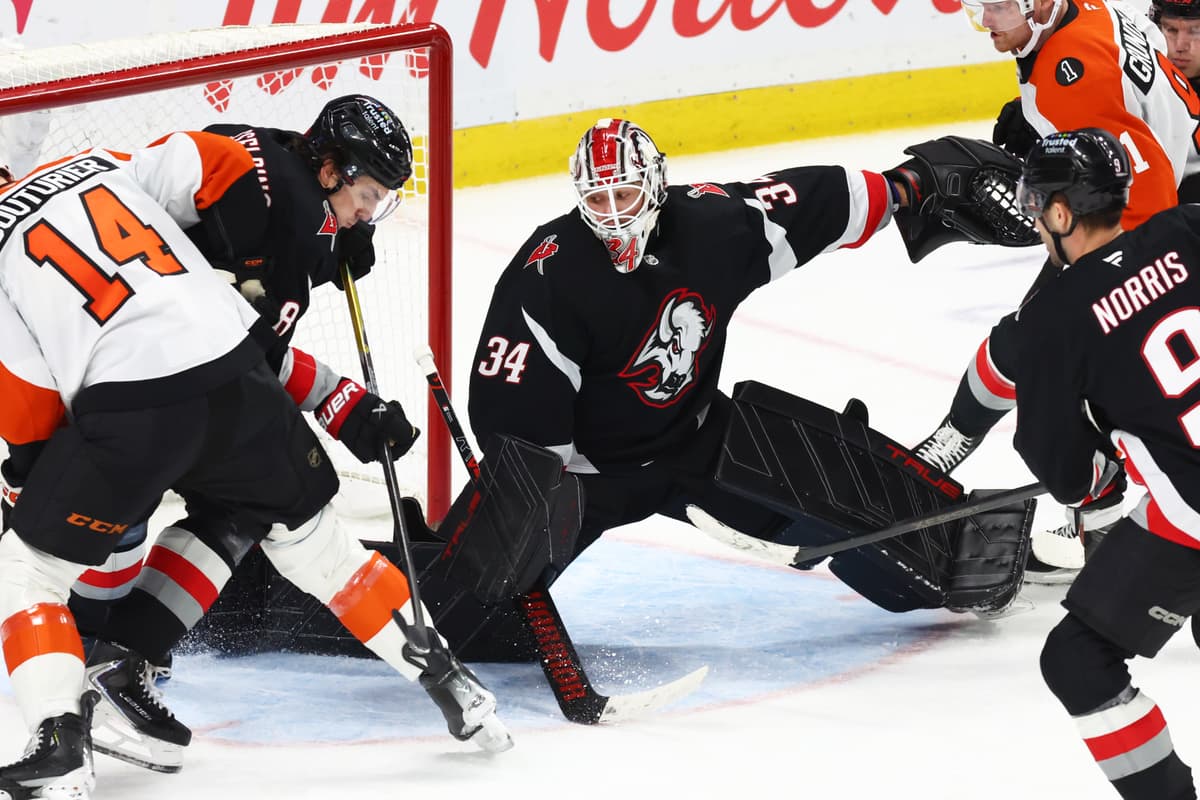
The Buffalo Sabres' goaltender, Alex Lyon, makes a save during an NHL game against the Philadelphia Flyers, December 18, 2025, at Buffalo. AP/Jeffrey Barnes

A play-by-play announcer for the Philadelphia Flyers, Tim Saunders, is spending two games in the penalty box for a ribald quip. Expect more broadcasters to get burned by hot mics as the culture’s bar for appropriate speech slips ever lower than the FCC’s.

The rule to treat any microphone as if it’s live is cited more often than it’s practiced. This was the case on Thursday night when the Flyers took on the Buffalo Sabres with Mr. Saunders calling the action for 97.5 The Fanatic.

Mr. Saunders tossed to a break, but his mic stayed live. While he hummed to pass the time, someone appears to have ducked under his desk. “While you’re down there?” the broadcaster asked, before using a slang word for a sexual act.

The color commentator and former player, Todd “The Fridge” Fedoruk, realized his partner’s mistake. “I think,” he said, “we’re still on the air, Tim,” prompting more chuckles. “No, we’re not,” Mr. Saunders said. “Are we?” More laughter ensued. 

“Are we?” Mr. Saunders repeated to the control room before a long pause. “Do you have us? Talk to me.” A better indication of his professionalism than letting the joke slip may be that, realizing his blunder, he didn’t react with expletives.

The public began sharing the moment on social media, indicating its appetite for juvenile jokes and schadenfreude. It was a rare moment when the NHL — smallest of the major leagues — went viral, prompting the Flyers to clutch the team pearls.

Mr. Saunders was issued “a two-game suspension,” Philadelphia wrote in a statement, while they “address this matter.” They said the broadcaster’s “remarks do not reflect the standards of conduct or values we expect from anyone associated with our organization.”

Before audio-capturing software was ubiquitous, hot-mic moments were heard only by those listening live. “Dump” or “bleep” buttons acted as safeguards, too, saving broadcasters and stations from embarrassment.

Many sporting events, though, are now streamed online. There’s often no delay button and more complicated plumbing, increasing the chances that something will slip through a digital crack. For over-the-air broadcasts, the risks are greater than mere embarrassment.

Radio and TV are regulated by the Federal Communications Commission, whose standards haven’t kept pace with society. Profanity that’s routine in broadcast mediums like podcasts, music, and movies can earn hefty fines when said over the air.

Foul language has become routine and boring in daily life. Even politicians have gotten into cursing, proving it is mundane. Because the joke Mr. Saunders told has been made countless times before, the chances that it would one day make it on air increased.

Rare is the broadcaster these days who keeps it clean 24/7. On WNBC-TV in New York City, news anchor Sue Simmons in 2008 got caught asking her co-host, “What the f— are you doing?” Nobody would have batted an eye in the newsroom, but her mic was hot.

The Flyers apologized to “all those affected” by Mr. Saunders “comments.” Yet seeing the reactions online, it’s hard to imagine just who felt harmed. Visitors at Philadelphia sporting events hear far worse, a profane reputation that’s a local point of pride.

In the over 2,700 comments on the statement from the Flyers, it was hard to find any fans or observers who condemned Mr. Saunders. Closest to negative reactions were the few who said they’d be fired for making such a joke.

A post by one of the over 17,800 Facebook members at the Flyers Talk group wrote that he’d regarded Mr. Saunders as “a nerdy, Poindexter” who’d gained “credibility” with the jest. Again, support was overwhelming. “If they fire him,” one fan said in apparent jest, “we riot.”

Although Mr. Saunders apologized for his “error in judgment,” he may face further penalties or even lose his job in the booth. But regardless of his fate, social media reactions are a chance to reflect on how crudeness has become common.

Since the FCC was formed in 1934, the bar for acceptable speech has dropped as broadcast formats have multiplied. Mr. Saunders’s suspension challenges the Flyers, feds, and fans to reflect on holding sportscasters to higher standards than the culture holds itself.


The New York Sun

© 2025 The New York Sun Company, LLC. All rights reserved.

Use of this site constitutes acceptance of our Terms of Use and Privacy Policy. The material on this site is protected by copyright law and may not be reproduced, distributed, transmitted, cached or otherwise used.

The New York Sun

Sign in or  create a free account

or
By continuing you agree to our Privacy Policy and Terms of Use