From the Super Bowl to the World Cup, How Trump Turned Sports Into a Political Power Tool
Our ‘Fan-in-Chief’ is using personal appearances, executives orders and strategic alliances to master the game behind the game.
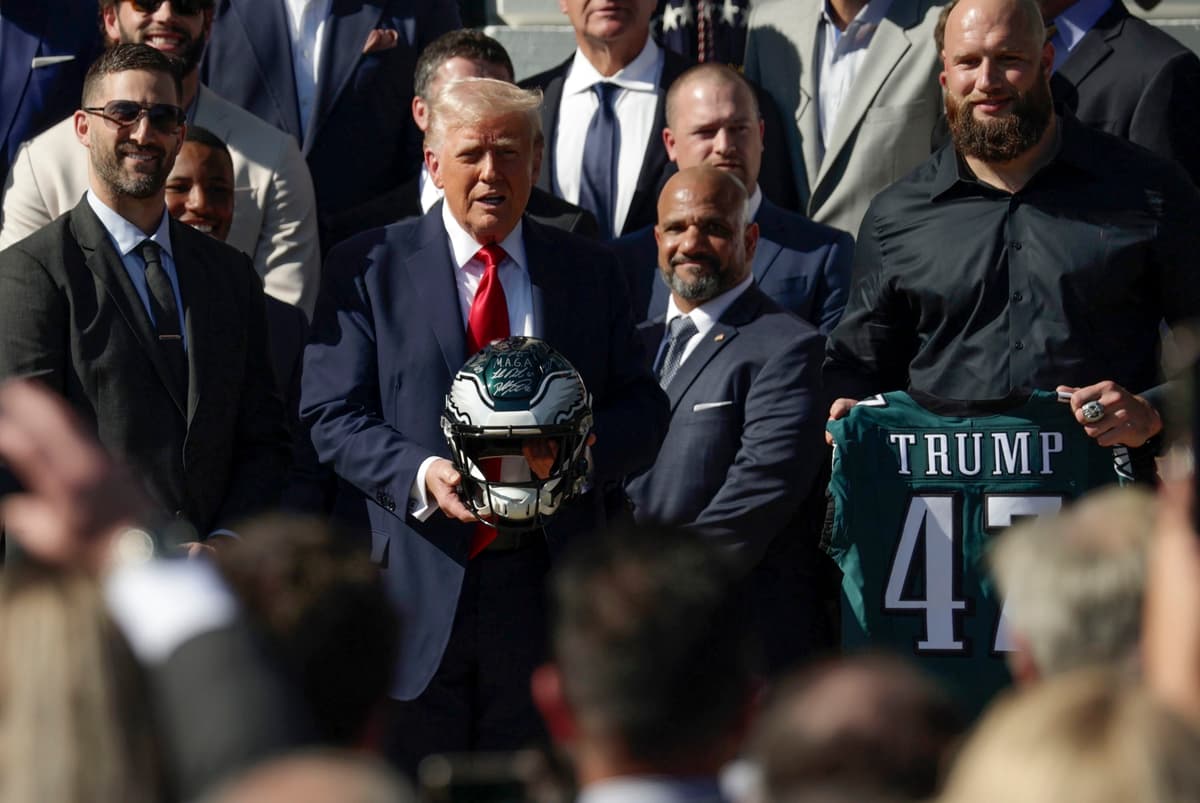
Most politicians treat attending a sporting event as a ceremonial exercise — a quick opportunity to don a team cap, shake a few hands, wave to the crowd and project an “everyman” image.
The complex business of sports like Title IX issues, financial disputes, labor battles, compensation and other legal matters were left to the NCAA or league commissioners to resolve, not the White House.
Donald Trump doesn’t follow that script.
In 2025, President Trump masterfully leveraged the visibility of major athletic events and the cultural lightning rods of sports’ most divisive issues to enhance his political and cultural agendas.
The 47th President shifted from “Fan-in-Chief” to self-appointed overseer of all sports, using public appearances, threatening rhetoric and the authority of the Oval Office to project an image of leadership, power and influence. By inserting himself into athletic arenas with unprecedented frequency, he draped himself in the symbolism of competition and patriotism and applied executive authority to reshape policy debates inside locker rooms, athletic departments, and Olympic committees. Mr. Trump didn’t just attend sporting events, he governed through them.
“I think sports is one fundamental example of Trump’s belief that he’s in charge of everything,” David Niven, a professor of Sports and Politics at the University of Cincinnati told the Associated Press.
The Best Seat in the House
A life-long sports fan, avid golfer, and former team owner, Mr. Trump began 2025 making history by becoming the first sitting president to attend a Super Bowl. He traveled to New Orleans in February to watch the Philadelphia Eagles beat the Kansas City Chiefs. The game was only part of his mission.
With the Super Bowl as the backdrop, he raised his profile as a compassionate leader when he met with the families of victims and emergency personnel connected to a terrorist attack on Bourbon Street that had shaken the city a month prior. A speeding truck killed 14 and injured dozens.
“Our prayers will remain with them for continued strength, comfort and healing,” Mr. Trump said in a statement released throughout the world.
The rest of the year’s itinerary read like a “Greatest Hits” tour of American sports. A few weeks after the Super Bowl, he attended the Daytona 500 where he drew roars from the crowd, pacing the field in the presidential limousine called “The Beast.”
He was at the NCAA wrestling championship last March in Philadelphia and stopped in on LIV Golf at Trump National Doral last April, blending personal business interests with sports diplomacy.
He made front-row appearances alongside his friend Dana White at UFC events in Miami and Newark, and the president stood in the middle of MetLife Stadium in New Jersey to present the championship trophy at the FIFA Club World Cup Final in July.
September was exceptionally busy with Mr. Trump appearing at the U.S. Open Tennis Final in Flushing, New York, marking his first appearance at the tournament in a decade and causing fans to be delayed entry due to security concerns.
He took in a baseball game in the Bronx when the New York Yankees and Detroit Tigers played on the 24th anniversary of the September 11 attacks and was on hand at Bethpage Black in Long Island for the opening day of the Ryder Cup Matches. He was there at the invitation of the PGA of America, an organization which three years earlier removed the 2022 PGA Championship from his golf course in New Jersey after the January 6 Capitol riot.
Mr. Trump took in more football, too. He became the third sitting to attend a regular-season NFL game when he watched the Detroit Lions and Washington Commanders in November and saluted future soldiers at the Army-Navy game in Baltimore in December.
Crowd responses to Mr. Trump’s appearances varied from raucous approval to boos to broadcasters at the U.S. Open tennis being asked to censor the crowd reactions. But the frequent appearances at sporting events achieved their purpose. Connecting to the nation’s biggest athletic spectacles and projected Mr. Trump as a man-of-the-people to massive audiences.
Executive Order to Sports
When he wasn’t maximizing his time on the Jumbotron, Mr. Trump impacted sports by signing a number of executive orders to reshape the landscape of professional and college sports.
His opposition to transgender athletes competing in women’s sports was a cultural issue that helped Mr. Trump win re-election and continued into 2025. He signed the “Keeping Men Out of Women’s Sports” executive order in February, empowering federal agencies to ensure schools receiving federal funding comply with the administration’s reading of Title IX, which interprets “sex” as the gender a person was assigned at birth.
“With this executive order, the war on women’s sports is over,” Mr. Trump declared during the signing ceremony.
Many of sports governing bodies followed by amending their rules, including the NCAA. “President Trump’s order provides a clear, national standard,” said NCAA President Charlie Baker, a former Massachusetts governor. Several months later, the U.S. Olympic and Paralympic Committee (USOPC) changed their policy to conform with Mr. Trump’s guidelines.
Mr. Trump also turned his attention to the unraveling model of college athletics. He signed the “Saving College Sports” executive order in July, an attempt to bring some clarity amid the chaos of NIL deals, the transfer portal, realignment chaos, lawsuits, and coaches leaving teams before the season concludes. The sweeping document, among other things, ordered labor officials to clarify whether college athletes can be considered employees of their schools.
Attempts by Congress to create stability and fairness in college sports continue to hit repeated roadblocks, despite pleas from the White House to provide suitable legislation.
“Urgent federal action is necessary to provide the stability, fairness and balance that will protect student-athletes and preserve college athletic opportunities,” the White House said in December.
At least one college coach thinks Mr. Trump is the only one who can restore some order in college sports. “He might be the only person that can actually do something to at least settle things down,” Tony Sanchez, the head football coach at New Mexico State told the Sun. “Right now, the way the rules are changing at the pace that they’re changing, it doesn’t make sense.”
World Cup Runneth Over
If domestic sports helped solidify Mr. Trump’s battleground, global soccer became his diplomatic stage. He eagerly aligned himself with the FIFA World Cup to be hosted by the United States, Canada and Mexico in July. The event will be the symbol of American hospitality during the country’s 250th anniversary celebration.
In March, he signed an Executive Order establishing a federal task force to coordinate all federal agencies involved in security logistics, and planning for the 2025 FIFA Club World Cup and the 2026 World Cup. In July, he allocated $625 million to be distributed by the Department of Homeland Security to ensure safety at the U.S. host cities.
The year-long courtship of FIFA culminated in December at the World Cup Draw at the Kennedy Center. It was there that Mr. Trump accepted the FIFA Peace Prize Award, a new award created by FIFA president Gianni Infantino, a close ally of Mr. Trump. Mr. Infantino said Mr. Trump earned the inaugural FIFA Peace Prize for brokering a ceasefire in Gaza.
“Mr. Trump said receiving the medal was “truly one of the great honors of my life,” adding, “the world is a safer place now.”
Mixed Messages
Yet, beneath the pageantry, Mr. Trump’s sports agenda is often marked by a striking paradox. While the red carpet to America appears to be out for the World Cup, the door is bolted for many potential attendees. Fans, players, and team officials, have concerns about the Trump Administration’s immigration enforcement.
As of January 2026, expanded travel bans imposed by the U.S. impacted 39 nations, including qualified teams like Iran and Haiti, effectively banning their fans from entry. Furthermore, White House backed enforcement operations by ICE and CBP in major host cities like Los Angeles, Miami and New Jersey/New York have created a climate of distrust and apprehension.
The World Cup is intended to be beyond politics, but politics is forcing millions to risk immigration issues or denial of visas.
Meanwhile trade relations with World Cup partner Canada haven’t gotten much better since Mr. Trump called Canada America’s 51st state. The imposition of tariffs up to 35 percent has further strained relationships.
An Ontario ad that featured segments of a speech by former President Ronald Regan saying that tariffs don’t work, reportedly angered the Trump Administration, which is now threatening the North American Free Trade Agreement “might” need to be renegotiated. Roughly 85% of U.S. imports from Mexico and Canada enter duty-free under the agreement also known as the U.S.-Mexico-Canada (USMCA) trade agreement.
Mexico, which hosts the World Cup opener on June 11 at Estadio Azteca in Mexico City, is adjusting to 25 percent tariffs on Fentanyl and cars and 50 percent tariffs on steel, aluminum, and copper.
2026 Birthday Party
As 2026 begins, the President’s sports menu shows no signs of slowing. The nation is celebrating its 250th birthday this year and sports will be prominent on Mr. Trump’s agenda. The World Cup will be a global spectacle that will have his imprint from start to finish and don’t be surprised if he presents the winners their trophy.
On June 14, Mr. Trump celebrates his 80th birthday on the South Lawn of the White House watching an historic UFC event promoted by his friend, Dana White. The night will be a blend of presidential power, political branding and combat force. Only 5,000 will attend, but millions will watch on television throughout the world. And there are sure to be more appearances at football and baseball games and golf events, including the PGA Tour’s return to Trump National Doral this year.

