
Governments Friendly to America Hang Back From an Endorsement of the Raid on Venezuela

Japan’s new prime minister, Sanae Takaichi, calls for restoring democracy in the oil rich South American nation.
Henry Nicholls-WPA Pool/Getty Images
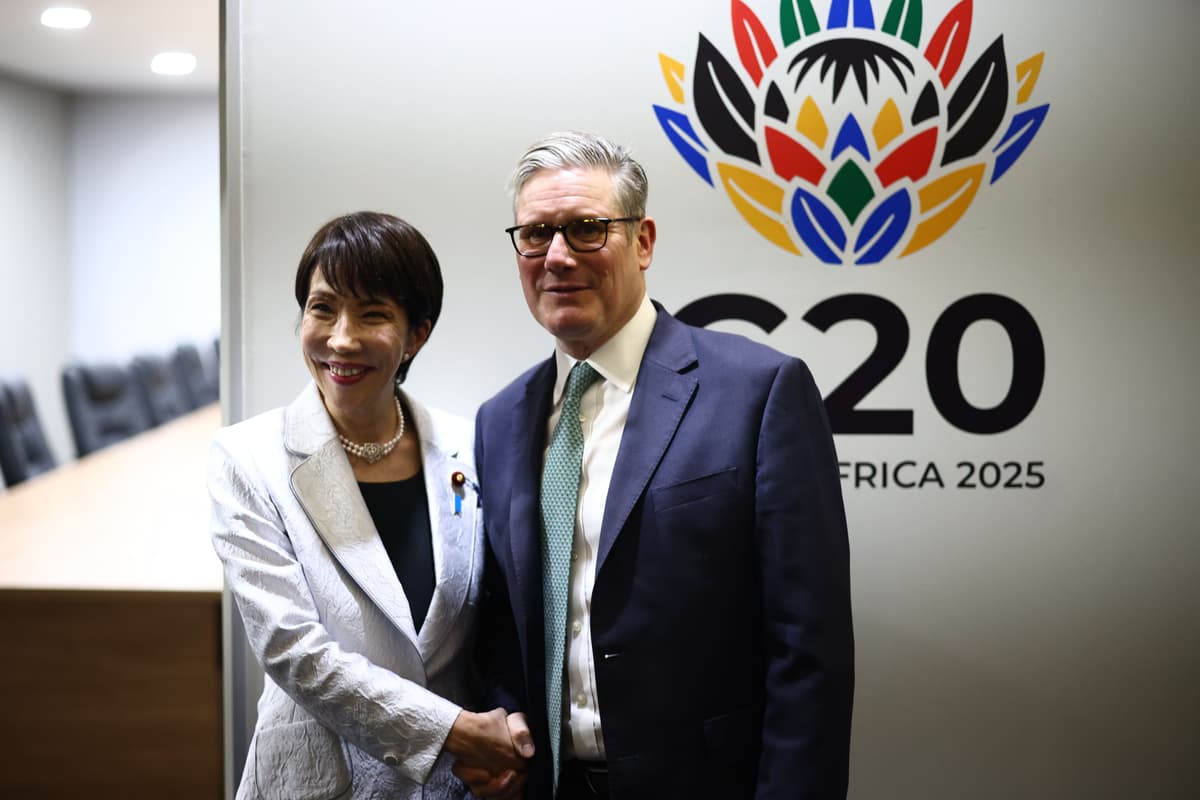
Prime Minister Keir Starmer, right, meets Japan's prime minister, Sanae Takaichi, at the G20 Leaders' Summit on November 22, 2025 at Johannesburg, South Africa. Henry Nicholls-WPA Pool/Getty Images

LONDON — The capture of Venezuela’s Nicolas Maduro came as the left-leaning president, Lee Jae-myung, of America’s ally, South Korea, had just arrived at Beijing to see Communist China’s party boss, Xi Jinping, whose foreign ministry had called the strike against Mr. Maduro “in clear violation of international law” and the United Nations Charter.

Ignoring the fate of Mr. Maduro, Mr. Lee promoted Korean-Chinese economic ties at a meeting with leaders of Korean and Chinese companies at which he said the two countries were “ships that sail in the same direction,” helping each other “grow through interconnected industrial supply chains.”

Mr. Lee’s China mission relieved him of having to take a stand right away on a topic that leaders of other American allies preferred to dance around carefully. None was more non-committal than Great Britain’s prime minister, Keir Starmer, who said “we should uphold international law” but first “establish the facts.”

While America’s foes, notably Russia and North Korea as well as China and Cuba, predictably lambasted Mr. Trump, leaders of America’s friends and allies hinted at their responses without quite declaring themselves for or against. 

Japan’s prime minister, Sanae Takaichi, already at odds with Beijing on Mr. Xi’s threats against Taiwan, signaled her support for Mr. Trump by posting on social media her call for ‘restoring democracy in Venezuela as soon as possible.” 

Tokyo, she said, would “work closely with other Group of Seven nations” — including Britain, France, Canada, Italy, and Germany as well as America and Japan — “to advance diplomatic efforts to restore democracy and stabilize the situation in Venezuela.”

The case of Mr. Maduro, however, raised one special concern at Tokyo and elsewhere in Asia: Beijing, taking the meticulous planning for what was almost a surgical extraction as an example, might attempt a similar blow against the president of the island democracy of Taiwan, Lai Ching-te.

“Will Beijing look to US capture of Venezuela’s Maduro for lessons on Taiwan?’’ was the headline over an article in Hong Kong’s South China Morning Post. Mr. Maduro’s capture, the paper noted, would be “closely studied by Beijing, “which has signaled its ability to target Taiwan’s leadership” in the latest military exercises near the island.

A former defense minister of Japan, Itsunori Onodera, also worried about the precedent set by the case. “The U.S. administration’s invasion of Venezuela constitutes a ‘change of the status quo by force,’” the Japan Times quoted him as saying. An attempt by China “to change the status quo by force against Taiwan,” he said, “raises concerns that East Asia could become increasingly unstable.”

Taiwan officials doubted China would exploit the case so easily, but across China the argument was compelling. One Chinese platform carried a suggestion that China “use the same method to reclaim Taiwan,” while another asked, “Since the US doesn’t take international law seriously, why should we care about it?”

The case even struck a chord in Vietnam, whose Communist rulers in Hanoi have to deal with simmering discontent more than half a century after defeating the American-backed South Vietnam regime in Saigon.

“On Facebook, the reactions came fast and mostly against the Hanoi regime,” writes a former American correspondent in Saigon, Carl Robinson, who visits Vietnam regularly. One overseas commenter took a jab directly at the Communist Party leader, boldly declaring: “President Maduro got arrested by the U.S. — when will it be Big Man To Lam’s urn?” he asked, referring to the general secretary of the ruling Communist Party. “Vietnamese people are hoping for that.”

Officially, Vietnam had forged a friendship with the Venezuelan regime. Mr. Maduro had visited Hanoi more than ten years ago and saw To Lam again at the parade in Moscow in May celebrating the 80th anniversary of the defeat of Germany in 1945.

At Seoul, anti-American protesters, many from groups that support the left-of-center ruling Minju or Democratic Party, protested outside the American embassy. The acting Venezuelan ambassador joined them, demanding Mr. Maduro’s release. 

Meanwhile the leader of a far-left party urged the government to oppose “the U.S. invasion,” South Korea’s Yonhap News reported. In the absence of Mr. Lee, all South Korea’s foreign ministry could do was to urge “involved parties in Venezuela to ease tensions.”


The New York Sun

© 2026 The New York Sun Company, LLC. All rights reserved.

Use of this site constitutes acceptance of our Terms of Use and Privacy Policy. The material on this site is protected by copyright law and may not be reproduced, distributed, transmitted, cached or otherwise used.

The New York Sun

Sign in or  create a free account

or
By continuing you agree to our Privacy Policy and Terms of Use