
Hochul and Mamdani, With Pro-Hamas Group Raging, Can Turn to Theodore Roosevelt for Tactical Inspiration

How the future president turned the tables on the leading antisemite of his day.
Via Wikimedia Commons
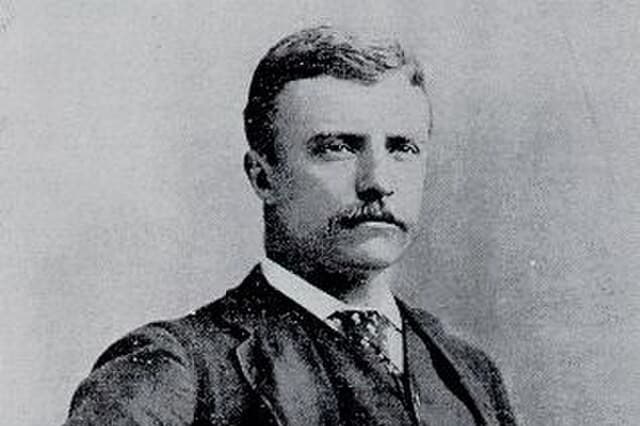
Theodore Roosevelt as New York City police commissioner in 1895. Via Wikimedia Commons

Mayor Zohran Mamdani of New York City and Governor Kathy Hochul at Albany are saying that pro-Hamas groups have “no place” in Gotham. Their words are welcomed. But actions like President Theodore Roosevelt’s legendary slap-down of an antisemitic speaker would better shame the haters.

On Thursday, the Palestinian Assembly for Liberation organized its second protest in 18 months at Queens. “Long live October 7th,” they shouted, carrying Hamas banners and anti-Israeli signs. “Say it loud and clear,” went another chant. “We support Hamas here.”

Ms. Hochul, in a post Thursday morning on X, branded Hamas “a terrorist organization that calls for the genocide of Jews.” Mr. Mamdani tweeted that night: “We will continue to ensure New Yorkers’ safety entering and exiting houses of worship as well as the constitutional right to protest.”

The agitators planted their Hamas flags outside the Young Israel of Kew Gardens Hills synagogue, at an intersection with a public and a Yeshiva school. As Mr. Mamdani stated, NYPD officers stood between the terrorist supporters and locals who turned out to voice their opposition.

In 1977, neo-Nazis planned a march at Skokie, Illinois, because it, too, had a large Jewish population. The town carried its objections to the Supreme Court, which ruled against them in National Socialist Party of America v. Village of Skokie. Counterprotests prevented the event, but the debate is one that’s never quite settled.

The conflict surfaced in 1895 on the same streets where protestors cheered Hamas. Roosevelt, then president of the Board of Police Commissioners, wanted a force that reflected the city’s diversity to carry forward his reforms. He recruited the city’s first Jewish officer, Otto Raphael, after learning of his heroism in stopping a runaway carriage.

After opening the door and convincing Raphael to step through it, Roosevelt stumped at Lower East Side halls to pitch law enforcement jobs to other Jewish New Yorkers. A steady trickle from synagogues and shuls began to swell the NYPD’s ranks.

Six months into Roosevelt’s term, word came that an infamous German antisemite, Hermann Ahlwardt, was heading for America. Jewish citizens urged the commissioner to ban the agitator or at least not grant his event police protection. This pitted the future president’s personal morality against his duty to uphold the Constitution.

Roosevelt knew that censoring Ahlwardt or giving vigilantes free rein would only amplify the antisemite’s message. TR was also a lifelong boxer who didn’t accept his hands being tied by the First Amendment. He devised a way to throw a jab, enlisting the help of those like Raphael who’d answered his call to service.  

“The proper thing to do” with Ahlwardt, Roosevelt decided, “was to make him ridiculous,” and TR conceived of what we’d today call a “troll” to do so. He ordered a deputy to assemble a security detail comprising only Jewish officers — or at least ones who’d embody Ahlwardt’s stereotype of what Jews looked like so he’d get the message.

“Don’t bother yourself to hunt up their religious antecedents,” Roosevelt said, meaning looks were more important than devotion. “Take those who have the most pronounced Hebrew physiognomy” or appearance, “the stronger their ancestral marking, the better.”  

Ahlwardt arrived on the Lower East Side to find his life in the hands of the very people he’d come to ridicule. The New York Sun’s lead story on December 13, 1895, described the “round, fat,” and “shiny-faced” antisemite being met by “about as many policemen in Cooper Union as there were Jews and Germans,” with “great freedom of speech permitted to all.”

The highlight of the evening was when “an egg,” judged not “warranted fresh” by the Sun, “sailed through the air.” It “burst” and splattered on Ahlwardt’s “coattails and trousers.” The paper called this “an expression of disapproval” based on the “howls, groans, hoots, yells, hisses, cat calls, yowlings, bellowings” and “epithets” throughout the event.

Words alone wouldn’t have been as effective in exposing Ahlwardt’s poisonous ideology as Roosevelt’s clever counterpunch. New Yorkers can hope that Ms. Hochul and Mr. Mamdani will follow his example today, finding ways to make Hamas supporters look ridiculous before the eyes of the world.


The New York Sun

© 2026 The New York Sun Company, LLC. All rights reserved.

Use of this site constitutes acceptance of our Terms of Use and Privacy Policy. The material on this site is protected by copyright law and may not be reproduced, distributed, transmitted, cached or otherwise used.

The New York Sun

Sign in or  create a free account

or
By continuing you agree to our Privacy Policy and Terms of Use