
Mamdani, Swearing-in at New York’s Forgotten First Subway Station, Gives Unknowing Salute to Capitalism

He extols subways that were built by private enterprise.
AP/Yuki Iwamura
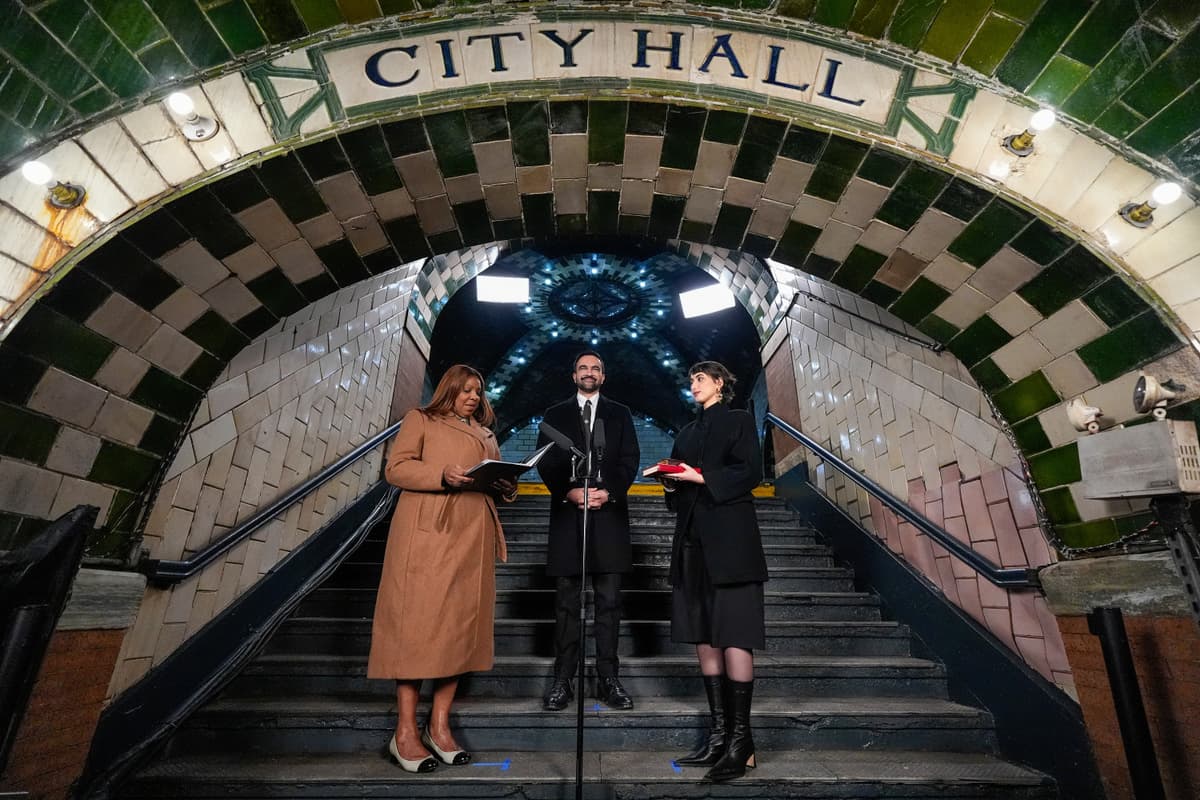
Attorney General Letitia James, left, administers the oath of office to Mayor-elect Zohran Mamdani, center, as his wife Rama Duwaji looks on, January 1, 2026. AP/Yuki Iwamura

Mayor Zohran Mamdani is beginning his future with an anchor in New York City’s past. His choice of the Old City Hall subway station for his private swearing-in ceremony with the Democratic socialist, Senator Bernie Sanders, however, invokes a legacy at odds with the pair’s government-first approach to affordability.

Mr. Mamdani described the abandoned subway stop as “a physical monument to a city that dared to be both beautiful and build great things that would transform working peoples’ lives.” He omitted that the station, like all subway lines at the time, was a product of private industry, not government mandates.

The Interborough Rapid Transit Company built the City Hall station in 1904, the first of Gotham’s 28 subway stops. Its tiled ceilings, skylights, brass chandeliers, and arches are relics of Gilded Age optimism. The station is accessible today only to members of the New York Transit Museum via guided tours.

On October 27, 1904, The New York Sun reported that “thousands” descended in a “swarm to test New York’s first underground railroad.” Mr. Mamdani’s predecessor, Mayor George B. McClellan, Jr., was on hand for a “formal turning over of the subway … to the operating company,” what might today be called deregulation.

subway
Police officers and other officials on the City Hall subway station platform, circa 1904. Getty Images/Hulton Archive

The Sun reported that the IRT’s general manager, Frank Hedley, urged the public “not to judge the Rapid Transit system by operation of the first few days.” There were “likely to be some delays,” he said.  But the system “will be improved in matter of operation from day to day until it is brought as nearly to perfection as possible.” 

It’s hard to imagine the Metropolitan Transportation Authority promising anything like “near perfection” today. About one-in-five trains fail to show up on time, with 18 percent delayed over five minutes or skipping past stations altogether, stranding the “working people” Mr. Mamdani champions. 

Had the IRT delivered the current level of service, it would’ve faced market pressures to improve. The company’s “entrepreneurs,” the Washington Post wrote in an editorial on Tuesday, “were more concerned with building a railroad that people would want to ride than placating public-sector union bosses and environmental activists.” 

city hall
New York City’s defunct City Hall subway station in 2018. Rhododendrites via Wikimedia Commons CC4.0

The Post noted that when City Hall created the “bloated” MTA in 1965, it took control of infrastructure that had been built with a profit motive. Bureaucrats “got involved in managing and operating it, with price-controlled fares that starved the system of funding.” 

As Mr. Mamdani pursues his goal of making buses free, he might reflect on how costs have ballooned since the city assumed control of the subways with a similar goal to make them more affordable. The cost of a ride will jump to $3 on Sunday. That’s equal to $1.82 in 1904, when the actual ride was priced at just a nickel. 

The $1 billion that the city loses to fare evaders each year alone is almost equal to what the IRT invested to build the city’s first lines. To stop fare beating, the government spends more: $7.3 million on “fins” that are proving ineffective and may even make dodging the fare easier.

NEW YORK, NEW YORK - JANUARY 1: Zohran Mamdani is sworn in as New York City's 112th mayor by New York Attorney General Letitia James, left, alongside his wife Rama Duwaji, right, in the former City Hall subway station on January 1, 2026 in New York City. Mamdani’s term as mayor begins immediately in the new year, and a public inauguration will also take place in the afternoon at City Hall. (Photo by
Mayor Zohran Mamdani is sworn in by Attorney General Letitia James, left, alongside his wife Rama Duwaji, right, at the former City Hall subway station on January 1, 2026. Amir Hamja, pool/Getty Images

The IRT built 9.1 miles of track and 28 stations, including the one under City Hall, for the equivalent of $1.2 billion today. By comparison, just Phase 1 of the Second Avenue Subway cost four times that to go less than 20 percent of the distance with a tenth of the stops — $4.45 billion for 1.8 miles of track and three stations. 

Phase 2 is projected to cost about $7.7 billion for an additional 1.5 miles of track and three more stations. Although a single, integrated system may make for easier transfers and operation, government control has removed fiscal pressure to keep costs down and improve performance for straphangers. Expansion is expensive and slow. 

The Old City Hall Station was shuttered in 1945, due to the longer modern trains stopping a dangerous distance from the platform. That design serves as a metaphor for Mr. Mamdani — a reminder that the gap between what government promises and what it can deliver is a difficult one to leap.


The New York Sun

© 2026 The New York Sun Company, LLC. All rights reserved.

Use of this site constitutes acceptance of our Terms of Use and Privacy Policy. The material on this site is protected by copyright law and may not be reproduced, distributed, transmitted, cached or otherwise used.

The New York Sun

Sign in or  create a free account

or
By continuing you agree to our Privacy Policy and Terms of Use